Desert Wildlife Safari: Uncovering the Secrets of Arabian Desert Creatures
The Arabian Desert is often perceived as a barren landscape. However, it teems with life, beautifully adapted to the extreme environment.
A Desert Wildlife Safari offers a profound opportunity to witness these unique creatures. Spotting them requires patience, timing, and knowledge.
Understanding the principles of Wildlife Conservation UAE is essential for ethical viewing.
This guide provides 10 powerful secrets to spotting unique Animals You Can See on your desert adventure.
We focus on the Desert Safari Wildlife and the best times for Arabian Oryx Spotting.
1. The Core Secret: Timing and the Desert Wildlife Safari
The desert’s animals are highly adapted to avoid the midday heat.
This adaptation dictates the best time for a successful Desert Wildlife Safari.
Nocturnal and Crepuscular Activity
Most Desert Safari Wildlife is active at night (nocturnal) or during the twilight hours (crepuscular).
The coolest times—dawn and dusk—are the best for sightings.
This behavior is a survival mechanism against the extreme heat.
Early Morning Advantage
Booking a very early morning safari offers the highest chance of seeing wildlife.
You catch the animals before they retreat to burrows or shade.
This makes the early hours prime time for Arabian Oryx Spotting.
2. Location Matters: Desert Safari Wildlife Conservation Areas
The highest probability of seeing Desert Safari Wildlife is within protected zones.
These areas provide safe havens for Rare Desert Creatures.
Dubai Desert Conservation Reserve (DDCR)
The DDCR is the primary location dedicated to Wildlife Conservation UAE.
Access to the DDCR is strictly controlled and limited to authorized operators.
Safaris within this area prioritize spotting Animals You Can See over high-speed driving.
This protection ensures the survival of species like the Oryx.
Non-DDCR Routes
Standard dune bashing routes are generally less conducive to spotting wildlife.
The high noise and traffic discourage animals from staying near the trails.
The difference in sighting success is vast between the two areas.
3. The Star Attraction: Arabian Oryx Spotting
The Arabian Oryx is the magnificent symbol of UAE conservation success.
This animal is the primary target for Arabian Oryx Spotting.
Distinctive Features
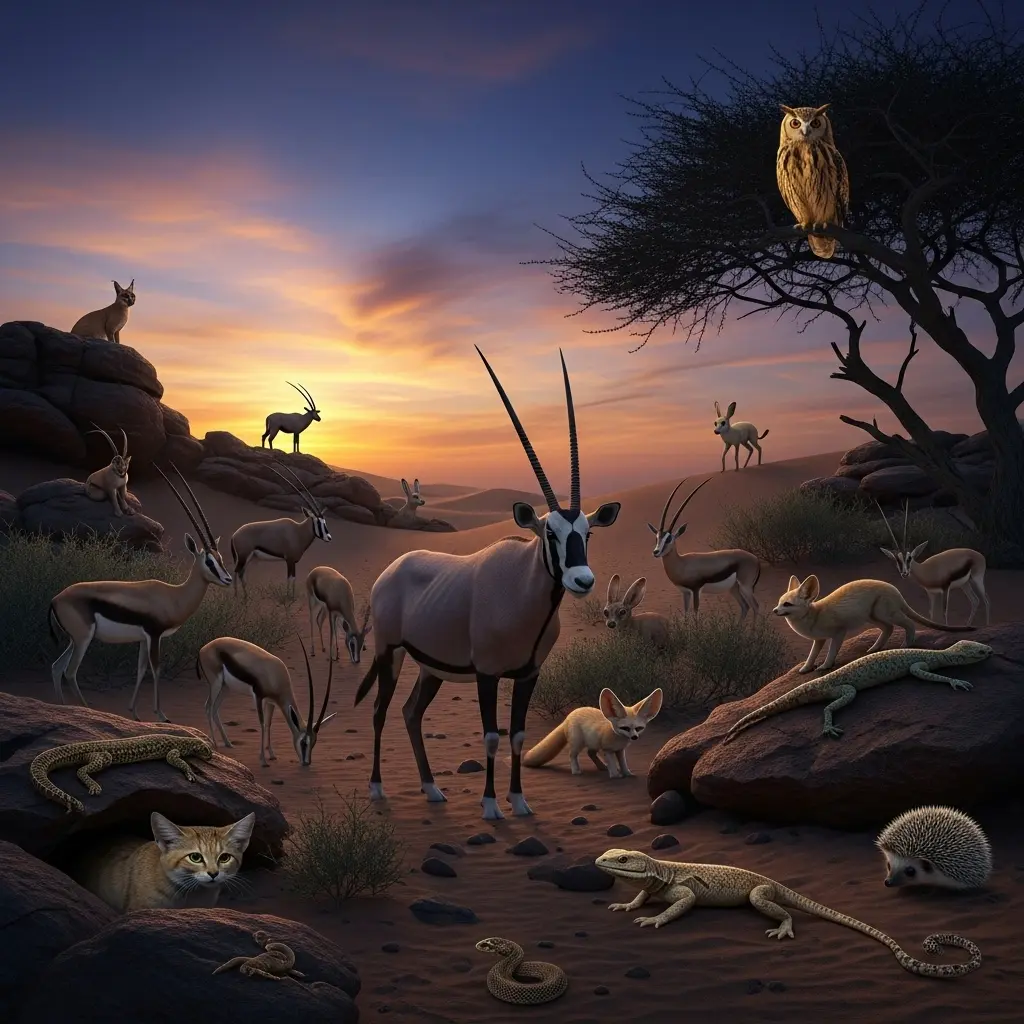
The Oryx is recognized by its brilliant white coat and long, straight, black horns.
Its white color reflects sunlight, keeping the animal cool.
Its elegance makes it a truly iconic example of Desert Safari Wildlife.
Conservation Success
The Oryx was once extinct in the wild. Thanks to breeding programs, it has been successfully reintroduced.
Spotting this animal is a testament to the efforts in Wildlife Conservation UAE.
4. Other Notable Animals You Can See
Beyond the Oryx, several other fascinating Animals You Can See inhabit the dunes.
This diversity adds excitement to the Desert Wildlife Safari.
Gazelles
Two types of gazelles are common: the Arabian Gazelle (Reem) and the Sand Gazelle (Dorcas).
They are smaller, faster, and often seen grazing on the sparse vegetation.
Spotting these graceful creatures requires sharp eyes and a quiet approach.
Nocturnal Desert Animals
The smaller, often cuter creatures are the Nocturnal Desert Animals.
These include the Arabian Red Fox and the shy Gerbils and Jerboas.
Viewing these requires a very quiet, late-night, or early-morning approach.
5. Wildlife Spotting Tips: Maximizing Sightings
Maximizing sightings requires specific Wildlife Spotting Tips and guide assistance.
Quiet Movement
The Desert Safari Nature Tour is best conducted at slow speeds.
The guide will often turn off the engine to allow for quiet observation.
Noise frightens Rare Desert Creatures away quickly.
Using Tracks
Guides are trained to read the tracks left in the sand overnight.
These tracks lead to burrows and feeding grounds.
Reading the desert floor is one of the most effective Wildlife Spotting Tips.
6. Ethical Wildlife Viewing: Safe Wildlife Viewing Protocol
Ethical conduct is mandatory for a rewarding Desert Wildlife Safari.
The principle is simple: “Leave No Trace, Take Only Pictures.”
Maintaining Distance
Always maintain a respectful, safe distance from all Desert Safari Wildlife.
Never encourage the guide to chase or drive too close to the animals.
This prevents unnecessary stress on the animals.
This adherence defines Safe Wildlife Viewing.
No Feeding
Never feed the Animals You Can See. Their diets are highly specialized.
Human food can be harmful or even fatal to their systems.
Respecting their natural diet is a key aspect of Wildlife Conservation UAE.
7. Desert Safari Nature Tour: Specialized Packages
For those prioritizing wildlife, a specialized package is necessary.
A general safari may not guarantee access to key areas.
Heritage Safaris
These tours often use vintage vehicles and follow slower, less-traveled paths.
The focus is on the environment and history, making them ideal for viewing.
This relaxed pace is perfect for Desert Safari Nature Tour enthusiasts.
Luxury Customization
Luxury tours, available through https://royaldesertadventures.ae/, offer bespoke routes.
You can explicitly request a route that prioritizes Arabian Oryx Spotting.
This ensures your Desert Wildlife Safari is tailored to nature.
8. Nocturnal Desert Animals: The Overnight Advantage
Seeing true Nocturnal Desert Animals requires staying past sundown.
Overnight Camping
An overnight desert adventure drastically increases your chances of sightings.
Animals emerge after the main camp crowds have left.
Guides often lead a short, quiet walk with red light torches to spot smaller creatures.
This is the only way to see true Rare Desert Creatures.
Red Light Usage
Red light does not disrupt the night vision of animals or humans as severely as white light.
It allows for respectful observation of Nocturnal Desert Animals.
This quiet search enhances the Desert Safari Nature Tour.
9. Threats and Conservation: Wildlife Conservation UAE
The threats to Desert Safari Wildlife are significant, emphasizing the importance of protection.
Habitat Loss
Urban expansion and commercial development threaten natural habitats.
The efforts in Wildlife Conservation UAE are crucial to counteract this loss.
Protected zones like the DDCR are essential barriers against expansion.
Supporting Conservation
Choosing an ethically certified operator supports Wildlife Conservation UAE financially.
A portion of the tour fees often funds research and protection programs.
This responsible choice makes your Desert Wildlife Safari meaningful.
10. Practicalities: Wildlife Spotting Tips for Tourists
A few practical tips ensure a comfortable and rewarding viewing experience.
Patience and Quiet
Patience is the biggest virtue. Wildlife sightings are never guaranteed.
Remain quiet in the vehicle when the guide signals a potential sighting.
Excessive noise will cause the Animals You Can See to retreat.
Camera Gear
Use a telephoto lens (zoom lens) to capture photos from a distance.
Avoid using flash, as it can startle Rare Desert Creatures and ruin night vision.
A sturdy tripod is helpful for sharp, distant shots.
11. Rare Desert Creatures: Beyond the Mammals
The desert ecosystem includes more than just large mammals.
Looking closer reveals many Rare Desert Creatures.
Birds of Prey
Various species of falcons, including the majestic Peregrine, patrol the skies.
They are often featured in a Desert Safari Falcon Show.
Other small desert birds, like larks and wheatears, are also common.
Reptiles and Insects
Small desert vipers and lizards are part of the ecosystem.
Your Desert Wildlife Safari guide knows where these creatures hide.
Staying on designated paths protects both you and these animals.
12. Desert Safari Nature Tour: Regional Variations
Different areas of the desert offer different Desert Safari Nature Tour sightings.
Knowing the location dictates expectations for Arabian Oryx Spotting.
DDCR and specific reserves hold the densest populations of Oryx.
Areas closer to the coast may offer more birdlife due to temporary water sources.
Vetting the exact route confirms the focus of your Desert Wildlife Safari.
13. Animal Adaptations: Understanding Desert Safari Wildlife Survival
The survival mechanisms of Desert Safari Wildlife are extraordinary.
The guide will often explain how these animals survive the Heat in Dubai Desert.
Water Conservation
Many animals gain all the moisture they need from the plants they eat.
Some excrete highly concentrated urine to conserve water.
This biological ingenuity is a fascinating part of the Desert Safari Nature Tour.
Temperature Regulation
Gazelles have specialized nasal structures that cool the blood flowing to the brain.
The white coat of the Oryx reflects solar radiation.
These adaptations allow them to thrive where other species cannot.
14. Supporting Operators: Safe Wildlife Viewing Partners
Choosing the right partner is vital for Safe Wildlife Viewing.
Operators listed on sites like https://dubaidesertsafarie.com/ often prioritize conservation.
Check for operators who have built reputations for ethical nature tours.
A reliable Desert Wildlife Safari ensures minimal environmental impact.
15. The Final Appeal of Desert Wildlife Safari
The Desert Wildlife Safari offers a perspective of the UAE beyond the skyscrapers.
It is a profound experience that highlights the resilience of nature.
Embrace the quiet, and you will be rewarded with sights of true Rare Desert Creatures.
Frequently Asked Questions (FAQs) – Long Answers
1. How does booking an early morning safari significantly increase the chances of Arabian Oryx Spotting and viewing other Desert Safari Wildlife?
Booking an early morning safari significantly increases the chances of Arabian Oryx Spotting and viewing Desert Safari Wildlife because it coincides with the crepuscular activity period. Desert animals are largely nocturnal or most active during the cooler hours of dawn and dusk to avoid the extreme daytime heat. The Oryx, gazelles, and foxes emerge to feed and socialize as the sun rises. Furthermore, the limited vehicle traffic and quiet environment of the early morning do not frighten the Rare Desert Creatures, ensuring optimal conditions for Wildlife Spotting Tips success.
2. Why are organized tours within the Dubai Desert Conservation Reserve (DDCR) the Best Spots for a Desert Wildlife Safari, and how is access regulated?
Organized tours within the DDCR are the best spots for a Desert Wildlife Safari because the area is legally protected and highly regulated, ensuring maximum animal density and habitat health. Regulation: Access is limited to authorized operators who pay conservation fees. This fee funds anti-poaching and breeding programs for Wildlife Conservation UAE. The restriction on vehicle numbers and speed ensures the animals are undisturbed. DDCR tours guarantee the highest chance of Arabian Oryx Spotting in a pristine, ethical environment, defining a true Safe Wildlife Viewing experience.
3. What precautions must be taken to ensure Safe Wildlife Viewing and ethical interaction with Animals You Can See during the safari?
Precautions for Safe Wildlife Viewing and ethical interaction are critical for any Desert Wildlife Safari. 1. Distance: Always maintain a respectful distance from the Animals You Can See and never leave the vehicle without the guide’s explicit instruction. 2. No Feeding: Never feed the animals, as human food is detrimental to their specialized diet. 3. Quiet Observation: Minimize noise to avoid startling or stressing the animals. 4. Photography: Use a telephoto lens to zoom in, rather than approaching the Rare Desert Creatures physically, adhering to Wildlife Spotting Tips.
4. How does the concept of “Leave No Trace” apply to a Desert Safari Nature Tour, and what is the responsibility of the visitor?
The “Leave No Trace” principle is fundamental to any Desert Safari Nature Tour. It dictates that visitors must remove everything they bring into the desert. Visitor Responsibility: This includes securing all trash (food wrappers, plastic bottles, tissues) and ensuring absolutely nothing is left behind. Responsible operators adhere to this by using designated trash containers and tracks. Visitors must actively participate in protecting the Desert Ecology to ensure the Desert Safari Wildlife habitat remains clean and undisturbed.
5. What are the key differences between a standard dune bashing safari and a dedicated Desert Safari Nature Tour in terms of speed and itinerary focus?
The key differences lie in speed and focus. A standard dune bashing safari prioritizes high-speed thrills and cultural entertainment. A dedicated Desert Safari Nature Tour (often found through providers like https://royaldesertadventures.ae/) prioritizes low-impact driving, observation, and education. The speed is slower, the itinerary includes more quiet stops for Wildlife Spotting Tips (using tracks), and the guide provides in-depth commentary on Desert Ecology and conservation, making the journey less about adrenaline and more about discovery.
6. Which Nocturnal Desert Animals are possible to see, and what kind of unique tour package is required to maximize sightings of these creatures?
Nocturnal Desert Animals that are possible to see include the Arabian Red Fox, various species of Gerbils, and Jerboas. To maximize sightings of these animals, an Overnight Desert Safari or a dedicated late-night/pre-dawn tour is required. These tours operate when the main safari crowds have departed and the smaller animals emerge to feed. Guides often use non-disruptive red light torches for spotting, ensuring the Desert Wildlife Safari is respectful of the animals’ natural cycle.
7. What role do the animal tracks in the sand play, and how does the guide use this information during the Desert Safari Nature Tour?
Animal tracks in the sand play a crucial role as the primary indicator of Desert Safari Wildlife activity. The guide uses this information by reading the tracks (determining the species, size, and direction of travel) to lead the Desert Safari Nature Tour toward potential sighting areas. Fresh tracks confirm recent activity and indicate proximity to watering or feeding spots, allowing the guide to predict where the Animals You Can See might be found during the safari.
8. How does the effort in Wildlife Conservation UAE directly support the tourism industry and enhance the quality of the Desert Wildlife Safari?
The effort in Wildlife Conservation UAE directly supports the tourism industry by protecting the very resource being sold. Protection: Breeding programs (like the Arabian Oryx Spotting project) ensure that iconic species survive, providing a unique selling point for the region. Quality: The creation of protected, pristine areas (DDCR) guarantees high-quality, memorable, and ethical Desert Wildlife Safari experiences that attract responsible, high-spending tourists. Conservation ensures the resource is not destroyed by mass tourism.
9. What camera gear and techniques are recommended for tourists who want to successfully photograph Rare Desert Creatures from a safe distance?
To successfully photograph Rare Desert Creatures from a safe distance, tourists should use specific camera gear and techniques. Gear: A telephoto lens (zoom lens, 70–300mm or longer) is essential to capture clear photos without approaching the animal. Techniques: Use a fast shutter speed (1/500th of a second or faster) to freeze any movement. Use a tripod or steady surface to prevent camera shake due to the heavy zoom. Never use a flash, as it can startle the Desert Safari Wildlife.
10. What are the signs of a fatigued or stressed animal, and what should the guide do to ensure Safe Wildlife Viewing if an animal shows these signs?
Signs of a fatigued or stressed animal include rapid or shallow breathing, excessive panting, constant pacing, or attempts to flee the area. If a guide observes these signs, the protocol for Safe Wildlife Viewing is to immediately retreat and create distance from the animal. They should turn off the vehicle’s engine and remain quiet until the animal calms down or moves away naturally. The guide should inform the visitors that the observation time is over, prioritizing the Desert Wildlife Safari creature’s welfare.
11. What is the role of external booking resources like https://hafiztourism.com/ in helping travelers find ethically certified Desert Wildlife Safari providers?
External booking resources like https://hafiztourism.com/ play a role in helping travelers find ethically certified Desert Wildlife Safari providers by providing transparency and specialization. Travelers should look for packages that explicitly mention “Eco-Tour,” “Conservation Drive,” or “Official DDCR Access.” These terms indicate a specialized focus that usually aligns with ethical practices. By comparing these designated packages, travelers can vet providers known for adherence to strict Wildlife Conservation UAE standards.
12. How does the habitat of the Arabian Oryx differ from the habitat of the Sand Gazelle, and what does this mean for Wildlife Spotting Tips?
The habitats of the Arabian Oryx and the Sand Gazelle differ slightly, which is key for Wildlife Spotting Tips. Arabian Oryx: Prefers open, relatively flat sand plains where it can graze and detect predators from a distance. Sand Gazelle: Often prefers areas with sparse shrubs and small dunes for cover, making them harder to spot. Guides will drive slowly along wide plains at dawn for the best chance of Arabian Oryx Spotting, whereas spotting gazelles often requires more active searching near vegetation.
13. How does the strict “No Feeding” rule contribute to the long-term Wildlife Conservation UAE success in the desert?
The strict “No Feeding” rule is vital to Wildlife Conservation UAE success because human food is detrimental to the animals’ health and natural behavior. Health: Human food is often too high in sugar, fat, or salt, causing digestive issues and disease. Behavior: Feeding encourages animals to become dependent on humans and lose their natural wariness, increasing their vulnerability to external threats and compromising their survival instincts, which is counterproductive to their conservation.
14. How can a visitor who is passionate about Desert Wildlife Safari ensure that the camp they book supports environmental sustainability and not just cultural entertainment?
A visitor can ensure their camp supports environmental sustainability by checking for specific details. They should look for evidence of solar power usage (rather than diesel generators), sustainable waste management (no waste left behind), and water conservation efforts at the camp. Choosing operators who are partners with or located near the DDCR often guarantees a commitment to Desert Conservation that goes beyond simple cultural entertainment, demonstrating a true focus on the Desert Wildlife Safari environment.
15. What are the key adaptations of Rare Desert Creatures that allow them to survive the extreme temperatures and scarcity of water in the Arabian Desert?
Rare Desert Creatures possess extraordinary adaptations to survive the extremes. Temperature: Many Nocturnal Desert Animals burrow deep into the sand during the day to escape the heat, emerging only at night. Water: Species like the gerbil and oryx are highly efficient at conserving water. They often gain sufficient moisture directly from the plants they eat, and some have specialized kidneys that produce highly concentrated urine to minimize fluid loss, showcasing remarkable biological engineering for survival in the Desert Wildlife Safari environment.