Traditional Arabic Costumes: Decoding Bedouin Dress & Cultural Attire
The desert safari is more than an adventure. It is an immersive cultural experience.
Understanding the clothing of the region is a fundamental part of this immersion.
Traditional Arabic Costumes are functional, modest, and rich with history.
They are designed to survive the harsh desert climate while upholding local values.
This guide provides 15 powerful secrets to decoding the true meaning of Traditional Arabic Costumes.
1. The Core Purpose: Functionality of Traditional Arabic Costumes
Every element of Traditional Arabic Costumes serves a practical purpose.
The designs are not arbitrary but are highly adapted to the desert environment.
They provide essential protection from the relentless sun and the sharp desert wind.
This functionality is central to the Bedouin Dress Code.
Protection from Heat and Sun
Contrary to intuition, loose-fitting, covering clothes are best for the heat.
The airy design allows air to circulate between the fabric and the body.
This airflow helps to wick away sweat and create a cooling effect.
The material of Traditional Arabic Costumes is typically light cotton or linen.
2. The Male Staple: The Thobe and Its Significance
The Thobe, also known as the Kandura, is the primary garment for men.
It is a long, white, or colored robe extending to the ankles.
This simple garment is instantly recognizable as the hallmark of the Emirati Traditional Clothes.
Color Coding and Climate
The most common Thobe color is white, especially in hot weather.
White reflects the sunlight, helping the wearer stay cool during the day.
Darker colors, such as brown or gray, are worn in the cooler winter months.
This color adjustment is part of the deep understanding of the desert’s climate.
The Thobe’s Cut and Fit
The cut of the Thobe varies subtly across different Gulf countries.
In the UAE, the collar is typically simple, and the garment is worn loose.
This ensures maximum air circulation, aligning with the core desert functionality.
The long sleeves provide complete sun protection for the arms.
3. The Female Veil: Decoding the Abaya
The Abaya is the outer garment worn by women.
It is a loose, black cloak that covers the body from the shoulders to the ankles.
The color black is preferred because it absorbs heat, theoretically creating a convection current that pulls heat away from the body.
The Abaya is a symbol of modesty, central to the cultural understanding of the region.
Modern Abaya Evolution
While traditionally simple, the Abaya has evolved significantly in modern times.
Many now feature intricate embroidery, subtle colors, and decorative embellishments.
This blending of tradition with modern aesthetics is a fascinating cultural development.
It shows that Traditional Arabic Costumes are not static.
The Importance of Modesty
The underlying principle of the Abaya is modesty and privacy.
It allows women to cover their everyday clothes when in public spaces.
When choosing Desert Safari Attire, visitors often look to the Abaya’s principles for guidance.
4. The Headwear Secrets: Ghutra and Keffiyeh
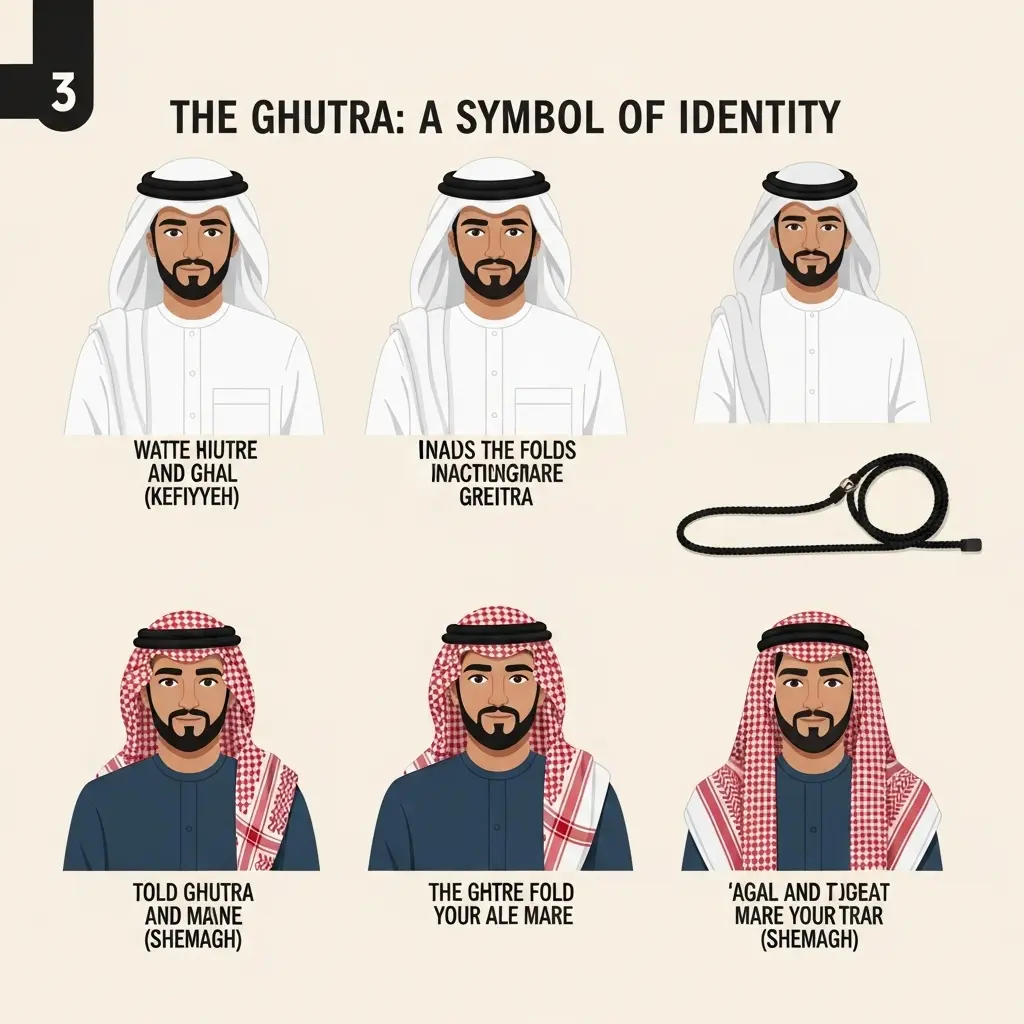
The male headscarf is one of the most practical and recognizable elements.
It is known by several names, including the Ghutra and the Keffiyeh.
This piece of the Bedouin Dress Code is vital for desert survival.
The Ghutra’s Function
The cloth provides critical protection for the head, neck, and face.
It shields the wearer from the intense sun and, more importantly, from sand and dust.
During a sandstorm or high wind, the Ghutra can be wrapped to cover the entire face.
It is an ingenious piece of Traditional Arabic Costumes engineering.
The Egal and Its Role
The Egal is the black cord used to secure the Ghutra in place.
Historically, the Egal was used to hobble camels after a long day of travel.
Today, it is a decorative accessory and a symbol of status and tradition.
It keeps the Ghutra securely fastened, even during dune bashing on a desert safari.
5. Footwear and Underlayers: The Desert Safari Attire Details
The garments worn beneath and on the feet complete the ensemble.
These elements also contribute to comfort and modesty.
Proper footwear is essential for walking on soft, hot sand.
Sirwal and Wizar
Underneath the Thobe, men often wear loose trousers called Sirwal.
These are for comfort and modesty, ensuring coverage even when sitting.
A heavy under-layer, the Wizar, may also be worn in the cooler evenings.
These hidden layers are key to the functionality of Traditional Arabic Costumes.
Footwear Choices
Traditional leather sandals were the historical footwear.
They allow air circulation and are easy to remove when entering a tent or home.
For a desert safari, however, closed shoes are often recommended for practical safety.
This protects the feet from heat, scorpions, and sharp objects in the sand.
6. Bedouin Dress Code: The Historical Context
The Bedouin Dress Code is not just fashion; it is a legacy.
It reflects centuries of adaptation by nomadic tribes to the harsh climate.
Their clothing was designed for mobility, durability, and camouflage.
The simplicity and effectiveness are the hallmarks of these Traditional Arabic Costumes.
Natural Materials
The original Bedouin Dress Code relied on natural, readily available materials.
These included sheep’s wool and woven goat hair for outer garments.
The clothing was often made to be easily repaired and highly resistant to wear and tear.
This historical practicality remains a strong influence on Traditional UAE Clothing.
7. Women’s Hidden Garments: Traditional UAE Clothing Layers
Women’s attire involves intricate layering that goes beyond the visible Abaya.
The layers provide both modesty and a sense of personal expression.
This complexity is part of the rich history of Traditional Arabic Costumes.
Dishdasha and Khaftan
The Dishdasha is the inner dress worn under the Abaya.
It can be bright, richly colored, and heavily embroidered.
The colors and patterns are often only visible to close family.
This personal expression counters the external uniformity of the black Abaya.
The Burqa (Mask)
A small metallic face mask, the Burqa, was historically worn by older women.
It covered the face from the forehead to the upper lip.
The purpose was cultural modesty, though it is less common among younger generations.
It is a powerful piece of Emirati Traditional Clothes history.
8. The Meaning of Thobe and Abaya Meaning in Social Context
The Thobe and Abaya Meaning transcends mere function; it is a social identifier.
It signifies respect for local customs and shared cultural identity.
Wearing Traditional Arabic Costumes is a source of pride for Emiratis.
National Identity
The clothing serves as a symbol of national and cultural pride.
It unifies people across different tribes and social classes.
It is a visible commitment to the values of the community.
The garments reinforce the cultural fabric of the UAE.
Respect for Visitors
When visitors choose modest Desert Safari Attire, they show respect.
It demonstrates an understanding and appreciation of the host culture.
This gesture is always warmly welcomed by local hosts and guides.
It is a practical way to engage with the Cultural Dress Guide.
9. Desert Safari Attire for Tourists: A Practical Guide
Visitors must adapt to the climate and culture when choosing Desert Safari Attire.
The key is to combine modesty with practical comfort for the activities.
This ensures a seamless and respectful Overnight Desert Adventure.
Modest Desert Wear for Women
Loose-fitting trousers or long skirts are recommended.
Tops should cover the shoulders and upper arms completely.
Light, breathable fabrics like linen or cotton are essential for comfort.
Following this standard of Modest Desert Wear shows respect for local customs.
Practicality for Men
Long shorts or trousers are acceptable for men.
T-shirts are fine, but sleeveless tops should be avoided, even on Desert Camping Spots.
Closed-toe shoes are essential for walking on the sand and safety around the camp.
Comfortable and respectful attire enhances the overall experience.
10. Seasonal Variations in Traditional UAE Clothing
Traditional UAE Clothing subtly changes with the seasons, demonstrating deep climatic knowledge.
The difference in temperature requires careful material selection.
This adaptability ensures comfort year-round, despite the heat.
Winter Material Shift
During the cooler months (November to March), Thobes are often made of slightly heavier wool blends.
The colors shift to darker tones, like beige, gray, or dark blue.
This provides extra warmth during the cool desert evenings.
This is a key detail in the full Cultural Dress Guide.
Summer Lightness
In summer, the purest white, lightest cotton is used.
The focus is entirely on maximum airflow and minimum heat absorption.
This seasonal shift is a refined art in managing the Desert Environment.
11. Decoding the Ghutra and Keffiyeh: Style and Meaning
The way the headscarf is worn communicates different things.
The various styles are part of the complex Arabic Fashion Secrets.
Understanding these styles adds depth to understanding Traditional Arabic Costumes.
Emirati Style (The Hamdani)
The Ghutra is neatly draped over the shoulders with one end typically brought up and draped over the top of the head.
It is often held in place with the black Egal.
This style is clean, sharp, and highly preferred in the UAE.
It reflects a more formal and professional look.
Saudi/Keffiyeh Style
The Keffiyeh is often red-and-white or black-and-white checked.
It is folded into a triangle and draped over the head, secured by the Egal.
This style is common across the Gulf and the wider Arab world.
The choice of color and pattern carries subtle regional differences.
12. Traditional Arabic Costumes: The Accessories
Accessories are simple but highly functional, complementing the primary garments.
These details often have a long history rooted in the Bedouin Dress Code.
They complete the ensemble of Traditional Arabic Costumes.
The Bisht
The Bisht is a thin, sheer, and often black or brown cloak.
It is worn over the Thobe for formal occasions, weddings, or official ceremonies.
It often features intricate gold or silver trimming along the edges.
It is a symbol of prestige and is highly valued.
The Sibha (Prayer Beads)
While not part of the required dress, prayer beads are a common accessory.
They are often held and used for counting prayers or simply for comfort.
They symbolize piety and are a subtle element of the overall look.
13. Safety and Comfort: Modest Desert Wear and Practicality
Modest Desert Wear for tourists is inherently safer in the desert environment.
It provides practical benefits that enhance the Desert Safari Attire choice.
This choice helps to ensure a comfortable and healthy trip.
Sun Protection
Long sleeves and trousers, essential for modesty, provide superior sun protection.
They eliminate the need for excessive sunscreen application on the skin.
This is critical protection against the severe sun in the desert.
This practicality is a feature of all effective Traditional Arabic Costumes.
Sand Protection
Covering the body prevents sand from irritating the skin, particularly during wind.
The loose fabric also helps to repel dust and sand more effectively.
This ensures a more pleasant experience during high-speed activities.
14. Cultural Dress Guide: Engaging with Local Fashion
Respecting the Cultural Dress Guide opens doors to deeper cultural exchange.
Locals appreciate the effort made by visitors to conform to modesty norms.
This consideration is highly valued on a safari or at any cultural site.
Where to Purchase Traditional Arabic Costumes
Local markets (souks) offer the best place to find high-quality garments.
Tailors can quickly measure and stitch a custom Thobe or Abaya.
Wearing these garments offers a unique souvenir and a deep appreciation for the culture.
This makes the Traditional Arabic Costumes a part of the visitor’s story.
15. The Role of Tourism: Promoting Traditional UAE Clothing
Tourism operators play a vital role in educating visitors on Traditional UAE Clothing.
They often provide opportunities for guests to try on the garments.
This hands-on experience enhances the cultural understanding of the trip.
High-end operators, like those at https://royaldesertadventures.ae/, often integrate these experiences.
Operator Standards
Reputable companies ensure their staff and guides uphold the dress code.
They are committed to preserving the cultural integrity of the safari experience.
Companies like https://dubaidesertsafarie.com/ provide information on appropriate Desert Safari Attire.
This ensures a harmonious blend of culture and adventure.
16. Arabic Fashion Secrets: Weaving and Textures
The fine details of the weaving and textures of Traditional Arabic Costumes are often overlooked.
These details speak volumes about the garment’s quality and regional origin.
Understanding this craftsmanship reveals deeper Arabic Fashion Secrets.
Fabric Quality
High-quality Thobes use expensive fabrics, often imported and finely woven.
The quality of the material is immediately noticeable in the drape and feel.
This emphasis on quality reflects the importance of the garment.
It shows that Traditional Arabic Costumes are valued cultural objects.
Embroidery and Tassel (Tarbousha)
The small tassel (Tarbousha) worn at the neck of the Thobe is a key detail.
It is not merely decorative but is often filled with perfume.
The embroidery on the cuffs and collar of the Thobe and the trim of the Abaya signifies status.
These intricate designs are important Arabic Fashion Secrets.
17. The Bedouin Dress Code for Children
Children also wear miniature versions of the Traditional Arabic Costumes.
This practice instills cultural pride and tradition from a young age.
It is a charming and important part of the Bedouin Dress Code legacy.
Practicality for Youth
The loose, protective nature of the children’s garments is also highly practical.
It allows for unrestricted play while maintaining protection from the sun and heat.
This ensures that the clothing remains functional, even for the most active child.
18. Understanding the Modest Desert Wear Color Palette
While white and black dominate, other colors are significant in Modest Desert Wear.
The choice of colors is a subtle language of the Cultural Dress Guide.
Understanding this palette adds depth to the safari experience.
Earth Tones
Browns, tans, and deep reds are common, especially in rural or traditional settings.
These colors blend with the desert environment and hide dust effectively.
They are practical colors rooted in the original Bedouin Dress Code.
Formal Colors
For special events, men might wear light blue, gray, or cream Thobes.
The shift to a different, non-traditional color signifies a celebration.
The Traditional Arabic Costumes thus adapt to the social calendar.
19. The Ghutra and Keffiyeh: Advanced Folding Techniques
The way the Ghutra is folded is an art form mastered over years.
It is a visible skill that is appreciated in the region.
Different folds serve different purposes in the Desert Environment.
The Cobra Fold
A complex fold that creates a distinctive, raised shape around the head.
It is often chosen for special occasions or by younger generations.
It is one of the most stylish Arabic Fashion Secrets.
The Simple Drop
This is the most functional fold, allowing the scarf to hang down the back and sides.
It maximizes protection from the sun on the neck and shoulders.
This simple technique is often seen during the heat of the day.
20. Essential Cultural Etiquette for Desert Safari Attire
The way one interacts with clothing is as important as the clothing itself.
Proper etiquette must be followed when wearing or viewing Traditional Arabic Costumes.
This courtesy is a mark of respect for the Emirati Traditional Clothes.
Sitting and Standing
Care should be taken not to allow the Thobe to drag on the ground excessively.
When sitting, the garment should be neatly draped to preserve modesty.
This conscious care is part of the ingrained cultural respect for the dress.
Never Mock
It is essential to view Traditional Arabic Costumes with curiosity and respect.
Any form of mockery or disrespect towards the cultural dress is highly offensive.
This simple rule ensures a positive cultural interaction.
21. Ensuring Best Desert Camping Attire Comfort
Even the most fashionable Desert Safari Attire must be comfortable for an overnight trip.
The Best Desert Camping involves exposure to wind and cold.
Practical preparation is crucial for a pleasant night under the stars.
Layers for the Night
For overnight guests, the key word is layers, even in the tent.
A light fleece or sweater is necessary for the Desert Stargazing Camp.
This extra insulation combats the drastic temperature drop in the desert.
This is a key part of the Desert Camping Guide.
22. Thobe and Abaya Meaning: Economic Status
Historically, the quality of the fabric dictated economic status.
While less pronounced today, quality still indicates wealth and standing.
This historical link is subtle but still present in the Thobe and Abaya Meaning.
Fine Textiles
The finest cottons and silks are used for bespoke garments.
The highest quality material is a sign of careful tailoring and expense.
The simple, unadorned Traditional Arabic Costumes can be extremely high-end.
23. Practical Tips from External Resources for Desert Safari Attire
Experienced operators offer valuable advice on what to wear for the best experience.
These external links confirm the best practices for Desert Safari Attire.
They ensure tourists are both comfortable and culturally appropriate.
Check https://hafiztourism.com/ for their recommended packing list.
24. Modest Desert Wear for Photography
For those interested in photography, Modest Desert Wear creates better images.
The solid colors and flowing lines complement the vast desert landscape.
They emphasize the cultural context of the pictures.
This blending of aesthetics and respect is key to great photography.
25. The Final Word on Traditional Arabic Costumes
The deep history, functional design, and cultural meaning make Traditional Arabic Costumes fascinating.
They are a living legacy of the Bedouin Dress Code and the Emirati Traditional Clothes.
By understanding these garments, the visitor gains a far richer understanding of the UAE.
Frequently Asked Questions (FAQs) – Long Answers
1. Why are Traditional Arabic Costumes, such as the Thobe and Abaya, mostly loose-fitting and long, despite the intense heat of the desert climate?
Traditional Arabic Costumes are loose-fitting and long primarily for two highly functional reasons adapted to the intense desert heat. Firstly, the loose fit allows for a pocket of air to be trapped between the fabric and the skin. As the body heats up, this air circulates freely, promoting evaporative cooling and wicking sweat away from the body, which is far more effective than tight-fitting clothes. Secondly, the long sleeves and full-length coverage of the Thobe and Abaya Meaning provide maximum protection from the sun’s intense UV rays. Covering the skin entirely prevents sunburn and minimizes heat absorption, which is key to survival and comfort in the arid environment, forming the foundation of the Bedouin Dress Code.
2. Should tourists wear Traditional Arabic Costumes during a Desert Safari, and where can they find authentic Emirati Traditional Clothes?
Tourists are not required to wear Traditional Arabic Costumes during a desert safari, but they are absolutely encouraged to wear clothing that aligns with Modest Desert Wear principles—covering shoulders, cleavage, and knees. Many desert safari camps, including those listed on platforms like https://dubaidesertsafarie.com/, offer guests the chance to try on a Thobe or Abaya for a brief photo opportunity, which is a fun and respectful cultural experience. For purchasing authentic Emirati Traditional Clothes to wear throughout the trip, the best places are the Gold and Textile Souks in Dubai, where quality tailors can create custom garments quickly and affordably.
3. What is the symbolic and practical function of the Ghutra or Keffiyeh, and how is the black cord (Egal) related to the Bedouin Dress Code?
The Ghutra (or Keffiyeh) is the traditional male headscarf, and its function is both symbolic and profoundly practical. Practicality: It shields the head and neck from the scorching sun and can be quickly adjusted to cover the face entirely, providing protection from dust and sand during high winds or a sandstorm. Symbolic: The color and folding style of the Ghutra/Keffiyeh can signify regional or tribal identity. The Egal is the black cord used to secure the Ghutra in place. Historically, the Egal was an actual rope used by Bedouins to hobble (tie the legs of) their camels to prevent them from wandering away at night. Today, it is a key piece of the formal Bedouin Dress Code, symbolizing heritage and tradition.
4. How does the concept of Modest Desert Wear for female tourists differ from the requirement for local women wearing the Abaya on a Desert Safari?
The concept of Modest Desert Wear for female tourists is a guideline based on cultural respect, while the Abaya for local women is an established cultural and religious practice. Tourists: Are generally expected to wear loose, non-revealing clothing that covers the shoulders and knees, prioritizing comfort and heat management. Light colors and breathable fabrics are recommended for Desert Safari Attire. Local Women: The Abaya is a loose, full-length black cloak worn over everyday clothing for public modesty. Tourists are not expected to wear an Abaya unless they choose to do so, but adhering to the spirit of Modest Desert Wear is highly appreciated by the hosts.
5. What are the key differences between a Luxury Desert Glamping experience and a standard overnight Desert Camping Spots tour regarding cultural attire and facilities?
The key differences between Luxury Desert Glamping and a standard overnight tour regarding cultural attire and facilities relate to quality and exclusivity. Luxury Desert Glamping (often offered by operators like those at https://royaldesertadventures.ae/) features proper, private en-suite facilities, allowing for greater privacy and comfort for changing clothes. They often provide higher-quality, cleaner rental Traditional Arabic Costumes for photo shoots. Standard Tours use communal facilities, which requires more careful planning for Desert Safari Attire changes. The cultural attire experience is usually limited to trying on a quick garment over your clothes for a picture near the main Desert Camping Spots area.
6. Why is the color white overwhelmingly preferred for the male Thobe (Kandura) in the summer, and what color variations are important for Traditional UAE Clothing in winter?
The color white is overwhelmingly preferred for the male Thobe in summer because of its superior heat-reflective properties. White reflects nearly all the visible light spectrum, minimizing the heat absorbed by the fabric and helping the wearer stay cool under the intense sun. This is a critical feature of all Traditional UAE Clothing designed for the hot climate. In the cooler winter months (November to March), men often switch to slightly heavier, darker Thobes in colors like beige, brown, grey, or dark blue. These darker colors absorb more sunlight, providing additional warmth and insulation during the cool desert evenings, which are often close to the freezing point.
7. How do the principles of the Cultural Dress Guide contribute to visitor safety and comfort during physically demanding activities like Dune Bashing?
The principles of the Cultural Dress Guide directly contribute to visitor safety and comfort during activities like Dune Bashing. By emphasizing Modest Desert Wear—long sleeves, trousers, and covering the body—the clothing protects the skin from two critical factors: 1. Sun Exposure: Preventing severe sunburn, which quickly leads to dehydration and heat exhaustion. 2. Sand and Dust: The covered skin is protected from the fine, abrasive sand kicked up during the fast-paced driving of Dune Bashing. Loose-fitting Desert Safari Attire also allows for unrestricted movement and better airflow, enhancing overall comfort and adherence to the Cultural Dress Guide simultaneously.
8. What is the significance of the tiny tassel (Tarbousha) found on the collar of a male Thobe, and how does it relate to Traditional Arabic Costumes?
The small tassel, known as the Tarbousha, found on the collar of a male Thobe, is a significant and often overlooked detail of Traditional Arabic Costumes. Its significance is twofold: 1. Decorative: It adds a touch of simple elegance and finish to the garment. 2. Scented: Historically and even today, the Tarbousha is often imbued with a small amount of concentrated perfume or incense oil (attar). As the wearer moves, the scent is released, providing a pleasant fragrance throughout the day. This detail highlights the sophisticated blend of practicality, aesthetics, and hygiene within the Traditional Arabic Costumes design.
9. Are there any specific items of Traditional Arabic Costumes that tourists are advised NOT to wear during a Desert Safari to avoid cultural faux pas or discomfort?
Yes, tourists are advised to avoid wearing certain specific items of Traditional Arabic Costumes to prevent cultural faux pas or discomfort. 1. The full Abaya and Shayla/Hijab: Unless one fully understands how to wear and manage these garments, wearing them incorrectly can be seen as disrespectful. 2. The Bisht (formal cloak): This expensive, often embroidered cloak is reserved for very formal occasions (weddings, official meetings) and is not appropriate for the casual setting of a desert safari camp. 3. The Egal without the Ghutra: The black cord should only be worn with the headscarf, as wearing it alone is incorrect. Focusing on Modest Desert Wear from a tourist’s regular wardrobe is always the safest approach.
10. How does a visitor distinguish between the quality of two different sets of Traditional UAE Clothing when shopping in the souks, and what should they prioritize?
When shopping for Traditional UAE Clothing in the souks, visitors should prioritize fabric quality and stitching. 1. Fabric Check: High-quality Thobes are made of fine, often imported cotton or wool blends that feel smooth, light, and drape well. Low-quality Thobes will feel coarse or overly stiff. 2. Stitching: Examine the embroidery around the collar and cuffs (or the Abaya trim); high-quality garments will have tight, even, and consistent stitching. 3. Fit: While a Thobe is loose, the shoulder seams should sit correctly. Do not compromise on these elements, as they are key Arabic Fashion Secrets that ensure the garment looks respectable and lasts longer.
11. What are the key differences between the male headscarf folding styles in the UAE (Emirati Style) versus other Gulf countries?
The key difference in male headscarf folding styles between the UAE and other Gulf countries lies in the level of formality and the ‘tail’ placement. UAE (Emirati Style/Hamdani): The Ghutra is often starched and ironed to be very crisp. It is secured by the Egal, and the two ends (tails) are typically brought forward over the shoulders and neatly tucked or draped, creating a sharp, formal, and sometimes slightly crested look. Saudi/Kuwaiti Styles: In some Saudi or Kuwaiti styles, the tails are allowed to hang loose down the back and sides, often with a less starched appearance, giving a more casual or voluminous look. These subtle variations are important Traditional Arabic Costumes social identifiers.
12. How does the Thobe and Abaya Meaning relate to the Bedouin’s nomadic history, and how has that functionality been preserved today?
The Thobe and Abaya Meaning is deeply rooted in the Bedouin’s nomadic history by prioritizing functionality, durability, and sun protection. Preservation: The original design principles of loose, full-body coverage have been preserved. The wide cut ensures mobility necessary for herding and travel. The long sleeves protect from the constant sun and wind exposure. Today’s garments use modern, lighter fabrics (like cotton/linen) that maintain the historical function of promoting airflow and durability, ensuring that the Bedouin Dress Code remains perfectly adapted to the desert environment, despite the shift to modern life.
13. What is the role of an organized tour operator, such as those listed on https://dubaidesertsafarie.com/, in providing information on Desert Safari Attire?
Organized tour operators, like those found on https://dubaidesertsafarie.com/, play a crucial role in providing authoritative information on Desert Safari Attire. They include dedicated sections on their booking pages detailing the recommended dress code for visitors. This information typically covers: 1. Modesty Guidelines: Ensuring cultural respect. 2. Practical Tips: Recommending closed-toe shoes and light layers for comfort. 3. Seasonal Advice: Reminding guests to bring warm jackets for the evening, even after a hot day. This proactive guidance helps prevent visitor discomfort and ensures adherence to the local Cultural Dress Guide.
14. How can tourists ensure their Modest Desert Wear is appropriate for the activities, such as camel riding or sandboarding, without compromising cultural sensitivity?
Tourists can ensure their Modest Desert Wear is appropriate for activities like camel riding or sandboarding by focusing on two key elements: flexibility and coverage. Flexibility: Wear loose trousers (not jeans, which retain heat) instead of skirts, as trousers allow for easier movement and are safer for mounting and dismounting camels or sandboarding. Coverage: Ensure tops are not low-cut and fully cover the shoulders, which maintains the required level of cultural sensitivity. This practical approach ensures that the Desert Safari Attire is both culturally respectful and safe for all physical activities.
15. Explain the concept of “layers” in the context of Traditional Arabic Costumes for both men and women, beyond the visible outer garments.
The concept of “layers” is essential in understanding Traditional Arabic Costumes for both genders, extending beyond the visible outer garments. Men: Under the Thobe, men often wear a white cotton undershirt and loose, full-length trousers called Sirwal. This provides modesty, comfort, and helps absorb sweat. In winter, an additional heavy undergarment (Wizar) might be worn for warmth. Women: Under the Abaya, women wear a fully finished dress called a Dishdasha or Khaftan. This inner layer is often brightly colored and intricately designed, serving as the personal fashion statement only seen by close family. These hidden layers are crucial for both comfort and upholding the deeper principles of Traditional Arabic Costumes modesty.