
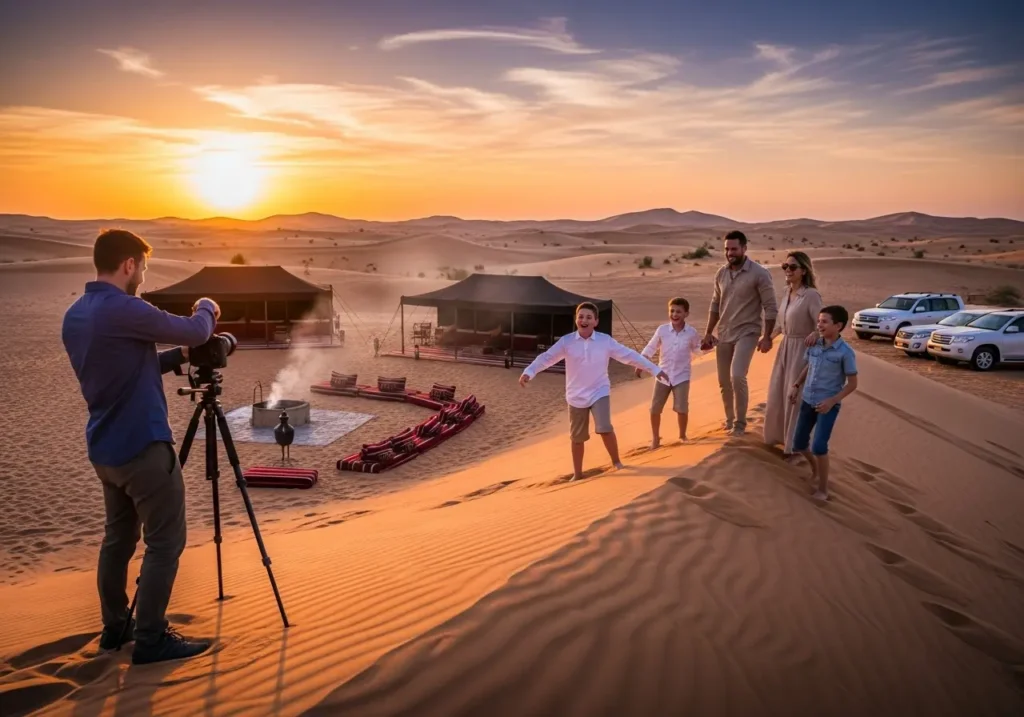
The Ultimate 2025 Guide to Dubai Safari Photography: An Epic Adventure
Welcome to the most definitive and in-depth guide to Dubai Safari Photography, a journey into a world where thrilling adventure meets breathtaking artistic opportunity. This is not just a tour; it is a chance to capture the very soul of the Arabian desert, a landscape of majestic beauty, dramatic light, and rich cultural heritage.
In a city celebrated for its futuristic architecture, the desert safari offers a canvas of timeless, natural beauty. For a photographer, this is a playground of light, texture, and color. A Dubai Safari Photography expedition is your ticket to creating images that are not just beautiful, but are also powerful, evocative, and truly unforgettable.
This exhaustive guide will be your personal mentor, navigating you through every facet of this photographic adventure. We will explore the essential gear you need, master the camera settings to conquer the desert’s unique challenges, and uncover the secrets to composing stunning images. We will cover every practical detail and insider tip you need to transform your desert safari into a successful Dubai Safari Photography mission.
Prepare to be inspired by the interplay of light and shadow on the golden dunes. Discover why a Dubai Safari Photography trip is more than just taking pictures—it is an essential and unforgettable way to connect with and capture the magic of this incredible city.
What is a Dubai Safari Photography Tour? A Deeper Look
At its core, a Dubai Safari Photography tour is not a specific package you buy, but rather an approach to the classic desert safari experience. It is about viewing the entire adventure—from the dune bashing to the cultural camp—through the creative lens of a photographer.
It is about understanding the unique photographic opportunities that each part of the safari presents and being prepared to capture them. It is a blend of a thrilling adventure tour and a dedicated landscape and cultural photography workshop, all rolled into one incredible evening.
The goal of a Dubai Safari Photography focused trip is to come away with a portfolio of stunning, diverse images that tell the complete story of the Arabian desert experience. This includes epic landscapes, dynamic action shots, intimate cultural portraits, and even magical night sky images.
Why the Dubai Desert is a Photographer’s Paradise
To master Dubai Safari Photography, you must first understand your incredible canvas. The Arabian Desert offers a unique combination of elements that make it one of the most rewarding and photogenic landscapes on Earth.
The Magical Desert Light
The quality of light in the desert is legendary among photographers, and for good reason. The fine dust particles that hang in the dry air act as a giant, natural softbox and color filter.
- The Golden Hour: The hour just after sunrise and, more relevantly for an evening safari, the hour just before sunset, is the “golden hour.” The low angle of the sun casts a warm, golden, and incredibly flattering light across the dunes, creating long, dramatic shadows that reveal every ripple and curve in the sand.
- The Blue Hour: The period just after the sun has set, but before the sky is completely black, is the “blue hour.” The sky takes on a deep, rich, royal blue color, which creates a stunningly beautiful and serene backdrop for photos of the camp or silhouettes on the dunes.
A Canvas of Minimalist Landscapes
The desert is the ultimate expression of minimalism. The clean, sweeping lines of the dune crests, the vast, uncluttered expanse of the sky, and the simple color palette of gold and blue allow for incredibly powerful and graphic compositions. This simplicity is a key element for successful Dubai Safari Photography.
Incredible Textures and Patterns
The desert is a world of texture. The wind constantly carves intricate, repeating patterns and ripples into the surface of the sand. Capturing these textures, especially in the low, raking light of the golden hour, can result in beautiful, abstract images. Animal tracks, like those of a desert fox or gazelle, can add a wonderful storytelling element to your shots.
A World of Dramatic Contrasts
The desert is a land of powerful contrasts, which always makes for compelling photography.
- Color Contrast: The deep orange of the red dunes against the brilliant blue of the sky is a classic and powerful color combination.
- Subject Contrast: The contrast between the ancient, timeless landscape and a modern, powerful 4×4 vehicle creates a fascinating visual narrative.
- Light Contrast: The deep shadows and bright highlights during sunrise and sunset create a dramatic, high-contrast scene that is full of mood and emotion.
A Diverse Range of Photographic Subjects
A single desert safari offers an incredible variety of subjects, making it a complete workout for your photographic skills. A good Dubai Safari Photography portfolio will include:
- Epic, wide-angle landscapes.
- Thrilling, high-speed action shots of dune bashing.
- Serene, iconic images of a camel caravan at sunset.
- Intimate, candid portraits of cultural life in the Bedouin camp.
- Dazzling, low-light shots of the evening’s entertainment.
- Awe-inspiring astrophotography of the starry night sky.
Choosing the Right Tour for the Best Dubai Safari Photography
Not all desert safari tours are created equal, especially from a photographer’s perspective. The right choice of tour can make a huge difference to the quality of your Dubai Safari Photography.
The Morning Safari: For Light and Solitude
- The Advantage: The primary advantage of a morning safari is the light. You get to experience the magical golden hour just after sunrise. The dunes are often pristine and untouched by the day’s traffic, offering clean, beautiful lines. There are also fewer people, which means a more peaceful experience and cleaner shots.
- The Disadvantage: You miss out on the sunset, the blue hour, the camp life, and the evening shows, which are all fantastic photographic subjects.
The Evening Safari: The Classic All-Rounder
- The Advantage: This is the most popular choice for a reason. It offers the widest variety of photographic opportunities in a single tour. You get the golden hour, the spectacular sunset, the blue hour, and the challenges of night photography at the camp. This is the best option for a comprehensive Dubai Safari Photography portfolio.
- The Disadvantage: It is the most crowded option. You will be sharing the sunset spot with other groups, which can make it challenging to get a clean shot.
The Private/VIP Safari: The Ultimate Photographer’s Choice
- The Advantage: This is, without a doubt, the best option for any serious photographer. A private tour gives you the ultimate luxury: control. You can ask your driver to stop wherever and whenever you see a great shot. You can spend as much time as you need at the sunset spot to get your composition perfect. There will be no strangers photobombing your pictures.
- The Disadvantage: It is significantly more expensive than a shared tour.
- Recommendation: For the absolute best Dubai Safari Photography experience, booking a private tour with a reputable company like Dubai Desert Safarie is a fantastic investment.
The Overnight Safari: For the Astrophotography Enthusiast
- The Advantage: This is the only option that gives you the time and the darkness needed for serious astrophotography. After the camp lights are dimmed, you can venture out with your tripod and capture the breathtaking beauty of the Milky Way. You also get the bonus of a sunrise shoot the next morning.
- The Disadvantage: It requires a greater time commitment.
Essential Photography Gear for Your 2025 Desert Adventure
While the best camera is the one you have with you, having the right gear can significantly expand your ability to capture stunning Dubai Safari Photography.
The Camera Body: DSLR vs. Mirrorless
For 2025, modern mirrorless cameras are the top choice for their compact size, excellent electronic viewfinders (which are great in bright sun), and advanced autofocus systems. A camera with a full-frame sensor will give you the best image quality, especially in the low-light conditions of the evening.
The Holy Trinity of Lenses
To be prepared for any situation, most professional photographers rely on three key lenses:
- The Ultra-Wide Angle Zoom (e.g., 16-35mm f/2.8): This is your lens for those epic, sweeping desert landscapes, for capturing the entire camp, and for dramatic astrophotography shots.
- The Standard Zoom (e.g., 24-70mm f/2.8): This is your versatile workhorse. It’s perfect for capturing the action of dune bashing, for environmental portraits, and for general shooting around the camp.
- The Telephoto Zoom (e.g., 70-200mm f/2.8): This lens is a secret weapon for Dubai Safari Photography. It allows you to compress the perspective, making distant dunes look closer and more stacked up. It’s also essential for candid portraits of the performers and for any potential wildlife sightings.
The Crucial Tripod
A sturdy yet lightweight tripod is non-negotiable if you are serious about your photography. It is absolutely essential for:
- Shooting in the low light of sunrise, sunset, and the blue hour.
- Creating tack-sharp, highly detailed landscape images.
- Long exposure photography, such as capturing the light trails of the Tanoura dancer or creating a silky effect on any water features.
- Astrophotography.
Essential Filters: The Secret Sauce
- Circular Polarizer (CPL): This is the most important filter for daytime desert photography. It works like polarized sunglasses, reducing glare, deepening the blue of the sky, and making the colors of the sand richer and more saturated.
- Neutral Density (ND) Filters: These reduce the amount of light entering the lens, allowing you to use slow shutter speeds even in bright daylight.
- Graduated ND (GND) Filters: These are dark on top and clear on the bottom, helping you to balance the exposure between a bright sky and a darker foreground during sunset.
Must-Have Accessories
- Spare Batteries: The heat can drain batteries faster, and you will be taking a lot of pictures. Bring at least one spare.
- Multiple Memory Cards: You don’t want to run out of space at a crucial moment.
- Remote Shutter Release: Essential for long exposures on a tripod to avoid camera shake.
- A Comprehensive Lens Cleaning Kit: Sand is the enemy of your camera. A rocket blower, a soft brush, and microfiber cloths are absolutely vital for any Dubai Safari Photography trip.
- A Good Camera Bag: A well-padded, sealed camera bag will protect your expensive gear from bumps and, more importantly, from the fine desert sand.
- A Red-Light Headlamp: For shooting at night, a headlamp with a red light mode will allow you to see your camera settings without ruining your night vision.
Mastering Your Camera: Technical Settings for Epic Dubai Safari Photography
Great gear is useless without a solid understanding of the fundamentals of photography. Mastering these technical skills is the key to unlocking your creative potential and capturing the best Dubai Safari Photography.
Understanding the Exposure Triangle in the Desert
This is the foundation of all photography, and the desert’s high-contrast light makes it especially important.
- Aperture (f-stop): For wide landscapes where you want everything in focus, use a high f-number like f/8 or f/11. For portraits where you want a blurry background, use a low f-number like f/2.8.
- Shutter Speed: To freeze the action of a 4×4 kicking up sand, you’ll need a fast shutter speed like 1/1000s. To capture the motion of a spinning Tanoura dancer, you’ll need a slow shutter speed like 1 second, which requires a tripod.
- ISO: During the day, keep your ISO as low as possible (ISO 100) for the best quality. As the sun sets and you move into the camp, you will need to increase your ISO to 800, 1600, or even higher to get a correct exposure.
The Power of Shooting in RAW
If your camera allows it, always shoot in RAW format instead of JPEG. A RAW file is like a digital negative; it captures all the data from the sensor, giving you much more flexibility to adjust exposure, colors, and details during the editing process. It is a game-changer if you want to create professional-quality Dubai Safari Photography.
Mastering Focus for Ultimate Sharpness
- Daytime: Use Single Point Autofocus (AF-S) to tell your camera exactly where you want it to focus. It’s perfect for static subjects like landscapes or a posed portrait.
- Action: Use Continuous Autofocus (AF-C) to track moving subjects like the 4x4s during dune bashing.
- Nighttime: Your camera’s autofocus will struggle in the dark. Switch to Manual Focus (MF). Use your camera’s live view screen, digitally zoom in on the brightest star or a distant light, and manually adjust the focus ring until it is a perfectly sharp point of light.
Composition Masterclass: Framing Your Desert Story
How you arrange the elements in your frame is what turns a snapshot into a photograph. The desert provides a perfect canvas for practicing strong composition.
- The Rule of Thirds: Imagine your frame is divided into a 3×3 grid. Place the horizon on the top or bottom third line, and place your main subject (like a camel or a 4×4) at one of the four intersection points for a more balanced and dynamic image.
- Leading Lines: The crests of the dunes create beautiful, natural S-curves. Use these lines to lead the viewer’s eye from the foreground to the background of your image. Tire tracks or a line of walking camels can also serve as powerful leading lines.
- The Importance of Scale: The desert is vast and majestic. To convey this sense of scale in your Dubai Safari Photography, include a small element like a person or a vehicle in your wide landscape shot. This gives the viewer a reference point and makes the dunes look even more immense.
- Creating Powerful Silhouettes: The sunset is the perfect time for this. Position your subject (a camel, a person in a dramatic pose) directly in front of the brightest part of the setting sun. Expose for the bright sky, which will turn your subject into a solid black shape.
- The Art of Patterns and Textures: Get down low and use a wide-angle lens to capture the intricate, repeating patterns that the wind carves into the sand. The low, raking light of the golden hour is perfect for revealing these beautiful textures.
A Shot-by-Shot Guide to Your Dubai Safari Photography Adventure
Let’s walk through the entire safari itinerary and identify the key moments and techniques to ensure you get the best possible shots.
The Journey and Dune Bashing
- Shooting from Inside the Car: This is challenging due to the bumps and reflections. Use a very fast shutter speed and a polarizing filter to cut down on window glare. The best shots are often of the other vehicles in your convoy.
- Shooting the Convoy: During a photo stop, ask your guide to drive a short distance away so you can capture the classic shot of the 4×4 on the crest of a dune, kicking up sand.
The Sunset Stop: The Golden Moment
This is the most important part of your Dubai Safari Photography mission.
- Arrive Ready: Have your tripod set up and your composition planned before the sun starts to set.
- Capture the Sunstar: Set your aperture to a high number (f/16 or f/22) and position the sun so it is just peeking over the edge of a dune. This will create a beautiful “starburst” effect.
- Shoot Through the Blue Hour: Don’t pack up as soon as the sun disappears. The 20-30 minutes after sunset, the “blue hour,” often produce the most beautiful, soft colors in the sky.
The Camel Ride: Iconic and Serene
- The Classic Caravan Shot: The best way to get this shot is to not be on the camel yourself! During the sunset stop, photograph the camel caravan as it walks along the crest of a dune. Use a telephoto lens to compress the perspective.
- Details and Portraits: Get up close and capture the details—the camel’s long eyelashes, the colorful saddle, the texture of its hair.
Life in the Camp: A Cultural Snapshot
- Capture the Ambiance: Use a wide-angle lens to capture the overall atmosphere of the camp, with its lanterns, bonfire, and Majlis seating.
- Candid Moments: The camp is full of life. Capture candid shots of the henna artist at work, the chefs at the BBQ, and guests enjoying themselves.
- The Entertainment: This is a low-light challenge. You will need a high ISO and a wide aperture. For the Tanoura dance, use a tripod and a slow shutter speed to capture the incredible motion and light trails of the dancer’s skirt.
Practical Tips and Booking Your Tour
A little practical planning can make a huge difference.
Protecting Your Gear from Sand
Sand is the number one enemy of your camera.
- Use a Protective Cover: A simple rain cover can do a great job of keeping sand out.
- Never Change Lenses in the Open: If you must change lenses, do it inside the 4×4 vehicle where it is less dusty.
- Clean Your Gear Thoroughly: After your safari, use a rocket blower and a soft brush to meticulously clean your camera body, lenses, and tripod.
What to Wear as a Photographer
- Practical Clothing: Wear clothing that you can move around in easily and don’t mind getting sandy. Pockets are useful for lens caps and batteries.
- A Hat and Sunglasses: Essential for protecting you from the sun while you are concentrating on your shots.
Booking Your Photography-Focused Safari
- Choose a Specialist: A company like Dubai Desert Safarie has extensive experience and understands the needs of photographers. When booking, mention that you are keen on photography.
- Consider a Private Tour: As mentioned, a private tour is the best investment you can make in your Dubai Safari Photography.
- Plan Your Wider Trip: For a complete photographic tour of the UAE, from the cityscapes to the desert, a full-service company like Hafiz Tourism can help you plan the perfect itinerary.
Your Invitation to Capture the Soul of the Desert
A Dubai Safari Photography adventure is more than just a tour; it is an opportunity to create a stunning portfolio of images that capture the essence of Arabia.
It is a celebration of light, a study in texture, and a journey into a world of incredible beauty.
Whether you are a seasoned professional with a bag full of gear or an enthusiastic amateur with a smartphone, the desert offers a canvas for everyone. So, charge your batteries, clean your lenses, and get ready to create your own masterpiece.