Dubai Desert Wildlife: 19 Astonishing Secrets to Spotting the Rarest Animals
The vast, sweeping dunes of the Arabian Desert conceal a surprising amount of life. This arid environment is not barren, but thriving.
Seeing the Dubai Desert Wildlife is often the most rewarding part of any safari.
It transforms a high-octane adventure into a profound ecological journey.
However, spotting these rare creatures requires timing, patience, and expert knowledge.
This guide provides 19 astonishing secrets. We reveal where and when to find the most significant animals.
Mastering these tips will turn your outing into a successful Arabian Oryx Spotting mission.
1. The Core Secret: Timing is Everything for Wildlife Conservation UAE
The intense daytime heat forces most Dubai Desert Wildlife into nocturnal or crepuscular routines.
H3: Crepuscular Activity Peak
The best time for any Safari Viewing Tips related to animals is during the crepuscular hours.
This means the early morning just after sunrise, and the late afternoon just before sunset.
The cooler temperatures encourage animals to leave their burrows and shelters.
H3: Safari Time Slots
Therefore, choose a sunrise safari or an afternoon/evening safari if you prioritize Arabian Oryx Spotting.
Mid-day safaris are guaranteed to be the least fruitful for seeing Rare Desert Animals.
This simple timing adjustment vastly improves your chances of encountering UAE Safari Fauna.
2. The Majestic Arabian Oryx Spotting Strategy
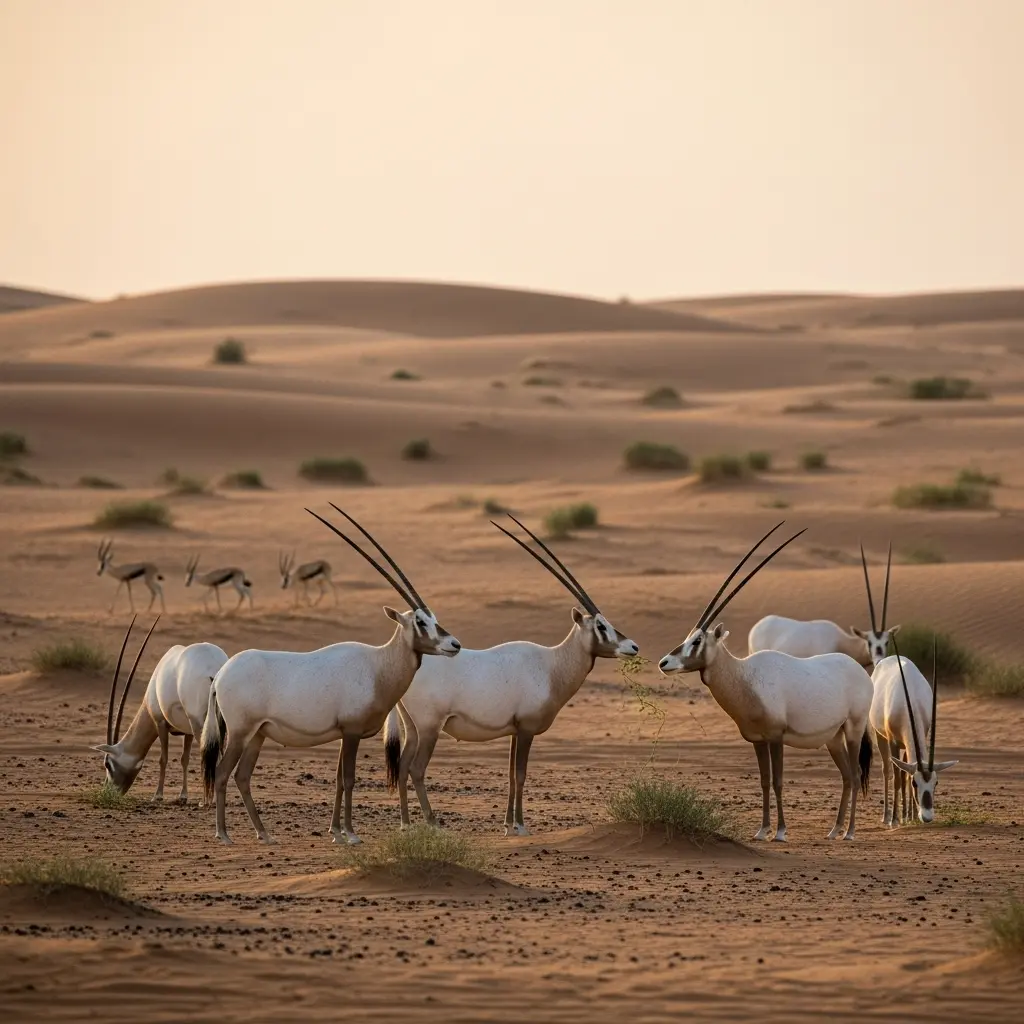
The Arabian Oryx is the flagship species of the Dubai Desert Wildlife conservation program.
H3: Designated Conservation Zones
The Oryx is not found everywhere. They live in large, protected herds within designated nature reserves.
Reputable operators often have access to these zones for controlled Arabian Oryx Spotting.
This focused effort ensures the protection of these majestic Rare Desert Animals.
H3: Behavior Patterns
Oryx often graze in the open during the cooler parts of the day. Look for their distinct white coat standing out against the ochre sand.
They are highly adapted to the Desert Animal Adaptations and can go without drinking water for long periods.
Their strong presence underscores the success of Wildlife Conservation UAE.
3. Gazelles: The Speed and Grace of UAE Safari Fauna
Two main types of gazelle inhabit the Dubai Desert Wildlife areas: the Sand Gazelle (Reem) and the Arabian Gazelle.
H3: Recognizing the Sand Gazelle
The Sand Gazelle is lighter in color and smaller. It is perfectly camouflaged against the light-colored sand.
They are extremely fast. Spotting them requires sharp eyes, often aided by binoculars.
They are common UAE Safari Fauna in the protected desert perimeter.
H3: Observing the Arabian Gazelle
The Arabian Gazelle is slightly darker and often found grazing near acacia trees or shrubs.
These are essential sources of moisture for their Desert Animal Adaptations.
Their herds are smaller, making them more challenging for Safari Viewing Tips.
4. The Desert Fox Habitat: Elusive and Nocturnal
The Desert Fox (or Red Fox) is a classic member of the Dubai Desert Wildlife, but rarely seen in daylight.
H3: Nocturnal Habits
The fox is largely nocturnal, making the evening safari a slightly better choice for a glimpse.
They emerge from their burrows after dark to hunt insects, rodents, and small reptiles.
The Desert Fox Habitat is often characterized by thickets or rocky outcrops.
H4: Identifying the Fox
Look for quick movements near the camp perimeter after the sun has set.
Their large ears help dissipate heat and are a key characteristic of Desert Animal Adaptations.
5. Reptiles and Insects: Hidden Wonders of Dubai Desert Wildlife
The small creatures of the desert often showcase the most ingenious Desert Animal Adaptations.
H3: Monitoring Reptiles
The Arabian Spiny-tailed Lizard (Dabb Lizard) is a common sight. It feeds on desert plants.
Look for them basking in the morning sun, often near their burrows in compacted earth.
These lizards are a vital part of the Desert Ecosystem.
H3: Insects and Beetles
Scarab beetles and Dung beetles are active, especially after any rare rainfall.
These tiny species are the unsung heroes of the Dubai Desert Wildlife food chain.
The insects provide food for the birds and small mammals.
6. Bird Watching Desert: Sky-High UAE Safari Fauna
The desert is a surprising stopover point for migratory birds, and home to several endemic species.
H3: Resident Bird Species
Look for the Cream-coloured Courser and the Desert Lark. They are perfectly camouflaged.
The majestic Falcon, often seen in displays at the cultural camps, is a key part of Arabian Culture.
Bird Watching Desert is best done during the morning safari hours.
H4: Spotting the Houbara Bustard
The endangered Houbara Bustard is a rare but treasured sighting. Its secretive nature makes it difficult to spot.
Its presence is a sign of a healthy Desert Ecosystem.
Conservation programs focus heavily on protecting this fragile species.
7. The Science of Survival: Desert Animal Adaptations
Understanding how animals survive the extreme conditions is key to Safari Viewing Tips.
H3: Water Conservation
Most Dubai Desert Wildlife obtain all the water they need from their food (seeds, insects).
They have specialized kidneys and high tolerance for dehydration.
This adaptation minimizes the need to travel long distances for water sources.
H3: Avoiding the Heat
Animals practice behavioral thermoregulation. They burrow deep into the cool sand during the day.
The nocturnal habits of the fox and the Rare Desert Animals are all about avoiding the brutal sun.
This avoidance is a cornerstone of their Desert Animal Adaptations.
8. Conservation Efforts: Wildlife Conservation UAE Focus
The existence of Dubai Desert Wildlife is heavily reliant on proactive government and private conservation programs.
H3: Protected Areas
Vast swathes of the desert are designated as protected reserves. Access is strictly controlled.
This protection ensures the survival of species like the Oryx and the Desert Gazelle.
Wildlife Conservation UAE funding supports breeding programs and habitat restoration.
H4: Private Initiatives
Luxury operators, such as those detailed on https://royaldesertadventures.ae/, often fund and support these conservation efforts.
Their commitment is integral to protecting the UAE Safari Fauna.
9. Safari Viewing Tips: Maximizing Your Sightings
A successful wildlife safari requires specific knowledge beyond just the animals.
H3: Silence and Patience
Animals are easily spooked by noise and sudden movement. Keep quiet when you enter a known Arabian Oryx Spotting area.
Patience is mandatory. The rewards are significant for those who wait.
This passive observation is the best of all Safari Viewing Tips.
H4: Using the Guide
Your trained safari guide is the best asset. They know the current grazing locations and migration paths.
Listen closely to their instructions. Their expertise increases your chance of seeing Rare Desert Animals.
10. The Small Mammals: Key to the Desert Ecosystem
Hares, gerbils, and jirds are fundamental to the Dubai Desert Wildlife food chain.
H3: The Desert Hare
The Cape Hare is a master of camouflage. Look for them in shallow scrapes beneath shrubs.
They are largely nocturnal but can be seen grazing at dawn.
The hare is a primary food source for the Desert Fox Habitat.
H3: Gerbils and Jirds
These small rodents are crucial to the Desert Ecosystem. They create burrows that shelter other species.
Their activity is mostly confined to the darkest hours.
11. Photography Tips: Capturing UAE Safari Fauna
Wildlife photography in the desert requires specific technical considerations.
H3: Telephoto Lens
A telephoto lens (200mm or more) is essential for close-up shots of the shy Rare Desert Animals.
Getting too close disturbs the Dubai Desert Wildlife.
This distance ensures ethical and successful Safari Viewing Tips photography.
H4: Low Light Capture
Use a higher ISO and a tripod during the crepuscular hours to compensate for low light.
The Best Time for Wildlife coincides with challenging lighting conditions.
12. The Desert Landscape: More Than Just Sand
The subtle variations in the desert landscape create different Desert Fox Habitat zones.
H3: Gravel Plains and Acacia Thickets
Gazelles often frequent the flat, gravel plains where small grasses grow.
The sparse acacia trees offer shade and a source of food.
These are prime spots for spotting Rare Desert Animals.
H4: Dune Crests and Valleys
The dune crests are often used by the Oryx for surveying the landscape.
The lower valleys provide protection from the wind and are foraging areas for the UAE Safari Fauna.
13. Avoiding Harm: Ethical Safari Viewing Tips
Responsible tourism is crucial for the success of Wildlife Conservation UAE.
H3: Maintaining Distance
Never chase, surround, or attempt to feed the Dubai Desert Wildlife. This disrupts their natural behavior.
The guide must always keep the vehicle at a respectful distance.
This ensures that future generations can also enjoy the Desert Animal Adaptations.
H4: Protecting the Habitat
Do not litter. Leave only footprints. The smallest piece of trash can harm these delicate Desert Animals.
Choosing environmentally conscious operators reflects ethical Safari Viewing Tips.
14. Seasonal Variations: Best Time for Wildlife
The season significantly impacts the visibility and behavior of the Dubai Desert Wildlife.
H3: Winter (Peak Viewing)
Winter months (November to March) are the Best Time for Wildlife.
The mild temperatures mean animals remain active for longer periods throughout the day.
This increases the window for successful Arabian Oryx Spotting.
H4: Summer Challenges
Summer heat severely limits visibility. Animals only emerge for short periods at dawn and dusk.
Spotting Rare Desert Animals is much harder during the high summer months.
15. The Feline Residents: Extremely Rare Desert Animals
While extremely rare, the Arabian Wildcat and the Sand Cat inhabit the furthest reaches of the desert.
H3: Sand Cat Mythology
The Sand Cat is perhaps the most elusive of all Rare Desert Animals. It has thick fur and pads to walk on the hot sand.
Spotting one is considered an extraordinary stroke of luck.
Their rarity is a true testament to the unique Desert Fox Habitat.
H4: Wildcat Distribution
The Arabian Wildcat, slightly larger, prefers rockier, mountainous regions, but occasionally ventures into the desert perimeter.
They are rarely, if ever, seen on a standard safari route.
16. The Role of External Expertise in Wildlife Conservation UAE
External organizations and research support Wildlife Conservation UAE efforts.
H3: Research Partnerships
Operators often work with research bodies to monitor the Oryx and Gazelle populations.
This collaboration provides valuable data on the health of the Dubai Desert Wildlife.
Platforms like https://dubaidesertsafarie.com/ often highlight operators committed to research.
H4: Global Standards
Adherence to global conservation standards ensures the long-term survival of the UAE Safari Fauna.
This commitment to ethical practice is a key factor in choosing a reputable tour provider.
17. The Oasis Effect: Micro-Habitats
Micro-habitats around small water sources or deep valleys sustain specific forms of Dubai Desert Wildlife.
H3: Water Holes
Even a small, ephemeral pool of water attracts a large volume of Desert Animals.
These areas are hotspots for Bird Watching Desert species and large mammals alike.
However, these areas are often kept secret to prevent over-visitation.
H4: Rocky Outcrops
The rocky areas provide shelter and a different vegetation type.
This diversified environment supports varied species, including certain specialized reptiles and insects.
18. Choosing Your Tour: Specialized Wildlife Safari
For true wildlife enthusiasts, a specialized safari focusing on nature over thrill is essential.
H3: Conservation Safaris
Choose a dedicated “Conservation Safari” or “Wildlife Drive” over a standard dune bashing tour.
These tours are slower, quieter, and focus entirely on locating the Rare Desert Animals.
They often require bookings through exclusive providers, such as those found via https://royaldesertadventures.ae/.
H4: Expert Guides
The quality of the guide is paramount. They must be trained in ecology, not just driving.
Look for operators (e.g., reviewed on https://hafiztourism.com/) that employ certified wildlife rangers.
19. The Essential Link: Wildlife Conservation UAE and Tourism
Sustainable tourism is the key financial engine for the future of Dubai Desert Wildlife.
By participating in ethical, conservation-focused safaris, tourists directly fund the protection of the environment.
This connection ensures the future of the UAE Safari Fauna.
Frequently Asked Questions (FAQs) – Dubai Desert Wildlife
1. What is the single most effective way to guarantee an Arabian Oryx Spotting during a Dubai Desert Wildlife safari?
The single most effective way to guarantee an Arabian Oryx Spotting is to book a dedicated conservation or heritage safari that is authorized to enter the restricted Dubai Desert Wildlife Reserve. These tours are non-aggressive, utilize open-top vintage vehicles, and follow established routes where the resident herds are known to graze during the cooler crepuscular hours. Oryx are protected and their location is often monitored, providing a high success rate for organized groups.
2. Why is the early morning (sunrise) the Best Time for Wildlife viewing, and how does it affect the behavior of Rare Desert Animals?
The early morning (sunrise) is the Best Time for Wildlife because the temperatures are at their lowest point before the midday heat. This cooler environment encourages Rare Desert Animals to be active. Nocturnal animals, like the Desert Fox Habitat residents, may still be foraging before retreating, while diurnal herbivores, like the Gazelles and Oryx, begin grazing. This brief window is when the highest number of species are visible above ground.
3. How has the Wildlife Conservation UAE program successfully brought the Arabian Oryx back from near extinction in the Dubai Desert Wildlife?
The Wildlife Conservation UAE program succeeded through a massive, coordinated effort involving captive breeding and habitat protection. Oryx were captured globally for breeding in the 1970s. The UAE established large, strictly protected reserves, ensuring a safe habitat free from human disturbance and poaching. Reintroduction programs, backed by substantial government funding, have seen their numbers rebound significantly, making the Arabian Oryx Spotting a symbol of conservation success.
4. What key Desert Animal Adaptations allow Gazelles to survive for long periods without accessing fresh water sources?
Gazelles possess several key Desert Animal Adaptations. Primarily, they derive most of their necessary water from the plants and grasses they consume, reducing reliance on standing water. They also possess specialized nasal passages that cool the blood flowing to the brain and feature a complex system of water retention, producing highly concentrated urine and dry feces to minimize water loss.
5. Where exactly is the Desert Fox Habitat located within the desert environment, and how should travelers look for them during an evening safari?
The Desert Fox Habitat is primarily located in areas with dense shrubbery, rocky outcrops, or stabilized, compacted dunes, which offer suitable burrowing conditions. During an evening safari, travelers should ask their guide to look for them near the perimeter of the cultural camp after the sun has set. They are opportunistic scavengers and often venture near human activity under the cover of darkness, making quiet observation essential for a rare glimpse.
6. What essential Safari Viewing Tips should photographers follow to ethically capture UAE Safari Fauna without disturbing them?
Photographers must prioritize ethical Safari Viewing Tips by maintaining a respectable distance (using telephoto lenses to avoid intrusion). Vehicles should remain on established tracks to prevent habitat damage. Silence is crucial; no sudden movements or loud noises should be made, as these can stress the UAE Safari Fauna. Never use a flash near nocturnal animals, as it can cause temporary blindness.
7. How do the small Rare Desert Animals, such as the Arabian Spiny-tailed Lizard, contribute to the health of the overall Desert Ecosystem?
The Arabian Spiny-tailed Lizard and other small Rare Desert Animals are crucial to the Desert Ecosystem as they fill critical roles in the food chain. The lizard acts as a primary consumer, feeding on plants and dispersing seeds, while also serving as a food source for larger predators like the Arabian Fox and desert birds. Their burrows also create micro-habitats, sheltering smaller organisms and aerating the soil.
8. Why are nocturnal creatures like the Desert Fox Habitat residents significantly more active during the peak season (winter) than in the summer?
Nocturnal creatures, while already active at night, are more visible and active during the winter because the nighttime air temperature is more moderate. In summer, the sand retains intense heat, making even the night hours uncomfortable, restricting their activity window. The cooler winter nights encourage them to forage for longer periods, increasing the chances of viewing the Dubai Desert Wildlife.
9. What is the role of specialized safari operators, like those found on https://royaldesertadventures.ae/, in funding and facilitating Wildlife Conservation UAE efforts?
Specialized safari operators, often highlighted on https://royaldesertadventures.ae/, play a direct role in funding Wildlife Conservation UAE by paying higher fees for exclusive access to conservation reserves. They also often dedicate a portion of their luxury ticket sales to fund habitat restoration, anti-poaching initiatives, and research projects. Their low-impact, sustainable approach serves as a model for responsible eco-tourism.
10. What specific Desert Animal Adaptations help certain bird species, which are critical for Bird Watching Desert, survive the intense heat and minimal water?
Desert birds, essential for Bird Watching Desert, survive the heat through behavioral and physiological adaptations. They use evaporative cooling by fluttering the gular (throat) area to dissipate heat. They also practice nocturnal or crepuscular foraging to avoid the sun and seek shade during the hottest hours. Some species can excrete concentrated salt solutions through nasal glands, minimizing water loss from urination.
11. What is the difference between the Arabian Gazelle and the Sand Gazelle, and which is easier for UAE Safari Fauna observers to spot?
The Arabian Gazelle is generally slightly darker and prefers areas with more vegetation, often found near small acacia trees. The Sand Gazelle (Reem) is much paler, smaller, and blends perfectly with the light, open sand. The Sand Gazelle is generally easier for UAE Safari Fauna observers to spot within the conservation reserves because they form larger herds and prefer the wide, open plains, which are often covered by safari vehicles.
12. How can tourists use external platforms like https://dubaidesertsafarie.com/ to verify an operator’s commitment to ethical Safari Viewing Tips?
Tourists should use external platforms like https://dubaidesertsafarie.com/ to read customer reviews and specifically search for mentions of “ethical practices,” “respectful distance,” and “driver knowledge of wildlife.” Operators with consistently high marks for maintaining distance from the Dubai Desert Wildlife and employing knowledgeable, eco-conscious guides demonstrate a stronger commitment to ethical Safari Viewing Tips.
13. Besides the 4×4, what other low-impact viewing methods are considered part of the Best Time for Wildlife safari experience?
Besides the 4×4, other low-impact methods for the Best Time for Wildlife often include guided walks or hikes during the cool morning hours, and hot air balloon rides over the conservation area. The balloon provides a panoramic, silent view of the Dubai Desert Wildlife herds without disturbing them, offering a truly unique perspective on the Arabian Oryx Spotting areas.
14. What are the signs of a healthy and stable Desert Ecosystem that a safari guide might point out to demonstrate successful Wildlife Conservation UAE efforts?
Signs of a healthy and stable Desert Ecosystem include: 1. Abundance of Key Species: Regular sightings of Oryx and Gazelle herds. 2. Diverse Vegetation: The presence of various native desert shrubs and grasses. 3. Predators: The occasional sighting of a smaller predator, such as the Desert Fox Habitat resident. 4. Cleanliness: The absence of human-made litter or pollution, demonstrating successful management by Wildlife Conservation UAE.
15. When booking a safari, what specific questions should a traveler ask their guide about the Bird Watching Desert opportunities and migratory patterns?
A traveler should ask their guide the following specific questions about Bird Watching Desert: 1. “What resident and migratory bird species are currently present?” 2. “Where are the key micro-habitats (like water sources or specific shrubbery) where birds congregate?” 3. “Is there a stop planned for passive bird observation?” The answers will gauge the guide’s expertise and the tour’s commitment to genuine Bird Watching Desert experiences.