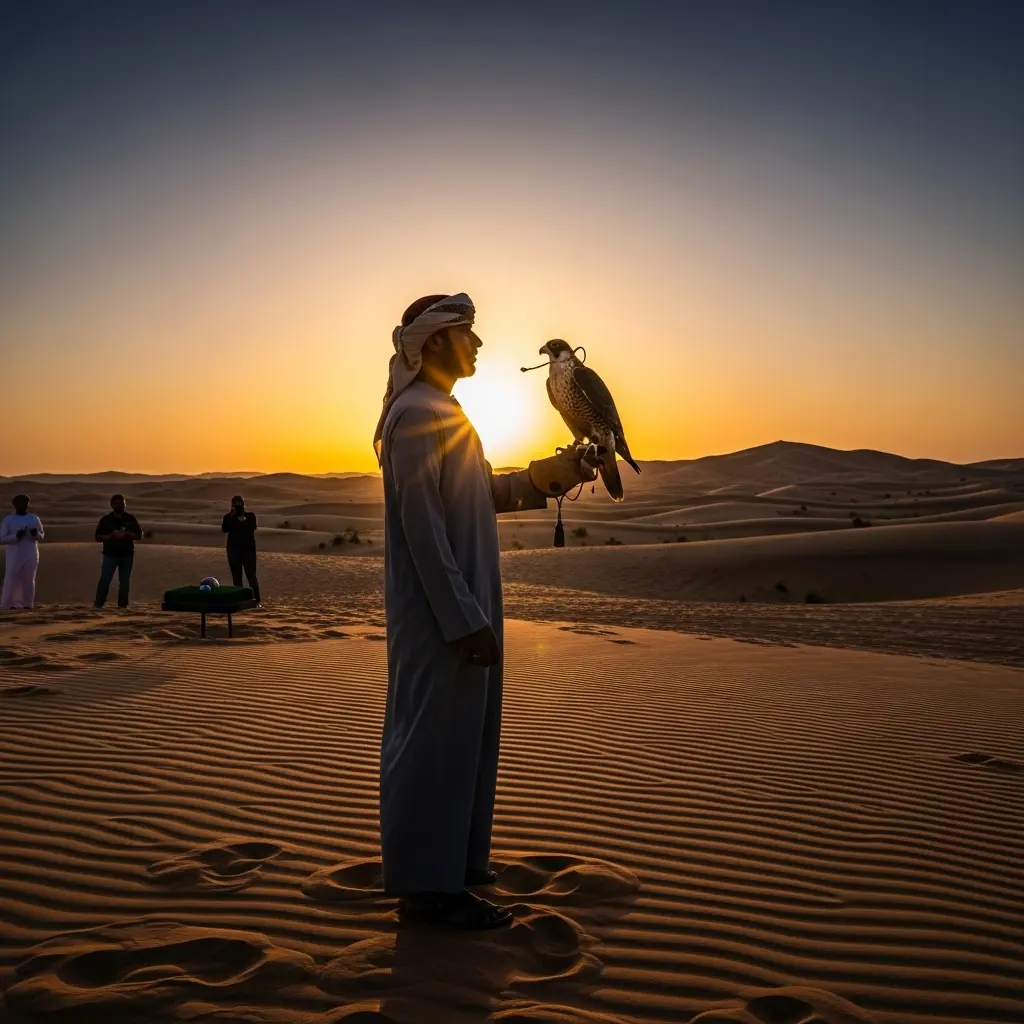
The Desert Falconry Show: Witnessing a Majestic Arabian Tradition
As the sun casts a golden glow over the vast Arabian Desert, a profound silence settles over the dunes. It is in this timeless setting that one of the region’s most captivating and ancient traditions comes to life: the Desert Falconry Show. This is far more than mere entertainment; it is a living exhibition of a cultural heritage that stretches back thousands of years. Witnessing the incredible bond between a falconer and his bird, and the breathtaking agility of these majestic predators, is an experience that connects you directly to the soul of Arabia.
A Desert Falconry Show is a highlight of many premium desert safaris, offering a glimpse into the Bedouin past when falcons were essential partners in survival. Today, it stands as a powerful symbol of Emirati national identity, courage, and nobility. The grace, speed, and precision of the falcon in flight are a sight to behold, leaving audiences in awe of both the bird’s natural abilities and the falconer’s profound skill.
This guide will take you deep into the world of Arabian falconry. We will explore its rich history, the magnificent birds of prey at its center, the intricate details of the show itself, and the vital conservation efforts that protect this tradition for future generations. Understanding the depth of this practice transforms the viewing of a Desert Falconry Show from a passive spectacle into an active appreciation of a deeply respected art form.
1. The Deep Historical Roots of Falconry in the Desert
To truly appreciate a modern Desert Falconry Show, one must understand its origins. Falconry in the Arabian Peninsula is not a sport that was developed for leisure; it was born out of necessity, a crucial tool for the survival of the Bedouin tribes in the harsh desert environment.
A 4,000-Year-Old Practice
Historians believe that falconry has been practiced in the region for at least 4,000 years. For the Bedouins, who lived a nomadic lifestyle, the falcon was an invaluable asset. Their diet was often limited, and the falcon, with its superior eyesight and incredible speed, was the perfect tool for hunting game such as hares, birds like the houbara bustard, and other small animals. This supplemented their diet with a vital source of protein.
The Falcon as a Family Member
The bond between a Bedouin and his falcon was incredibly deep. The bird was not treated as a mere tool but as a cherished member of the family. It would often be kept inside the family tent and treated with the utmost care and respect. This partnership was built on trust and a profound understanding of the bird’s nature, a tradition of compassionate handling that continues in the ethical practices of a modern Desert Falconry Show.
The Symbolism of the Falcon
Over time, as the region developed, the falcon’s role evolved from a hunting partner to a powerful status symbol. It came to represent courage, perseverance, and nobility. Falconry became the sport of sheikhs and dignitaries, a practice that showcased skill, patience, and a deep connection to the natural world. This regal association is still evident today, and the falcon is a national emblem of the United Arab Emirates.
The Role of Sheikh Zayed
No history of modern falconry is complete without mentioning the late Sheikh Zayed bin Sultan Al Nahyan, the founding father of the UAE. He was an avid and expert falconer who learned the craft from the Bedouins in his youth. He championed falconry not just as a sport but as a vital piece of the nation’s heritage. Crucially, he was also a pioneering conservationist who introduced regulations and programs to ensure the practice was sustainable, a legacy that directly influences the conservation-minded approach of every reputable Desert Falconry Show today.
2. The Stars of the Show: The Majestic Birds of Prey
A Desert Falconry Show showcases some of the most impressive predators in the avian world. While several species can be trained, three types of falcons are particularly prized for their unique abilities and historical significance in the region.
The Peregrine Falcon: Nature’s Speed Demon
The Peregrine Falcon is arguably the most famous bird in any show. It holds the title of the fastest animal on the planet. In its spectacular hunting dive, known as a “stoop,” it can reach speeds exceeding 320 km/h (200 mph). A Desert Falconry Show is one of the few opportunities to witness this incredible velocity up close as the bird dives for the lure. Their agility and speed make them a breathtaking spectacle.
The Saker Falcon: The Traditional Bedouin Choice
The Saker Falcon is a larger and more powerful bird than the Peregrine. Historically, this was the preferred falcon for Bedouin hunters due to its strength, resilience, and ability to take down larger prey like desert hares. They are intelligent and form strong bonds with their falconers. Watching a Saker Falcon in a Desert Falconry Show gives you a direct link to the historical practices of the desert nomads.
The Gyrfalcon: The Arctic Powerhouse
The Gyrfalcon is the largest species of falcon in the world. Originating from the Arctic regions, these magnificent birds are highly prized for their size, strength, and stunning plumage, which can range from pure white to dark grey. While not traditionally used by the Bedouins, they have become a prestigious part of modern falconry in the UAE, often used in shows to demonstrate raw power and presence.
3. Deconstructing the Desert Falconry Show Experience
A well-orchestrated Desert Falconry Show is a masterclass in training, trust, and natural ability. The experience is carefully designed to demonstrate the falcon’s skills in a safe and engaging way.
The Grand Unveiling
The show typically begins with the falconer bringing the bird out to the demonstration area. The falcon will be wearing a leather hood, known as a “burqa.” This hood is a crucial piece of equipment that keeps the bird in a calm and relaxed state by covering its eyes. The dramatic removal of the hood signals the start of the action and is the moment the bird becomes fully aware of its surroundings.
The Lure and the Chase
The core of the show involves the falcon chasing a lure swung on a long rope by the falconer. The lure is typically baited with a piece of meat and is designed to mimic the movement of prey. This is not just for show; it is a fundamental training and exercise technique. As the falconer swings the lure, the falcon will perform a series of high-speed passes, steep dives, and agile turns, showcasing its incredible aerial prowess and hunting instincts.
The Falconer’s Art
It is vital to understand that the falcon is not a pet and is never truly “tamed.” It is a wild animal that chooses to cooperate with its handler. The falconer’s skill lies in building a relationship of trust and positive reinforcement. During the Desert Falconry Show, you will see the falconer using subtle hand signals and calls to guide the bird. The perfect, seamless return of the falcon to the falconer’s gloved fist is the ultimate demonstration of this partnership.
Essential Falconry Equipment
Understanding the tools of the trade enhances your appreciation for the show.
4. A Modern Commitment to Conservation and Ethics
The tradition of falconry has evolved significantly. A key message in any modern Desert Falconry Show is the importance of conservation. The UAE has become a global leader in falcon welfare and the protection of wild populations.
From Survival to Preservation
While falconry began as a means of hunting for food, it is now practiced in the UAE primarily as a heritage sport and a way to preserve cultural traditions. The focus has shifted from the hunt itself to the skill of training and the bond with the bird. Reputable operators, like those featured on https://royaldesertadventures.ae/, are committed to showcasing this heritage in a responsible manner.
World-Class Conservation Initiatives
The UAE has invested heavily in protecting birds of prey. The Abu Dhabi Falcon Hospital is the world’s largest public falcon hospital, treating thousands of birds each year. The nation has also pioneered large-scale captive breeding programs for Saker and Peregrine falcons. A significant portion of these captive-bred birds are released back into the wild along their natural migration routes, helping to sustain global populations.
Ensuring Ethical Practices
When you watch a Desert Falconry Show with a licensed tour operator, you can be assured of the birds’ welfare. These falcons are prized athletes and are treated as such. They receive a specialized diet, live in climate-controlled aviaries, and are given the highest level of veterinary care. The relationship with the falconer is one of mutual respect, not dominance. Supporting organized, professional shows helps combat the illegal trade of wild-caught falcons.
5. How to Maximize Your Falconry Show Experience
To ensure you have the best possible experience, a little planning goes a long way.
Choosing the Right Safari
Not all desert safari packages include a Desert Falconry Show. It is typically featured in more premium, heritage-focused, or luxury tour packages. Standard budget safaris often skip this activity. When booking your trip, you must specifically look for a tour that lists falconry on its itinerary. Comparison sites like https://dubaidesertsafarie.com/ and https://hafiztourism.com/ often allow you to filter tours by the activities included.
The Best Time for a Show
Falcons, like most predators, are naturally most active during the cooler parts of the day. For this reason, falconry shows are almost always scheduled for the early morning (as part of a sunrise safari) or in the late afternoon just before sunset. This timing is not just for the comfort of the guests but also for the welfare of the birds, ensuring they can perform at their peak.
Tips for Photography
Capturing great photos of a fast-moving falcon is challenging but rewarding.
- Use a Fast Shutter Speed: To freeze the action and get a sharp image of the bird in flight, use a shutter speed of at least 1/1000th of a second.
- Continuous Shooting Mode: Set your camera to burst mode to take a rapid series of shots as the falcon flies past. This increases your chances of getting the perfect frame.
- Anticipate the Action: Watch the lure and try to predict the falcon’s flight path. Pan your camera along with the bird’s movement for a dynamic shot.
- Focus on the Details: Don’t just shoot the action. Capture the intricate details of the falcon’s feathers, its intense gaze, and the interaction between the bird and the falconer.
Frequently Asked Questions (FAQs)
1. Why do falcons wear hoods? The leather hood, or ‘burqa’, is one of the most important tools in falconry. A falcon’s primary sense is its vision, which is incredibly acute. The hood calms the bird by blocking out visual stimuli, preventing it from becoming stressed, scared, or aggressive in unfamiliar environments. It allows the falconer to transport and handle the bird safely, and the removal of the hood signals that it is time to fly.
2. How fast can the falcons in the show actually fly? The speeds are genuinely incredible. The Peregrine Falcon, the star of many shows, is the fastest member of the animal kingdom. While its average horizontal flight speed is around 100 km/h (62 mph), it’s the hunting dive, or “stoop,” that is breathtaking. In a stoop, a Peregrine can exceed 320 km/h (200 mph), a velocity you get to witness during a Desert Falconry Show as it dives for the lure.
3. Do the falcons ever fly away and not return to the falconer? It is extremely rare, but it can happen. These are wild animals, not domesticated pets. However, the falconer works for months or even years to build a strong bond of trust and dependency. The falcon knows that the falconer is its source of food and safety. Additionally, modern falconers use tiny, lightweight radio transmitters attached to the bird’s leg, so in the rare case a bird does fly astray, it can be safely tracked and recovered.
4. What do the falcons eat? Falcons are carnivores. In a professional and ethical setting, such as that of a reputable Desert Falconry Show, they are fed a high-quality, varied diet to keep them in peak physical condition. This typically includes quail, pigeon, and chicken. The lure used during the show is baited with a small piece of meat, which serves as an immediate reward for the falcon’s effort.
5. Is it possible for guests to hold a falcon? Yes, this is often a highlight offered after the main demonstration. Under the strict supervision of the professional falconer, guests are often given the opportunity to wear a falconer’s gauntlet (the thick leather glove) and have the falcon perch on their arm for a photo. This is a truly memorable and thrilling experience, allowing you to appreciate the bird’s size and intensity up close.
6. How long does it take to train a falcon? Training a falcon is a long and patient process that requires immense skill. The initial process of getting a bird comfortable with the falconer’s presence and willing to fly to the glove can take several weeks of intensive, daily work. Achieving the level of trust and responsiveness needed for a public Desert Falconry Show can take many months, and the training and conditioning is an ongoing process throughout the bird’s life.
7. Are the falcons used in the shows native to the UAE? While some species like the Saker Falcon are found in the region, many of the falcons used today, particularly Peregrines and Gyrfalcons, are not native. The UAE is a major global hub for falconry, and high-quality birds are sourced from captive breeding programs around the world. The UAE itself has world-class breeding facilities to ensure a sustainable supply of falcons for the heritage sport.
8. What is the cultural significance of the falcon in the UAE? The falcon is a potent national symbol, representing strength, courage, nobility, and the nation’s deep Bedouin roots. It is featured on the UAE’s coat of arms and on its currency. For Emiratis, falconry is more than a sport; it is a direct link to their ancestors and the values of patience, perseverance, and a deep respect for nature.
9. Are these shows available on all desert safaris? No, and this is a crucial point for tourists to understand. A Desert Falconry Show is considered a premium activity. It is not typically included in standard, budget-level evening desert safaris. It is most often featured as part of luxury, premium, or heritage-focused safari packages, and is also a common feature of morning or sunrise safaris. Always check the itinerary carefully before booking.
10. How does the falcon’s eyesight compare to a human’s? A falcon’s vision is one of its most remarkable attributes. It is estimated to be around eight times more powerful than human vision. This incredible acuity allows them to spot small prey from enormous distances, over a mile away. When you see a falcon in a show looking up into the sky, it is scanning an area far beyond what any human can perceive.
11. Is falconry considered an ethical practice? When practiced responsibly, as it is in the UAE’s official heritage sport, falconry is considered highly ethical. The focus is on the welfare of the bird. Modern falconry relies almost exclusively on captive-bred birds, which prevents any impact on wild populations. These birds live in excellent conditions, receive expert veterinary care, and the training methods are based on positive reinforcement, not punishment.
12. What is the average lifespan of a falcon in captivity? With the high level of care, nutrition, and protection from predators and disease they receive, falcons in a professional falconry setting can live significantly longer than their wild counterparts. While a wild falcon might live for 5-7 years, a well-cared-for falcon in captivity can live for 15-20 years.
13. Can anyone become a falconer in the UAE? Falconry is a deeply respected and complex skill. While many Emiratis practice it as a hobby passed down through generations, becoming a professional falconer who performs in a Desert Falconry Show requires years of apprenticeship, dedication, and a deep, intuitive understanding of avian behavior. It is not something that can be learned from a book.
14. What happens to falcons when they get old and can no longer fly in shows? These birds are highly valued and are cared for throughout their entire lives. When a falcon becomes too old to perform, it is retired. It will live out the rest of its life in the comfort of its aviary, receiving the same high-quality food and care as the younger, active birds. Many are also used for educational purposes or become part of breeding programs.
15. Is a Desert Falconry Show exciting for children? Children are often completely captivated by a falconry show. The high-speed flight of the birds and the close interaction is very exciting for them. The educational component is also valuable, as they learn about biology, history, and culture in a very engaging way. The opportunity to hold a falcon for a photo is usually the absolute highlight for younger guests.
16. What’s the main difference between a falcon and a hawk? While both are birds of prey, they have distinct characteristics. Falcons, like the ones in a Desert Falconry Show, are built for speed. They have long, pointed wings and typically catch their prey in mid-air after a high-speed dive. Hawks generally have broader, shorter wings, and are built for soaring and maneuvering through trees. They are more likely to hunt by surprising their prey from a perch.
17. Do the falcons have names? Yes, every falcon has a name. The falconer develops a deep personal bond with each of his birds, and naming them is an important part of that relationship. During the show, the falconer will often introduce the bird by its name and may use it when calling the bird back to the glove.
18. Why is the morning or late afternoon the best time for a show? This timing is based on the falcon’s natural behavior and physiology. Falcons are most active and energetic in the cooler temperatures of the early morning and late afternoon. Flying and hunting in the extreme heat of the midday sun would be unnatural for them and would cause significant stress and exhaustion. Scheduling the shows at these times ensures the bird’s welfare and a peak performance.
19. What is the ‘lure’ that the falconer swings? The lure is a piece of equipment, usually made of leather and feathers, that is swung on a long cord. It is designed to simulate the appearance and movement of a prey bird, like a houbara bustard. A small piece of meat is attached to it as a reward. Swinging the lure is the primary way falconers exercise their birds and demonstrate their incredible speed, agility, and diving ability to an audience.
20. How does a Desert Falconry Show connect to the broader desert safari experience? The Desert Falconry Show acts as a cultural anchor for the entire desert safari. While dune bashing provides the thrill and the BBQ dinner provides the hospitality, the falconry provides the historical soul. It elevates the tour from a simple adventure into a meaningful cultural lesson, giving guests a deeper appreciation for the resourcefulness and heritage of the Bedouin people who first mastered this remarkable partnership with nature.