Bedouin Cultural Experience: The Heart of the Arabian Desert Safari
The Arabian Desert safari is a journey of contrasts. High-speed thrills meet ancient tradition.
The soul of this journey lies in the Bedouin camp. This is where the Bedouin Cultural Experience unfolds.
These camps are much more than a dinner venue. They are living museums of the Arabian Desert Culture.
Discover why participating in a Cultural Desert Safari offers a truly Special Desert Experience.
This guide reveals the secrets that make the Bedouin Camp Experience so unforgettable.
1. The Foundation of Bedouin Hospitality
The entire Bedouin Cultural Experience is built upon the ancient tradition of Bedouin Hospitality.
The concept is rooted in the nomadic belief that all desert travelers are guests.
This tradition dictates that a guest must be offered shelter, food, and protection for at least three days.
This generosity is the essence of Arabian Desert Culture.
The Welcome Ritual
The ritual begins the moment you arrive at the Bedouin Camp Experience.
Guests are immediately offered Gahwa (Arabic coffee) and fresh dates.
This welcoming gesture symbolizes warmth, peace, and respect.
It sets a refined tone for the Bedouin Cultural Experience.
2. The Architectural Design: A Traditional Desert Camp
The structure of the camp is designed to reflect authentic nomadic dwelling.
The Majlis Seating
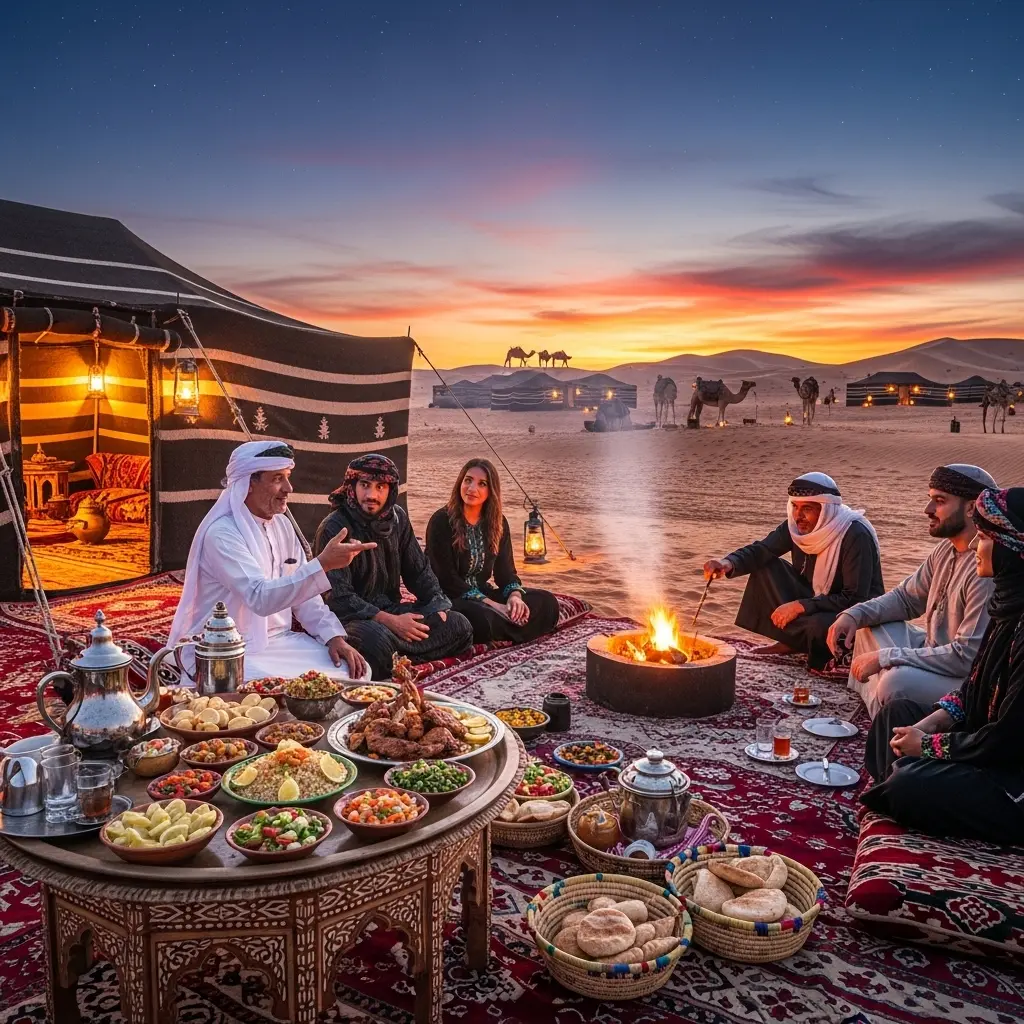
The central area features the Majlis, the traditional Arabic sitting area.
It includes low tables, plush cushions, and ornate carpets.
This design encourages relaxation, community, and social interaction.
This seating arrangement is vital to the Traditional Desert Camp atmosphere.
Open-Air Design
Most Bedouin Camp Dubai setups are open-air, often centered around a courtyard or stage.
This open design allows guests to fully experience the Desert Night Sky and the natural environment.
It connects the Cultural Desert Safari to the vastness of the desert.
3. The Gastronomy: A Special Desert Experience in Cuisine
Food is central to the Bedouin Cultural Experience, symbolizing abundance and community.
The BBQ Feast
The dinner is a feast, usually featuring a generous BBQ buffet.
It includes locally sourced, traditionally marinated meats like lamb, chicken, and kebabs.
This communal meal is a highlight of the Bedouin Camp Experience.
Local Delicacies
Guests are introduced to various regional delicacies.
These often include Hummus, Tabbouleh, and Manakish.
A traditional dish called Harees or Thareed might also be served.
This rich culinary offering defines the Special Desert Experience.
4. Cultural Immersion Activities at the Bedouin Camp Dubai
The camp offers hands-on activities that provide insight into UAE Cultural Heritage.
Henna Art
Professional artists offer Henna painting, a centuries-old tradition of temporary body art.
This popular activity allows guests to take home a piece of the Dubai Desert Culture.
It is a beautiful and intricate part of the Bedouin Camp Dubai visit.
Traditional Attire
Guests have the opportunity to try on traditional Arabic clothing, such as the Kandura and Abaya.
Wearing the local dress for photos is a fun way to engage with the Cultural Desert Safari.
This immersive element creates lasting memories.
Shisha Smoking
A designated area is set aside for Shisha (water pipe) smoking.
This relaxed, social activity is a hallmark of Bedouin Hospitality.
It provides a moment of leisure under the stars.
5. The Performing Arts: Arabian Desert Culture Unveiled
The live entertainment brings the Arabian Desert Culture to life after dinner.
Tanoura Dance
The captivating Tanoura Dance is a form of Sufi folk dance.
The male dancer spins continuously in a vibrant, multi-layered skirt.
This mesmerizing performance represents the spiritual journey and the celestial movements.
It is a stunning, unique part of the Bedouin Cultural Experience.
Belly Dance
The energetic Belly Dance performance is a symbol of celebration and joy.
The rhythmic movement and colorful costume create a festive atmosphere.
It is an engaging and popular part of the Traditional Desert Camp evening.
6. The Role of the Guide: Bedouin Hospitality Storytelling
The safari guide acts as the storyteller, bridging the modern world with the Arabian Desert Culture.
Historical Context
They provide context on the historical use of falcons, the challenges of nomadic life, and the significance of the Bedouin Camp Experience.
This educational element transforms the fun into a meaningful cultural lesson.
Language and Customs
The guide explains the customs and basic Arabic greetings.
This insight into Bedouin Hospitality makes the guest feel welcome and informed.
7. Customization and Exclusivity: Luxury Bedouin Cultural Experience
High-end operators offer a tailored Bedouin Cultural Experience.
Private Majlis
Luxury tours often include a private, secluded Majlis area within the camp.
This provides the comfort and privacy of a Special Desert Experience.
This is perfect for families or couples seeking tranquility.
Gourmet Dining Upgrades
The Cultural Desert Safari can be upgraded to include gourmet dining.
This might involve à la carte menus or dedicated chef service.
Explore premium, customized tours with partners like https://royaldesertadventures.ae/.
8. The Falconry Display: Dubai Desert Culture Symbol
The Falconry Display is a powerful symbol of Dubai Desert Culture and heritage.
Ancient Tradition
Falconry was an essential hunting technique for survival in the desert.
The display showcases the skill, training, and the deep respect between the handler and the bird.
It is a visually striking and historical part of the Bedouin Cultural Experience.
The Sunset Backdrop
The display is often timed just as the sun sets, creating a dramatic, unforgettable backdrop.
This blend of nature, history, and spectacle defines the Special Desert Experience.
9. The Tranquility: The Traditional Desert Camp at Night
After the performances end, the Traditional Desert Camp offers a profound moment of peace.
Stargazing Opportunity
The distant location of the Bedouin Camp Dubai ensures minimal light pollution.
This offers a stunning opportunity for clear stargazing.
The vastness of the Desert Night Sky completes the Bedouin Cultural Experience.
Silence and Solitude
The quiet transition after the excitement provides a moment of solitude.
It is a chance to reflect on the Arabian Desert Culture and the surrounding beauty.
10. Booking the Authentic Bedouin Camp Experience
Selecting the right partner is vital for a truly authentic Bedouin Camp Experience.
Vetting Authenticity
Look for operators committed to authentic cultural representation, not just a flashy show.
Consult external links like https://dubaidesertsafarie.com/ for reviews that focus on cultural depth.
Reliable providers ensure a genuine Cultural Desert Safari.
Quality Assurance
Operators like https://hafiztourism.com/ are known for maintaining high standards in camp hygiene and service.
This ensures your Special Desert Experience is both authentic and comfortable.
11. UAE Cultural Heritage: The Role of the Tent
The tent itself is a crucial element of UAE Cultural Heritage represented in the camp.
Symbolic Shelter
The traditional black or brown tent (or a stylized modern equivalent) symbolizes shelter.
It represents the safety and welcoming spirit inherent in Bedouin Hospitality.
The tent design is a tribute to the nomadic past.
Architecture and Climate
The tent structures were ingeniously designed to manage the extreme desert climate.
Their material and shape provide shade and allow air circulation.
This practicality is a key part of Arabian Desert Culture.
12. Dubai Desert Culture: The Language of Gahwa
The coffee, or Gahwa, is more than a beverage in Dubai Desert Culture.
Hospitality Ritual
It is a central pillar of Bedouin Hospitality and a key part of the welcoming ritual.
It is traditionally served without sugar, symbolizing the pure, unadulterated nature of the welcome.
The way it is poured and served follows strict, respectful customs.
Symbol of Trust
Accepting the Gahwa signifies trust and mutual respect between the host and the guest.
This simple act holds deep cultural meaning in the Bedouin Cultural Experience.
13. Bedouin Camp Dubai: The Importance of Carpets
The use of colorful, intricate carpets is a dominant feature of the Bedouin Camp Dubai.
Aesthetic and Comfort
Carpets provide comfort on the sand or packed earth.
They define the communal and private spaces within the Traditional Desert Camp.
Their patterns often tell stories or reflect tribal designs.
Defining Space
The carpets symbolically transform a bare patch of desert into a welcoming Majlis area.
This elevates the ground into a place of honor for the Bedouin Camp Experience.
14. Cultural Desert Safari: The Art of Storytelling
Storytelling is a vital, ancient tradition in a Cultural Desert Safari.
Oral History
Without written records, stories passed down history, law, and lineage.
Guides often share tales of the desert, its wildlife, and the Bedouin ancestors.
This oral history brings the Arabian Desert Culture to life.
Engaging Narratives
Listening to these stories around the campfire or under the stars is a unique part of the Special Desert Experience.
It connects the visitor to the long lineage of the desert dwellers.
15. The Role of Camels in the Bedouin Cultural Experience
The camel’s presence at the camp is fundamental to the Bedouin Cultural Experience.
Symbol of Life
The camel is the ultimate symbol of life, endurance, and wealth in the Dubai Desert Culture.
Their presence reminds guests of the nomadic past and the challenges of the desert.
The brief camel ride offered is a nod to this history.
Photographic Icon
The silhouette of a camel against the sunset is the most photographed image of the Traditional Desert Camp.
This powerful symbol remains the icon of the Bedouin Camp Experience.
16. Ensuring Authenticity in the Traditional Desert Camp
Authenticity is the measure of a high-quality Traditional Desert Camp.
Avoiding Cliché
The best camps strive to offer a genuine atmosphere, avoiding overly touristy clichés.
They focus on the quality of the interactions and the food.
This commitment to realism provides a superior Special Desert Experience.
Staffing
Camps that hire staff with genuine local or regional heritage often provide the most authentic Bedouin Hospitality.
Their knowledge and pride in their culture are immediately apparent.
17. The Modern Bedouin Cultural Experience: Blending Old and New
The modern Bedouin Cultural Experience skillfully blends old and new elements.
Comfort Integration
Air conditioning or cooling fans are integrated subtly into the Bedouin Camp Dubai design.
Modern, clean restroom facilities are provided.
These modern comforts ensure the Cultural Desert Safari is enjoyable for international guests.
Entertainment Updates
While the dance forms are traditional, modern lighting and sound systems are used to enhance the spectacle.
This fusion makes the Bedouin Camp Experience vibrant and polished.
18. Booking Advice: When to Prioritize Bedouin Hospitality
When booking, prioritize operators who emphasize Bedouin Hospitality and cultural depth.
Avoid the cheapest, mass-market safaris.
These often prioritize speed over quality, offering only a brief, superficial Bedouin Cultural Experience.
A moderate investment secures a far more enriching experience.
19. Family Fun in the Bedouin Camp Dubai
The Bedouin Camp Dubai is highly family-friendly.
Children enjoy the excitement of the shows, the henna art, and the simple pleasures of the sand.
The open atmosphere is conducive to family bonding and enjoyment.
It is a shared Special Desert Experience for all ages.
20. Conclusion: The Lasting Impact of the Bedouin Cultural Experience
The Bedouin Cultural Experience is the soul of your desert trip. It grounds the adventure in history, tradition, and profound hospitality.
From the taste of the Gahwa to the silence of the Arabian Desert Culture under the stars, every detail is crafted for memory.
Choose a safari that values this heritage to unlock a truly Special Desert Experience.
For exclusive, culturally rich tours, visit https://royaldesertadventures.ae/.
Frequently Asked Questions (FAQs) – Long Answers
1. What is the symbolic significance of the Gahwa (Arabic coffee) and dates served upon arrival at the Traditional Desert Camp?
The serving of Gahwa (Arabic coffee) and dates is the most important ritual demonstrating Bedouin Hospitality at the Traditional Desert Camp. The dates symbolize abundance and welcome, while the coffee is a profound symbol of trust, respect, and peace. Gahwa is traditionally served without sugar, often in small, handle-less cups, and offered multiple times. Accepting the coffee signifies a mutual agreement of trust between the guest and the host, marking the beginning of the complete Bedouin Cultural Experience and the host’s commitment to protection.
2. How does the open-air design and Majlis seating of a Bedouin Camp Dubai contribute to the Arabian Desert Culture and atmosphere?
The open-air design and Majlis seating of a Bedouin Camp Dubai are fundamental to the Arabian Desert Culture and atmosphere. The open design allows guests to fully connect with the natural environment, including the Desert Night Sky, the desert air, and the vast horizon. The low, cushion-based Majlis seating (traditional gathering spots) promotes communal interaction and equality. It encourages guests to relax, share stories, and participate in a shared Bedouin Cultural Experience, moving away from the formality of urban life and embracing the nomadic tradition of close community.
3. What are the key distinctions between the traditional Tanoura Dance and the Belly Dance performances seen at the Bedouin Camp Experience?
The key distinctions between the Tanoura Dance and the Belly Dance are their origins, performers, and symbolic meanings within the Bedouin Camp Experience. The Tanoura Dance is typically performed by men and has Sufi spiritual origins, where the continuous spinning symbolizes a mystical connection to the universe and the celestial movement. The Belly Dance is a secular, joyful performance, traditionally performed by women, signifying celebration and entertainment. While both are artistic, the Tanoura is generally viewed as cultural and spiritual, while the Belly Dance is viewed as festive entertainment.
4. How can tourists ensure the Bedouin Camp Experience they book is authentic rather than overly commercialized and touristy?
Tourists can ensure a genuine Bedouin Camp Experience by prioritizing operators that focus on quality over volume. Look for Cultural Desert Safari packages that advertise smaller group sizes and secluded camps. Read reviews that specifically mention the authenticity of the food, the knowledge of the guides, and the quality of the cultural interactions, rather than just the number of shows. Operators who specialize in premium or private tours, such as those found on https://royaldesertadventures.ae/, often invest more in genuine cultural presentation and less in mass entertainment spectacle.
5. How is the tradition of Bedouin Hospitality maintained and demonstrated by modern safari operators during the Evening Safari?
The tradition of Bedouin Hospitality is maintained by modern safari operators through several practices during the Evening Safari. It begins with the ceremonial welcome, including the offer of dates and Gahwa. Staffing: Operators hire friendly, knowledgeable guides who are trained to be welcoming and attentive. Food: The abundance of the BBQ feast symbolizes generosity. Inclusivity: The range of activities ensures all guests feel included and entertained, adhering to the ancient principle that the guest must be well-cared for during their Bedouin Cultural Experience stay.
6. What essential elements of Dubai Desert Culture are explained by the safari guide to enhance the visitor’s understanding of the camp?
The safari guide is crucial for explaining essential elements of Dubai Desert Culture to enhance the visitor’s understanding of the camp. They explain the historical necessity of Falconry for hunting, the importance of the Camel as a livelihood symbol, and the strict rules governing Bedouin Hospitality. They also detail the functionality of the Traditional Desert Camp (like why the tents and carpets are structured as they are) and share basic Arabic phrases to facilitate respectful cultural interaction.
7. Why is the camp’s location important for the Special Desert Experience, particularly concerning stargazing and solitude?
The camp’s location is critical for a Special Desert Experience because it directly affects the level of solitude and the quality of stargazing. A camp located far from the city’s light pollution guarantees a clearer view of the Arabian Night Sky, which is a primary attraction. Furthermore, a remote location ensures the camp is surrounded by natural silence, without the noise of highway traffic or other large tour groups, allowing for a truly peaceful and authentic Bedouin Cultural Experience.
8. What is the significance of the Henna Art offered at the Traditional Desert Camp, and is it a local, authentic custom?
The Henna Art offered at the Traditional Desert Camp is a local, authentic custom that holds cultural significance, especially for women. Henna is a dye prepared from the Henna plant and has been used for centuries across the Middle East and South Asia for festive, ceremonial, and decorative purposes. It symbolizes beauty, celebration, and good fortune. By offering it, the Cultural Desert Safari engages guests in a time-honored tradition that remains an active part of UAE Cultural Heritage and is a unique takeaway from the camp.
9. How can a family ensure the Traditional Desert Camp dinner includes options suitable for children with specific dietary needs or picky appetites?
A family can ensure the Traditional Desert Camp dinner is suitable by selecting reputable operators and communicating needs in advance. Good operators, such as those on https://dubaidesertsafarie.com/, offer Special Desert Experience options. They should be notified of any dietary restrictions (vegetarian, vegan, allergies) at the time of booking. Most buffets already include child-friendly staples like plain rice, grilled chicken, and simple salads. Pre-communication is key to ensuring the catering team prepares safe and suitable options.
10. How does the concept of a “soft adventure” in the desert tie into the peaceful atmosphere of the Traditional Desert Camp?
The concept of “soft adventure” (like camel riding and sandboarding) ties into the peaceful atmosphere of the Traditional Desert Camp by providing balance and context. The high-energy, “hard adventure” (dune bashing) gets you to the remote location. The camp then serves as a peaceful cultural oasis where the soft adventure activities allow for calm, reflective interaction with the landscape and local traditions. The camp’s tranquility is the necessary reward after the excitement, fulfilling the complete narrative of the Cultural Desert Safari.
11. What modern safety and hygiene upgrades have been integrated into the Bedouin Camp Dubai setup for international tourists?
Modern safety and hygiene upgrades integrated into the Bedouin Camp Dubai setup include: 1. Clean, designated washroom facilities with running water and modern plumbing. 2. Food handling protocols adhering to international hygiene standards, with covered buffet stations. 3. Discreet fire suppression equipment and clear emergency exits. 4. Pest control and general maintenance to ensure a comfortable and healthy Bedouin Camp Experience for international tourists, complementing the traditional atmosphere with modern safety.
12. What is the significance of the Falconry demonstration as part of the Bedouin Cultural Experience, and how is it related to survival?
The Falconry demonstration is highly significant to the Bedouin Cultural Experience as it symbolizes the ancient art of survival and skill in the desert. Falcons were not pets but essential hunting partners, providing meat during the harsh winter months when food was scarce. The demonstration showcases the deep bond between the falconer and the bird, highlighting the precision, training, and respect central to this tradition. It is a powerful, living connection to the practical Arabian Desert Culture and heritage.
13. What is the difference between a traditional Bedouin tent and the “Glamping” setups offered in some Special Desert Experience packages?
The difference is primarily in luxury and permanence. A traditional Bedouin tent is a simple, functional structure designed to be easily dismantled and moved, reflecting the nomadic life. A “Glamping” setup, often part of a Special Desert Experience package, is a permanent or semi-permanent luxury suite. These feature solid floors, proper beds, air conditioning, en-suite modern bathrooms, and high-end furnishings, transforming the simple tent into a comfortable Luxury Desert Safari accommodation while retaining the traditional aesthetic.
14. How does the availability of private cultural activities (like one-on-one henna or photography sessions) enhance the Bedouin Cultural Experience?
The availability of private cultural activities significantly enhances the Bedouin Cultural Experience by making it more intimate and personal. In a large group, interactions are rushed. In a private setting (often found via https://dubaidesertsafarie.com/ or https://royaldesertadventures.ae/), the guest receives dedicated time for a henna application or a private storytelling session. This deeper, unhurried connection allows for meaningful conversation and learning, enriching the Bedouin Cultural Experience far beyond what is possible in a crowded environment.
15. What are the common local spices and flavors used in the BBQ dinner, and what is the typical selection of traditional Arabic sweets?
The BBQ dinner features common local spices like Za’atar, Turmeric, Cumin, and Cardamom in marinades for meats and in traditional bread. The flavors are savory, aromatic, and distinctly Middle Eastern. The selection of traditional Arabic sweets typically includes Baklava (flaky pastry with nuts and syrup), Luqaimat (sweet dumplings drizzled with date syrup), Umm Ali (an Egyptian bread pudding), and various forms of sticky, date-based cakes. This sweet conclusion is a final, generous touch of Bedouin Hospitality to the Bedouin Camp Experience.