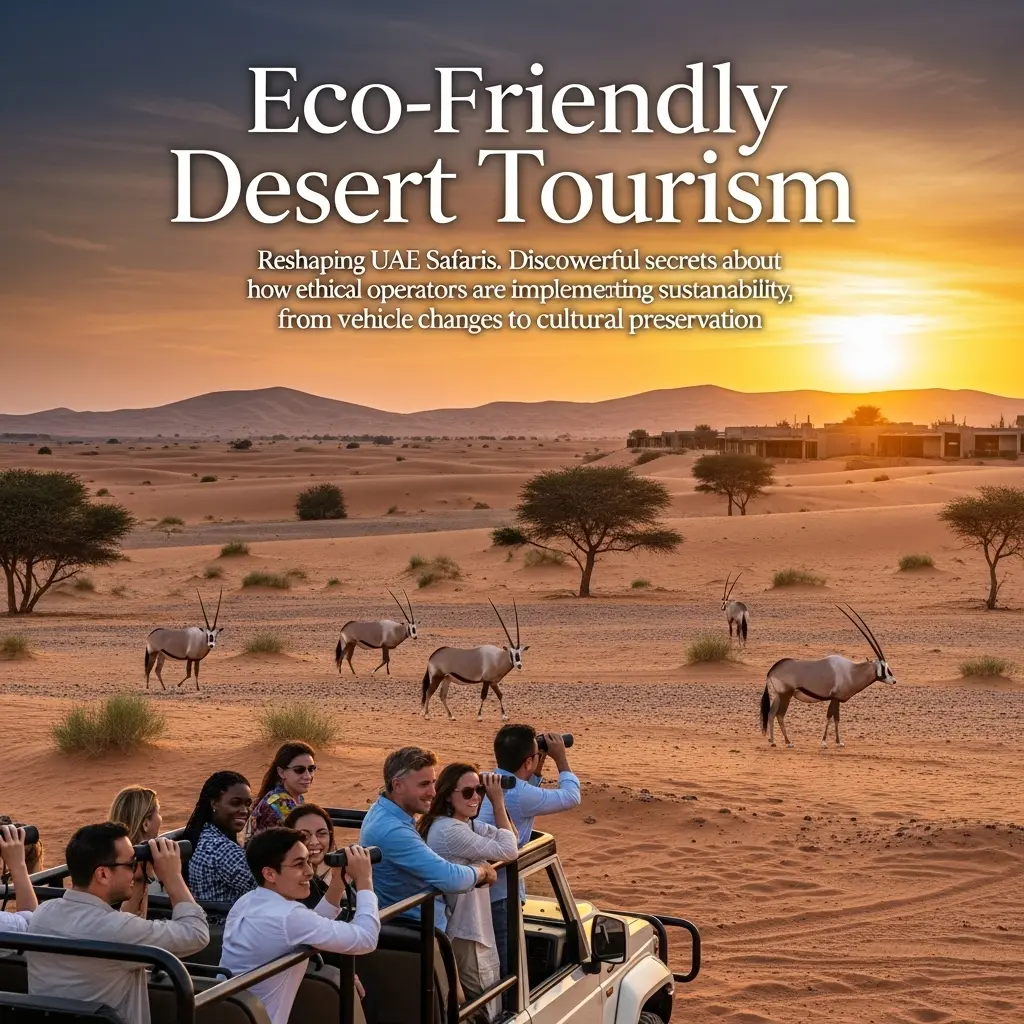
Eco-Friendly Desert Tourism: The Powerful Shift to Sustainable Safari Practices
The stunning landscape of the Arabian Desert is a precious natural resource. As tourism grows, the need for preservation becomes critical.
The shift toward Eco-Friendly Desert Tourism is reshaping the entire safari industry.
It moves the focus from high-impact thrill to respectful, Sustainable Desert Safari experiences.
This extensive guide details the powerful ways operators are embracing Ethical Safari Practices.
Understanding these changes helps you choose a truly Eco-Friendly Safari.
1. The Imperative for Eco-Friendly Desert Tourism
The desert ecosystem is fragile and slow to recover from damage.
Uncontrolled off-roading and mass tourism threaten native flora and fauna.
Eco-Friendly Desert Tourism recognizes that the environment is the product itself.
Protecting the desert ensures the viability of the safari industry for future generations.
This ethical commitment defines Responsible Desert Travel.
2. Vehicle Technology: Low Impact Safari Solutions
The most immediate change in Eco Tourism UAE involves the safari vehicles.
The Move to Low Impact Safari Vehicles
Traditional dune bashing 4x4s have a significant carbon footprint.
Progressive operators are transitioning to Low Impact Safari solutions.
This includes using hybrid or even electric 4×4 vehicles for transfers and designated drives.
These vehicles reduce both emissions and noise pollution in the Desert Wildlife Safari areas.
Tire Pressure Regulation
Ethical Safari Practices include strict tire pressure management.
Tires are inflated appropriately for the terrain, minimizing ground disturbance.
This simple act prevents unnecessary erosion of the soft sand.
3. Desert Conservation and Protected Areas
Desert Conservation is at the heart of Eco-Friendly Desert Tourism.
Restricted Access
The Dubai Desert Conservation Reserve (DDCR) is the prime example of Desert Conservation.
Entry is strictly controlled to protect native species and the Desert Ecology.
Only licensed, approved operators practicing Sustainable Desert Safari can access these areas.
Wildlife Observation
The focus shifts from aggressive driving to passive wildlife observation.
Guests use specialized viewing spots to see the Arabian Oryx and gazelles.
This quiet respect defines Desert Wildlife Safari.
4. Zero-Waste and Camp Management
Green Tourism Dubai demands rigorous waste management protocols at the camps.
Zero-Waste Commitment
Eco-Friendly Safari operators strive for zero waste left behind.
All trash, including grey water and food scraps, is meticulously collected and removed from the desert.
No foreign materials are left in the fragile desert environment.
Sustainable Camp Infrastructure
Camps are increasingly using sustainable power sources.
Solar panels are used to power lighting and refrigeration.
This reduces the reliance on noisy, polluting generators.
This commitment to Green Tourism Dubai ensures a clean Sustainable Desert Safari.
5. Cultural Preservation: Responsible Desert Travel
Eco-Friendly Desert Tourism includes respecting and preserving local heritage.
Supporting Local Communities
Ethical operators hire and train staff from local communities.
This ensures that the economic benefits of Responsible Desert Travel stay within the region.
It preserves the UAE Cultural Heritage tied to the desert.
Authentic Interactions
Cultural activities focus on authentic experiences rather than cheap theatrics.
The Eco-Friendly Safari seeks to educate visitors on the Bedouin way of life.
6. The Evolution of Dune Bashing: Low Impact Safari
Dune bashing itself is evolving in response to the push for a Low Impact Safari.
Gentler Driving
Some operators offer “gentle drives” that focus on the scenic views rather than high-octane thrills.
This reduces stress on the environment and on the vehicle.
It provides a quieter, more reflective Responsible Desert Travel experience.
Dune Recovery
Operators committed to Desert Conservation participate in dune recovery efforts.
This involves avoiding over-used areas and allowing the sands to naturally recover.
7. Certification and Accountability in Eco Tourism UAE
Certification ensures accountability within Eco Tourism UAE.
Third-Party Certification
Look for operators who have achieved recognized Eco-Friendly Desert Tourism certifications.
These third-party audits verify that the operator is genuinely committed to Ethical Safari Practices.
Certification provides assurance that you are choosing a truly Sustainable Desert Safari.
Transparency
Green Tourism Dubai relies on transparent communication with guests about the tour’s environmental commitment.
A good operator will explain their Desert Conservation efforts clearly.
8. Water Conservation and Re-Use
Water is the most precious resource in the desert. Eco Tourism UAE focuses heavily on conservation.
Efficient Use
Camps use water-efficient plumbing and systems.
Water used for hand washing is sometimes collected and recycled for irrigation of native plants in dedicated areas.
This reduces the strain on local water tables.
This conservation is a necessity for a Sustainable Desert Safari.
9. Educating Visitors: Ethical Safari Practices
Visitor awareness is crucial to successful Ethical Safari Practices.
Pre-Tour Briefings
Operators provide detailed briefings on environmental Desert Safari Rules.
This includes strict policies on littering and interactions with wildlife.
Guests are partners in Responsible Desert Travel.
Guide Training
Guides receive specialized training in Desert Ecology and conservation principles.
They educate guests about the Desert Wildlife Safari and the importance of its preservation.
10. The Shift to Heritage and Culture
The Eco-Friendly Desert Tourism movement promotes cultural immersion over pure thrill.
Heritage Safaris
Heritage safaris use traditional forms of transport, such as vintage 1950s Land Rovers.
These tours travel slower, reducing environmental impact and noise.
The focus is on storytelling and Arabian Desert Culture.
This emphasis on history creates a powerful Eco-Friendly Safari.
11. Technology in Desert Conservation
Technology plays a vital role in modern Desert Conservation.
GPS Tracking
Vehicles are equipped with GPS tracking to ensure they stay on designated trails.
This prevents accidental intrusion into protected Untouched Desert Spots.
This technological oversight enforces Responsible Desert Travel.
Drone Monitoring
Drones are sometimes used to monitor Desert Wildlife Safari populations and track protected habitats.
This remote observation minimizes human disturbance to the animals.
12. Booking Your Eco-Friendly Safari Experience
Choosing your Eco-Friendly Safari requires intentional vetting.
Vetting Quality and Ethics
Look for operators who focus on quality and offer tours specifically named “Conservation” or “Heritage.”
Compare their practices against standard tours.
External platforms like https://dubaidesertsafarie.com/ provide reviews that often mention sustainability.
Exclusive Eco-Tours
For truly exclusive, low-impact experiences, private operators specialize in this area.
Specialized providers like https://royaldesertadventures.ae/ focus on Low Impact Safari luxury.
13. Supporting Local Economy and Green Tourism Dubai
Eco-Friendly Desert Tourism supports the local economy sustainably.
Local Sourcing
Camps committed to Green Tourism Dubai source food and materials locally.
This reduces the carbon footprint associated with long-distance transport.
It also supports local farmers and businesses.
Long-Term Investment
Choosing an Eco-Friendly Safari supports the long-term investment in Desert Conservation.
Your trip contributes directly to the efforts to protect the environment.
14. Sustainable Desert Safari and the Visitor Experience
A Sustainable Desert Safari often offers a richer, more profound visitor experience.
Deeper Connection
The slower pace and focus on nature create a deeper connection to the environment.
The absence of noise and crowds allows for true enjoyment of the Arabian Desert Scenery.
This tranquility is a hallmark of Low Impact Safari.
Unique Memories
Spotting a wild Arabian Oryx during a Desert Wildlife Safari creates a unique, lasting memory.
This type of experience surpasses the fleeting thrill of speed alone.
15. The Commitment to Ethical Safari Practices
The industry’s commitment to Ethical Safari Practices is an ongoing process.
It involves constant innovation in vehicle technology and camp management.
The future of the desert safari is green, ethical, and responsible.
This shift benefits the planet and the visitor equally.
Frequently Asked Questions (FAQs) – Long Answers
1. What is the main difference in the itinerary and focus between a standard safari and a Sustainable Desert Safari?
The main difference lies in the focus and intensity of the activities. A standard safari prioritizes high-intensity thrills, such as aggressive dune bashing, with less emphasis on the environment. A Sustainable Desert Safari prioritizes environmental protection and cultural immersion. The itinerary features gentler driving within designated zones, extended time for wildlife observation (like the Arabian Oryx), and educational sessions on Desert Conservation. The focus shifts from high-impact speed to Responsible Desert Travel, emphasizing the slow, quiet appreciation of the Desert Ecology and native wildlife.
2. What specific types of vehicles are being introduced to support Eco-Friendly Desert Tourism and reduce carbon footprint?
To support Eco-Friendly Desert Tourism, operators are increasingly introducing vehicles with a lower carbon footprint. This includes the use of hybrid 4×4 vehicles, which switch to electric power at lower speeds and idle times. Some advanced, dedicated Eco-Friendly Safari tours utilize vintage Land Rovers (meticulously maintained) for slower, low-impact heritage drives. The aim is to reduce reliance on large, gas-guzzling modern 4x4s for the core safari experience, lowering overall emissions and promoting Green Tourism Dubai.
3. How can a traveler verify if a safari operator is truly committed to Ethical Safari Practices and not just “greenwashing”?
A traveler can verify an operator’s commitment to Ethical Safari Practices by looking for objective evidence. 1. Certification: Check for recognized third-party certifications in sustainable tourism. 2. DDCR Access: Look for tours operating within or near the regulated Dubai Desert Conservation Reserve, as this implies strict adherence to conservation rules. 3. Transparency: A genuine operator will clearly detail their waste management and vehicle standards on their website, rather than just vague environmental statements. External reviews on sites like https://dubaidesertsafarie.com/ often provide reliable testimony regarding their actual practices.
4. What are the key rules visitors must follow regarding wildlife interaction during a Desert Wildlife Safari in a conservation area?
During a Desert Wildlife Safari, visitors must adhere to strict rules regarding wildlife interaction to protect the animals and maintain Desert Conservation. 1. No Feeding: Never feed any wildlife, as it disrupts their natural diet and behavior. 2. Maintain Distance: Keep a respectful, prescribed distance from all animals, especially the Arabian Oryx and gazelles. 3. No Touching: Do not attempt to touch or approach the animals. 4. Stay on Trails: All vehicles must remain on designated tracks to avoid crushing burrows or disturbing habitats. These are fundamental for Responsible Desert Travel.
5. What does the term “Low Impact Safari” refer to, and what activities are typically excluded from these packages?
The term “Low Impact Safari” refers to a tour designed to minimize environmental disturbance, making it a sustainable choice. A Low Impact Safari typically excludes the most environmentally taxing activities. This means aggressive, high-speed dune bashing is replaced with slow, scenic drives or smooth off-roading. Large-scale mass camp entertainment and ATV/Quad biking are often excluded or replaced with quiet, traditional activities like guided nature walks, stargazing, and heritage drives, maintaining a focus on Desert Ecology and observation.
6. How does the concept of a Sustainable Desert Safari benefit the local culture and economy in the UAE?
A Sustainable Desert Safari benefits the local culture and economy by promoting long-term viability and heritage preservation. Operators committed to Eco-Friendly Desert Tourism often employ guides and staff from local communities, ensuring economic benefits stay local. They support cultural authenticity by focusing on genuine Bedouin experiences (storytelling, traditional food) rather than superficial shows. This respectful approach ensures that the Arabian Desert Culture and traditions are valued and maintained for future generations, enhancing Responsible Desert Travel.
7. What initiatives are in place at the camps for water and energy conservation as part of Green Tourism Dubai efforts?
As part of Green Tourism Dubai efforts, camps implement several initiatives for water and energy conservation. Water: Camps use low-flow fixtures and often collect grey water (from sinks) for non-potable use or specialized irrigation of native plants. Energy: Camps increasingly rely on solar power to run lighting, refrigeration, and cooling systems, significantly reducing the use of polluting diesel generators. Waste cooking oil is often collected for recycling. These practices are essential for operating a sustainable Eco-Friendly Safari in an arid environment.
8. Why are specialized guides with conservation training essential for a Desert Wildlife Safari experience?
Specialized guides with conservation training are essential for a Desert Wildlife Safari because they possess the knowledge required to interpret the Desert Ecology and locate animals without disturbing them. They understand animal behavior patterns, habitat locations, and the importance of maintaining safe viewing distances. Their expertise ensures that the Desert Wildlife Safari is both educational and ethical, providing guests with meaningful encounters while strictly adhering to Ethical Safari Practices and conservation regulations.
9. What types of certification should I look for when choosing a Sustainable Desert Safari operator, and how do they impact quality?
When choosing a Sustainable Desert Safari operator, you should look for international or local certifications related to sustainable tourism, such as those from the Global Sustainable Tourism Council (GSTC) or local governmental conservation bodies. These certifications ensure that the operator meets verifiable standards for environmental protection, waste management, and social responsibility. Choosing a certified operator often correlates with higher quality because the discipline required for sustainability translates into better operational standards and customer service.
10. Are Luxury Desert Safari packages also committed to Eco-Friendly Desert Tourism, or are they mutually exclusive?
Luxury Desert Safari packages are increasingly committed to Eco-Friendly Desert Tourism and are not mutually exclusive. Many high-end providers recognize that exclusivity is best maintained through conservation. They offer premium Responsible Desert Travel that includes: private access to conservation areas (funding the preservation); the use of private, low-impact heritage vehicles; and gourmet dining that adheres to sustainable sourcing. You can find these offerings by checking specialized providers like https://royaldesertadventures.ae/, where luxury often includes a significant Desert Conservation contribution.
11. How can visitors contribute to Ethical Safari Practices by managing their personal waste and litter during the tour?
Visitors can directly contribute to Ethical Safari Practices by rigorously managing their personal waste. The key is to follow the “pack it in, pack it out” principle. This means securely keeping all personal waste (including water bottles, food wrappers, and tissue paper) contained within a small bag throughout the tour. Visitors should never litter or discard anything on the dunes. By using the designated bins at the camp, travelers help maintain the pristine condition of the desert and support the operator’s Zero-Waste commitment.
12. What advice is there for a traveler seeking a genuinely low-impact, quiet Arabian Desert experience versus a crowd-focused one?
For a genuinely low-impact, quiet Arabian Desert experience, travelers should seek tours that prioritize solitude and small groups. Advice includes: 1. Choose Morning Safaris: They are often quieter than evenings. 2. Book Heritage or Conservation Tours: These tours deliberately move slower and visit quieter zones. 3. Avoid Peak Season (Winter Weekends): Travel mid-week during the off-peak season. 4. Look for Small Group Limits: Operators advertising a maximum of 4-6 guests per vehicle guarantee a more peaceful Low Impact Safari experience.
13. What is the significance of using traditional methods (like fire pits and lanterns) in the camp as opposed to modern lighting for Green Tourism Dubai?
The significance of using traditional methods like fire pits and lanterns, even with modern solar backups, lies in cultural authenticity and reduced light pollution. While not purely a Green Tourism Dubai measure, the soft, low light output from traditional sources minimizes light scatter, enhancing the clarity of the Desert Night Sky for stargazing. Furthermore, it creates a warm, atmospheric ambiance that honors the Arabian Desert Culture while being less energy-intensive than bright, modern lighting arrays.
14. How can tourists utilize external links like https://hafiztourism.com/ to find Sustainable Desert Safari options and compare their ethical claims?
Tourists can utilize external links like https://hafiztourism.com/ to find Sustainable Desert Safari options by specifically searching for terms like “eco-friendly” or “conservation.” They should compare the package descriptions offered by different operators on the platform, looking for specific guarantees: mention of DDCR access, small group size limits, and a detailed commitment to waste management. Comparing these factual claims across different packages helps travelers choose a verified, Responsible Desert Travel option.
15. How has the focus on Eco-Friendly Desert Tourism influenced the design and structure of the desert safari camps themselves?
The focus on Eco-Friendly Desert Tourism has significantly influenced the design and structure of desert safari camps. Camps are now often designed to be semi-permanent or easily removable, minimizing long-term ground impact. Infrastructure features include raised flooring (to protect the underlying sand), modular structures, and dedicated, separate units for waste and recycling. This commitment to portability and clean operation ensures that the Eco-Friendly Safari leaves a minimal footprint on the