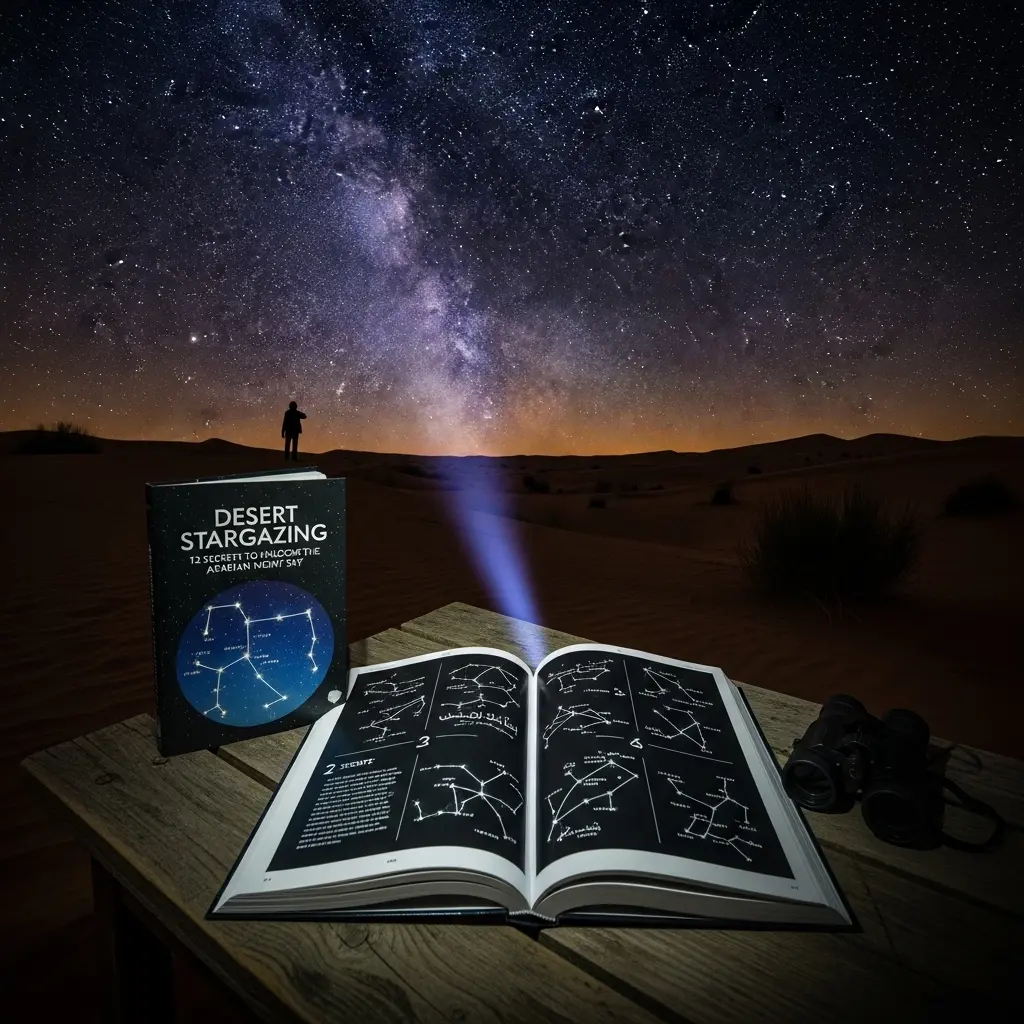
Desert Stargazing: The Unrivaled Beauty of the Arabian Night Sky
The modern marvel of Dubai dazzles under millions of city lights. Yet, true brilliance lies just beyond the urban glow.
The Desert Stargazing experience offers a profound connection to the cosmos.
This vast, unpolluted landscape provides the perfect canvas for viewing the Arabian Night Sky.
It is an essential activity for anyone booking a Desert Safari Stargazing package.
This comprehensive guide reveals why Stargazing in the Desert is superior and how to make the most of your celestial journey.
1. The Core Advantage: Why Desert Stargazing Wins
The reason Desert Stargazing is so spectacular is simple physics: the absence of light pollution.
Escaping City Light Pollution
City lights scatter into the atmosphere, creating a dome of orange glow that obscures all but the brightest stars.
The Arabian Desert is one of the world’s best remaining dark-sky areas.
This isolation allows for an unobstructed view of the Desert Night Sky.
The Low Humidity Factor
The arid climate of the UAE also contributes to the clarity of the Arabian Night Sky.
Low humidity means fewer particles in the air to scatter starlight.
The resulting view is crisp, sharp, and intensely defined, perfect for Night Photography Desert.
2. Choosing the Best Stargazing UAE Experience
Not all desert safaris are created equal when it comes to observing the sky.
Desert Safari Stargazing Packages
Look for specialized Desert Safari Stargazing or overnight safari packages.
These packages are intentionally timed to conclude after the camp lights are dimmed or turned off.
This ensures maximum visibility for the Best Stargazing UAE.
Dedicated Desert Astronomy Tours
The most detailed experience comes from dedicated Desert Astronomy tours.
These are often led by experts or professional astronomers.
They provide high-powered telescopes and specialized guidance on constellations.
The Role of Overnight Safaris
An overnight Dubai Desert Tour provides the longest and best opportunity for Desert Stargazing.
Once all the crowds leave, the silence and darkness are absolute, creating the perfect viewing environment.
3. Essential Gear for Desert Stargazing
While the naked eye provides an incredible view, a few tools will enhance your Stargazing in the Desert experience.
Red Light Torch
White light ruins your night vision, which takes up to 30 minutes to fully adapt.
A red light torch is a mandatory tool for Desert Stargazing. It allows you to see without compromising your eye’s dark adaptation.
Use a red light torch to consult star charts or guide your path.
Binoculars
Even simple binoculars will dramatically enhance your view of star clusters and the Moon.
They are a cost-effective alternative to a full telescope for Desert Night Sky viewing.
This is a simple yet effective Desert Photo Tip.
Star Chart Apps
Modern smartphone apps (used with a red light filter) can quickly identify constellations and celestial bodies.
These tools instantly enrich your Desert Astronomy knowledge.
4. The Celestial Beauty of the Arabian Night Sky
The Arabian Night Sky holds unique significance due to its historical importance for navigation and storytelling.
The Milky Way
The core attraction of Desert Stargazing is often the Milky Way—our own galaxy viewed edge-on.
In truly dark skies, the Milky Way appears as a stunning, hazy river of light.
This spectacle is rarely visible from populated areas.
Identifying Constellations
Learn to identify the Big Dipper, the Little Dipper, and the prominent constellation of Orion.
The desert sky allows you to see many more stars, making these familiar shapes even more pronounced.
This cultural and scientific view defines the Best Stargazing UAE.
5. Night Photography Desert: Capturing the Cosmos
Capturing the Desert Night Sky requires patience and specific technical knowledge.
Camera Settings for Night Photography Desert
Use a manual mode on your DSLR or mirrorless camera. Night Photography Desert requires specific settings.
-
Aperture: As wide as possible (f/2.8 or f/4) to gather maximum light.
-
Shutter Speed: Use a long exposure (15 to 30 seconds).
-
ISO: High sensitivity (ISO 1600 to 6400) to brighten the dark sky.
Essential Equipment
A sturdy tripod is mandatory for long exposures. Any movement will result in blurry stars.
Use a remote shutter release or a self-timer to avoid shaking the camera when pressing the button.
This ensures sharp Desert Stargazing astrophotography.
6. Historical and Cultural Significance of Desert Astronomy
Desert Astronomy is deeply rooted in the history of the Arabian Peninsula.
Navigation for Nomads
The stars were the ancient map for the Bedouin tribes. They used celestial bodies to navigate the vast, featureless desert at night.
Learning the constellations was essential for survival and trade routes.
This history adds context to your Stargazing in the Desert experience.
Storytelling and Folklore
Many constellations and prominent stars have unique Arabic names and local folklore associated with them.
A good guide or astronomer will share these stories, enriching your view of the Arabian Night Sky.
This cultural layer is a unique part of the Desert Night Sky experience.
7. Choosing Your Best Stargazing UAE Location
While most deserts are dark, some locations are better suited for Best Stargazing UAE tours.
Conservation Reserves
Areas within or adjacent to conservation reserves often have strict rules against vehicle lights after dark.
This minimizes any stray light interference.
The serene environment of these locations enhances the overall Desert Safari Stargazing experience.
High Dunes
Finding a location on top of a high dune offers a better horizon view, reducing atmospheric distortion.
It also provides an elevated, clear line of sight for capturing the entire Arabian Night Sky.
8. Desert Safari Stargazing: A Complete Experience
Desert Safari Stargazing combines adventure, culture, and science into one memorable night.
The excitement of dune bashing is followed by the peace of the Desert Stargazing.
The contrast between the day’s high-energy activities and the quiet reverence of the night is profound.
This balance defines a high-quality Dubai Desert Tour.
9. Safety and Comfort for Desert Stargazing
While focusing on the stars, safety and comfort must not be overlooked during Stargazing in the Desert.
Staying Warm
The desert cools dramatically after sunset. Always bring warm layers, even if the day was hot.
Blankets or sleeping bags are often provided during Desert Safari Stargazing tours.
Staying warm ensures you can fully enjoy the Desert Night Sky without distraction.
Navigation Safety
Stick close to your group and guide. The desert is disorienting in absolute darkness.
Never wander away from the designated viewing area during your Desert Astronomy session.
10. Best Desert Photoshoot Ideas for the Night Sky
For those with astrophotography gear, the Desert Stargazing offers unparalleled Night Photography Desert opportunities.
Star Trails
Use an extremely long exposure (30 minutes or more) or stack multiple short exposures to capture star trails.
This shows the Earth’s rotation, turning the stars into beautiful arcs of light.
A sturdy tripod is mandatory for this advanced Night Photography Desert technique.
Milky Way Shots
Align your camera towards the brightest part of the Milky Way core (seasonal).
Use the 500 Rule (divide 500 by your lens focal length) to determine the maximum shutter speed to avoid star blurring.
This ensures you capture the stunning detail of the Arabian Night Sky.
11. Customizing Your Dubai Desert Tour for Stargazing
For a truly specialized experience, look for operators who prioritize the celestial view.
Some Dubai Desert Tour companies partner with local astronomy experts.
These bespoke tours provide access to scientific-grade telescopes and guided commentary.
For luxury, personalized astronomy trips, consult https://royaldesertadventures.ae/.
12. Utilizing External Resources for Desert Astronomy Forecasts
Planning your Desert Stargazing trip is aided by external resources.
Checking the lunar cycle is crucial; the dark nights around the New Moon offer the best views.
External platforms like https://dubaidesertsafarie.com/ often provide seasonal advice on Best Stargazing UAE conditions.
Checking the weather forecast for cloud cover is another simple step.
13. The Profound Silence of Stargazing in the Desert
The stillness of the desert at night amplifies the sensory experience of Stargazing in the Desert.
The silence allows for deep contemplation of the cosmos.
This profound peace is a key reason why many seek out the Desert Night Sky.
It provides a spiritual and mental escape from the busy city.
14. Desert Stargazing and the Aurora Borealis (A Note)
While the Desert Stargazing offers incredible views, the Aurora Borealis (Northern Lights) is not visible from the UAE.
The UAE is too close to the equator for this phenomenon.
The beauty of the southern celestial hemisphere, however, is on full display during the Desert Night Sky view.
15. The Impact of Desert Astronomy on Modern Science
The ancient traditions of Desert Astronomy laid the groundwork for modern science.
Arab scholars meticulously mapped the stars, many of which still bear their Arabic names.
This history highlights the intellectual heritage of the Best Stargazing UAE region.
16. Desert Safari Stargazing: Tips for Children
Desert Safari Stargazing is an educational and inspiring activity for children.
Use binoculars to help them focus on the Moon and brighter planets.
Tell them the stories of the constellations.
Allow them to use the red light torch, giving them a sense of active participation in the Dubai Stargazing.
17. The Visual Contrast: Dubai Stargazing vs. City View
The visual contrast between a city view of the sky and true Desert Stargazing is shocking.
From the city, you see dozens of stars; from the desert, you see thousands.
This contrast underscores the damage done by light pollution and the immense opportunity of the Desert Night Sky.
This clarity makes the Stargazing in the Desert experience unforgettable.
18. Ensuring the Best Stargazing UAE Trip During Peak Season
During peak tourist season, booking your Best Stargazing UAE trip well in advance is crucial.
The best overnight safaris and specialized Desert Astronomy tours fill up quickly.
Consulting reliable booking platforms like https://hafiztourism.com/ early ensures you secure your spot.
Planning ahead guarantees access to the darkest skies.
19. Photography Tip: Including Foreground Elements for Night Photography Desert
To add depth to your Night Photography Desert shots, include a recognizable foreground element.
This could be a silhouette of a person, a camel, or the outline of a tent.
This grounding element shows the scale of the Desert Night Sky against the Earth.
Use a long exposure and ‘paint’ the foreground with your red light torch for a subtle glow.
20. The Desert Stargazing Community and Guides
Many Desert Stargazing guides are passionate amateur astronomers.
They often bring their own equipment and expertise to share with guests.
Their enthusiasm for the Arabian Night Sky is infectious and enhances the entire Desert Astronomy session.
21. Utilizing External Links for Booking and Advice
Booking through reputable external links provides assurance for your Desert Safari Stargazing trip.
Check platforms for guides who specialize in the night sky.
Desert Stargazing requires a commitment to dark skies, so verify the operator’s dedication to a remote location.
22. Desert Stargazing: A Profound, Low-Impact Adventure
Desert Stargazing is a beautiful, low-impact adventure.
It is peaceful, educational, and leaves virtually no environmental footprint.
This makes it an ideal activity for eco-conscious travelers seeking a profound Dubai Desert Tour.
The memory you take home is entirely intangible and profound.
23. The Future of Dubai Stargazing
As light pollution increases globally, the value of true dark skies rises.
The future of Dubai Stargazing may involve greater governmental protection for dark sky reserves.
This effort would ensure that the magic of the Arabian Night Sky remains accessible for generations.
24. Final Thoughts on Your Desert Stargazing Journey
The Desert Stargazing experience is a powerful reminder of our place in the universe. It is an essential component of any complete Dubai Desert Tour. Embrace the cold, welcome the dark, and let the magnificent Arabian Night Sky tell you its ancient stories.
Frequently Asked Questions (FAQs) – Long Answers
1. Why is Desert Stargazing significantly better than attempting to view the night sky from within a city like Dubai?
Desert Stargazing is significantly better than viewing the night sky from a city like Dubai primarily because of the extreme difference in light pollution. Dubai’s massive urban light emissions create a bright dome of light that scatters into the atmosphere, completely obscuring all but the brightest stars and planets. This is known as the Bortle scale light pollution level 8 or 9. Conversely, the secluded desert areas outside the city fall into the Bortle scale 2 or 3 (dark skies), where there is minimal artificial light. This allows the naked eye to see thousands of stars, including the faint, cloudy band of the Milky Way, making the entire Stargazing in the Desert experience profoundly superior and unforgettable.
2. What specific equipment (telescope, binoculars, apps) are recommended for beginners to enhance their Desert Night Sky viewing experience?
For beginners looking to enhance their Desert Night Sky viewing experience without investing in an expensive, complex telescope, a few items are highly recommended. A good pair of binoculars (7×50 or 10×50) are the best starting point; they gather significantly more light than the naked eye and can reveal star clusters and surface details on the Moon. A simple red light torch is essential to prevent eye dark adaptation from being ruined. Finally, using a star chart application on a smartphone (with the screen set to red light mode) can quickly help identify constellations and track celestial movements during the Desert Astronomy session.
3. Does the phase of the Moon affect the quality of Desert Stargazing, and when is the best time to book for optimal viewing?
Yes, the phase of the Moon critically affects the quality of Desert Stargazing. For optimal viewing of faint deep-sky objects, particularly the Milky Way, the Best Stargazing UAE occurs during the New Moon phase. During a New Moon, the sky is at its darkest, maximizing the contrast and visibility of fainter stars and nebulae. Conversely, a Full Moon, while beautiful for viewing itself, is so bright that it acts as a significant form of light pollution, washing out fainter celestial bodies. Travelers should check the lunar calendar and aim to book their Desert Safari Stargazing package close to the New Moon date.
4. How should visitors prepare for the significant temperature drop in the desert at night to ensure comfort during their Desert Night Sky observation?
Visitors must prepare for the significant temperature drop in the desert at night to ensure comfort during their Desert Night Sky observation. The arid environment loses heat rapidly after sunset, and even if the day was hot, the night can be surprisingly cold, especially in winter. Preparation should include bringing multiple warm layers: a thick jacket, a scarf, a hat, and long trousers are essential. Many operators on a Dubai Desert Tour will provide thick blankets or even sleeping bags during the viewing session, but bringing your own warm clothing is the most reliable Desert Stargazing safety tip.
5. What specialized camera settings are required for Night Photography Desert to successfully capture star trails or the Milky Way?
Successfully capturing the Night Photography Desert requires specific manual camera settings for long exposures. For the Milky Way or static star fields, use a wide-angle lens with the aperture set as wide as possible (e.g., f/2.8). The ISO should be high (ISO 3200 to 6400). The shutter speed should be set between 15 and 30 seconds (using the 500 Rule to avoid star trailing). For Star Trails, the exposure must be much longer, often 30 minutes or more (or achieved by stacking multiple 30-second exposures in software). A sturdy tripod and remote shutter release are absolutely mandatory for any Night Photography Desert technique.
6. How do operators of Desert Safari Stargazing packages ensure that camp lights do not interfere with the viewing experience for guests?
Operators of high-quality Desert Safari Stargazing packages take active measures to ensure camp lights do not interfere with the viewing experience. This is achieved by: 1. Choosing remote locations far from city glow; 2. Turning off all non-essential lights at the camp during the dedicated viewing time; 3. Using low-intensity, downward-facing lights or strategically placed red lighting in necessary areas (like pathways and washrooms); and 4. Escorting guests to a completely dark, designated viewing area outside the camp’s immediate perimeter for optimal Desert Night Sky visibility.
7. What historical significance does the Arabian Night Sky hold for the Bedouin culture, and how is this shared during a Desert Astronomy session?
The Arabian Night Sky holds immense historical significance for the Bedouin culture, having served as the essential map and clock for nomadic life. Stars were used to navigate the vast, featureless desert, determine seasonal changes, and calculate prayer times. During a Desert Astronomy session, a skilled guide or astronomer shares this heritage by relating the Arabic names of prominent stars (many of which are still used globally) and telling the ancient folklore and stories associated with the constellations. This blending of science and oral tradition enriches the visitor’s Desert Stargazing experience far beyond simple viewing.
8. What types of specialized Desert Stargazing tours or equipment are offered by luxury providers like https://royaldesertadventures.ae/?
Luxury providers like https://royaldesertadventures.ae/ offer highly specialized Desert Stargazing tours that include premium equipment and services. These may feature: High-Powered, Scientific-Grade Telescopes managed by a professional astronomer; Private, Secluded Viewing Platforms set up on the dunes; Personalized Guided Commentary on celestial mechanics and mythology; and Luxury Amenities such as comfortable star beds, gourmet refreshments, and warm, custom blankets. These bespoke tours guarantee the best possible conditions and expert knowledge for viewing the Arabian Night Sky.
9. Besides low light pollution, what other natural factors in the UAE desert contribute to its status as a Best Stargazing UAE location?
Besides low light pollution, the UAE desert’s status as a Best Stargazing UAE location is boosted by its low humidity and high number of clear nights. The arid climate means there is less moisture and fewer atmospheric particles in the air to scatter starlight, resulting in sharper, clearer images (better “seeing”). Additionally, the UAE experiences a high number of cloudless nights year-round compared to more temperate regions, offering more reliable conditions for Stargazing in the Desert.
10. How can a family with young children best approach a Desert Safari Stargazing trip to keep the children engaged and comfortable?
A family with young children should approach a Desert Safari Stargazing trip by prioritizing comfort and engagement. Comfort: Dress the children in extra warm layers and bring comfortable blankets, as kids often get cold quickly when sitting still. Engagement: Keep the viewing short and focused; use binoculars to see the Moon’s surface, which is visually exciting for them. Tell them the simple stories of the most recognizable constellations (like Orion) and allow them to use the red light torch under supervision, giving them a sense of purpose during the Desert Stargazing session.
11. What is the distinction between a Desert Astronomy session led by a guide and one led by a professional astronomer?
The distinction lies in the depth of knowledge and equipment. A Desert Astronomy session led by a safari guide is usually a basic, fun introduction to the visible constellations, often using laser pointers for identification. A session led by a professional astronomer (common in bespoke or specialized Best Stargazing UAE tours) involves a deeper scientific understanding, includes the use of high-powered, often computerized telescopes, and provides detailed commentary on astrophysics, planetary science, and cosmology, transforming the experience from simple identification to genuine scientific learning.
12. Are there any specific cultural etiquette tips tourists should follow while observing the Arabian Night Sky at a Bedouin camp?
Yes, while observing the Arabian Night Sky at a Bedouin camp, tourists should follow simple cultural etiquette. Maintain a respectful, quiet demeanor during the viewing time, avoiding loud talking that might disturb the peace and contemplation of others. If a demonstration or storytelling session is underway, give the speaker your full attention. Most importantly, avoid using bright white light from phones or torches, as this is disruptive and disrespectful to others whose eyes are dark-adapted for Desert Stargazing.
13. What is the “Milky Way season” and how does it influence the optimal time for Desert Stargazing in the UAE?
The term “Milky Way season” refers to the time of year when the Milky Way core (the brightest, most spectacular part of our galaxy) is most prominently visible and high in the night sky. In the UAE, the core is best visible during the summer months (roughly March to October), especially in the late evening/early morning hours. While the winter sky still offers amazing Desert Stargazing (seeing clear constellations), photographers and enthusiasts aiming to capture the most brilliant view of the galactic core should plan their Night Photography Desert trip during the summer season, close to the New Moon.
14. How can I verify that a general booking site like https://dubaidesertsafarie.com/ offers reliable Desert Safari Stargazing packages?
You can verify that a general booking site like https://dubaidesertsafarie.com/ offers reliable Desert Safari Stargazing packages by cross-referencing their package details. Look for specific mention of a “dedicated viewing time” after the camp entertainment ends, confirmation of “lights out” policies, and a location that is significantly far from the main city. Read customer reviews that specifically mention the clarity of the stars. Reliability is key; a site must partner with operators who commit to remote, dark desert locations for the Desert Stargazing activity.
15. What are the best tips for maintaining the cleanliness of specialized Night Photography Desert equipment from the ever-present sand?
Maintaining the cleanliness of specialized Night Photography Desert equipment from the fine sand is crucial. The best tips are: 1. Never change lenses in the open desert. Do it inside a tent or vehicle. 2. Use a dedicated air blower (not compressed air) to gently remove surface sand from the camera body before putting it away. 3. Keep all equipment in sealed, padded bags when not in use. 4. Use protective filters on your lenses to shield the front element from scratches. This meticulous care ensures your gear remains operational for multiple Night Photography Desert sessions.