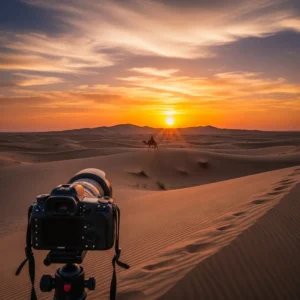
Desert Drive: 11 Pro Secrets for Jaw-Dropping Dune Bashing Action Shots
The dune bashing experience is the heart-pounding centerpiece of a Dubai desert safari. It’s a chaotic ballet of powerful 4x4s carving impossible paths over towering mountains of sand. The adrenaline the thrill and the spectacular sight of vehicles defying gravity are moments you’ll want to remember forever. Yet for most photographers this high-octane adventure translates into a frustrating collection of blurry unfocused and uninspired images. The challenge is immense but the rewards for getting it right are unparalleled dune bashing action shots.
This guide is your roadmap to conquering the chaos. We are going to move beyond simple “point and shoot” and dive deep into the specific techniques professional photographers use to freeze fast-paced action in its tracks. From preparing your gear before the ride begins to mastering the critical camera settings and compositional tricks this is your blueprint for creating sharp dynamic and spectacular dune bashing action shots. Prepare to transform your safari photos from a blurry memory into a gallery of jaw-dropping moments.
The Foundation: Pre-Safari Gear and Preparation
Success in action photography begins with preparation. What you do before the 4×4’s engine even starts can make or break your photos.
Choosing Your Weapon: The Right Camera and Lens
While any camera can take a picture some are far better suited for this specific challenge.
- DSLR/Mirrorless: These are your best options due to their fast autofocus systems high burst rates and manual controls.
- Action Camera (GoPro): A fantastic choice for video and wide-angle stills. Its key advantages are its incredible stabilization and durability.
- Smartphone: Modern smartphones with good “burst” modes can work but they lack the fast tracking autofocus of dedicated cameras.
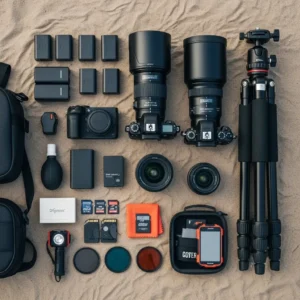
For your lens a versatile standard zoom (like a 24-70mm or 24-105mm) is ideal. The single most important rule of gear preparation is this: do not attempt to change lenses during the dune bashing ride. The combination of violent motion and airborne sand is a recipe for disaster for your camera’s sensor. Pick one lens and stick with it.
Essential In-Car Accessories
A few small items can make a huge difference. A secure camera strap worn around your neck or wrist at all times is non-negotiable. A microfiber lens cloth should be in your pocket to quickly wipe away any sand that gets on your lens. A circular polarizing filter can also be a secret weapon helping to reduce the intense glare and reflections from the vehicle’s windows.
The Safety Briefing: Protecting Yourself and Your Gear
Dune bashing is an intense physical experience. You will be bounced around significantly. Always wear your seatbelt. To get stable shots brace your elbows against your body or the seat. Securely wrap the camera strap around your wrist so that even if you lose your grip your camera won’t go flying. This is not just about getting great dune bashing action shots; it’s about basic safety.
The Technical Blueprint: Mastering Your Camera Settings
This is where the magic happens. The right camera settings are the difference between a blurry mess and a crystal-clear action shot.
The Need for Speed: Shutter Speed is King
To freeze the motion of a vehicle moving at high speed you need a very fast shutter speed. This is the single most important setting for capturing incredible dune bashing action shots. A slow shutter speed will result in motion blur.
Set your camera’s mode dial to Shutter Priority (S or Tv). In this mode you choose the shutter speed and the camera automatically selects the appropriate aperture. A great starting point is 1/1000th of a second. For extremely fast passes or to freeze the individual grains of sand being kicked up push it even higher to 1/2000s or beyond.
Autofocus Mastery: Tracking the Action
Your subject is moving erratically so you need an autofocus system that can keep up. Single shot autofocus (AF-S) will not work.
You must switch your camera to Continuous Autofocus (AF-C for Nikon/Sony or AI Servo for Canon). In this mode the camera will constantly readjust focus on a moving subject as long as you keep the shutter button half-pressed. Combine this with a “Zone AF” or “Dynamic Area AF” setting which uses a cluster of focus points to make it easier to keep the focus locked on the vehicle.
Burst Mode: Your Secret Weapon
The peak moment of action—a vehicle cresting a dune with all four wheels in the air—lasts for a fraction of a second. Trying to capture it with a single click is a matter of pure luck.
Increase your odds dramatically by setting your camera’s drive mode to its fastest “Continuous High” or “Burst” setting. When the action happens hold down the shutter button to fire off a rapid succession of shots. This gives you a sequence of images to choose from ensuring you have captured the most dramatic split-second. This is a vital technique for amazing dune bashing action shots.
ISO: The Brightness Lever
In Shutter Priority mode your camera controls the aperture. But what happens if the light changes? To maintain your fast shutter speed the camera needs a third variable to adjust brightness: ISO.
Set your ISO to “Auto”. This allows the camera to automatically increase or decrease the sensor’s sensitivity to light as needed. To prevent your images from getting too grainy go into your camera’s menu and set a maximum limit for the Auto ISO such as ISO 3200 or 6400.
The Art of Composition: Framing from Inside the Vehicle
Capturing the experience from a passenger’s perspective can create incredibly immersive and relatable photos.
The Driver’s Perspective Shot
One of the most effective ways to show the action is to frame the shot from behind the driver. Get a composition that includes a partial view of the driver’s hands on the steering wheel the dashboard and the vast expanse of desert visible through the windscreen. This tells a story and places the viewer right in the middle of the thrilling experience.
The Passenger’s Reaction Shot
Don’t forget the human element. The pure unfiltered expressions of joy excitement and terror on the faces of your fellow passengers are a fantastic subject. These shots capture the emotion of the ride making for compelling and memorable dune bashing action shots.
The “Through the Window” Shot
Shooting through the side window can be tricky due to reflections but it’s often the best view of the action. To minimize reflections get your lens as close to the clean glass as possible. A circular polarizing filter can significantly help cut down on glare. Frame your shot to show the spray of sand being kicked up by the wheels.
The Interior Detail Shot
Sometimes the most interesting shots are in the small details. Capture a photo of a passenger’s hands gripping the roll cage a close-up of the sandy speedometer or the dramatic view of the convoy in the rearview mirror. These shots add texture and a cinematic quality to your photo story. A tour with a provider like https://royaldesertadventures.ae/ ensures you’re in a modern well-maintained vehicle worth capturing.
The Hero Shot: Capturing Other Vehicles from a Vantage Point
The most spectacular dune bashing action shots are often taken from outside the vehicle capturing another 4×4 in your convoy against the epic landscape.
Communicating with Your Driver
This requires a photo stop. Don’t be afraid to communicate with your safari marshal. On a quality tour they are often happy to stop for a few minutes at a scenic high point to allow guests to take photos. This is your golden opportunity.
The “Sand Plume” Shot
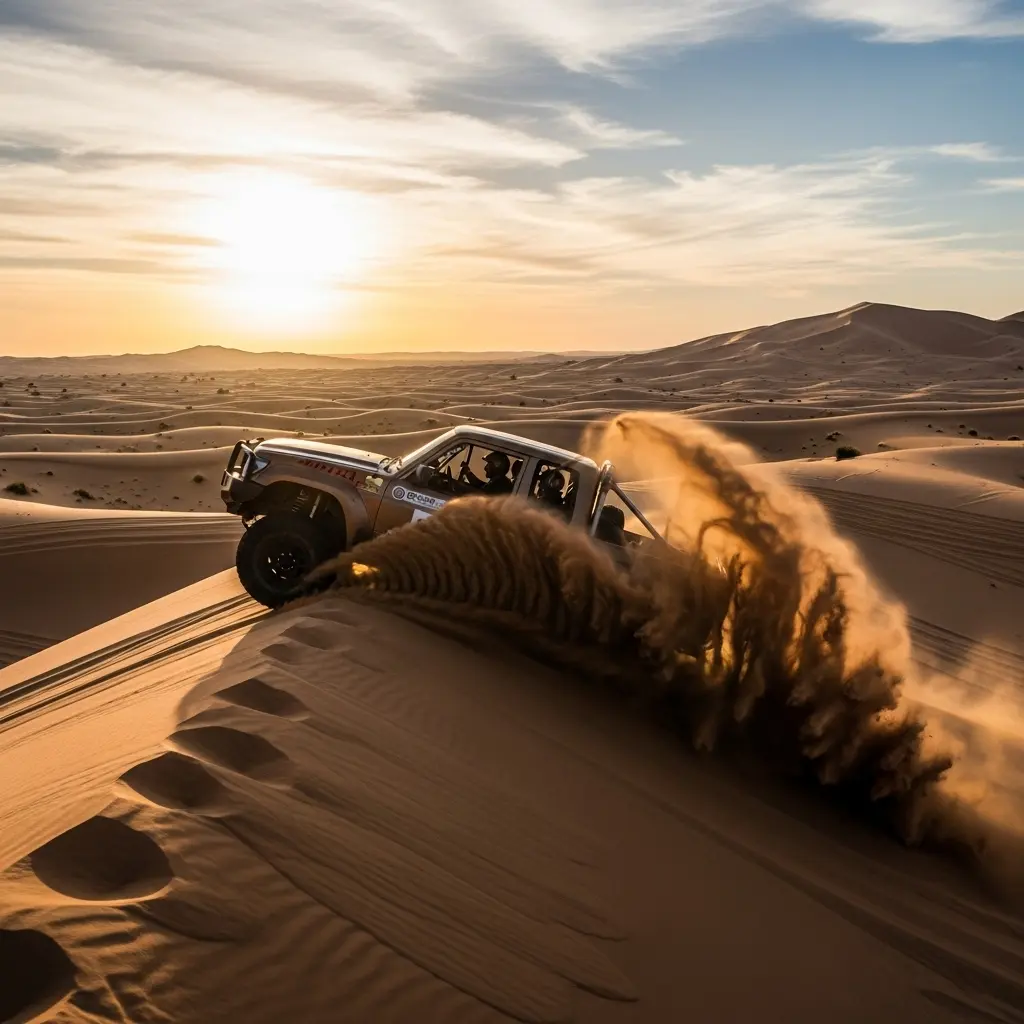
This is the money shot. From your high vantage point have your driver coordinate with another vehicle to perform a sweeping turn or scale a dune below you. As the 4×4 carves through the sand it will kick up a massive plume of golden dust. Time your burst of shots to capture the vehicle framed by this spectacular spray of sand backlit by the setting sun.
The Panning Technique: Conveying Motion
To create a photo that screams “speed” you can use a technique called panning. This involves intentionally using a slower shutter speed to create motion blur in the background while keeping the vehicle sharp.
- Set your camera to Shutter Priority and choose a slower speed like 1/60s or 1/80s.
- Stand with your feet planted and track the moving vehicle smoothly with your camera turning your upper body.
- As you pan press and hold the shutter button firing a burst of shots.
- Crucially continue your smooth panning motion even after you’ve taken the pictures.
The result is a dynamic shot where the 4×4 is sharp and the desert background is a beautiful artistic blur.
Smartphone and Action Cam Strategies
Maximizing Your Smartphone
Use your phone’s Burst Mode by holding down the shutter button. Before the ride starts tap and hold on the screen to lock the focus and exposure to prevent the camera from getting confused by the fast motion. Use the telephoto lens if you have one to compress the perspective when shooting other cars.
The GoPro Advantage
A GoPro is born for this. Its “HyperSmooth” stabilization is phenomenal creating incredibly smooth video even during the most violent bumps. Its wide field of view is perfect for capturing the entire interior of the car. Use a suction cup mount on a window or a head strap for a truly immersive point-of-view shot. The quality of GoPro footage can make for some incredible dune bashing action shots.
Capturing the raw energy of dune bashing is a rewarding challenge. It pushes you to think fast and react instinctively. By mastering the technical settings and keeping a creative eye open for unique compositions you can ensure your photos do justice to this unforgettable desert adventure. Great experiences from operators like https://dubaidesertsafarie.com/ and https://hafiztourism.com/ are the perfect canvas for your photography practice.
Frequently Asked Questions (FAQs)
1. What is the absolute minimum shutter speed for sharp dune bashing photos?
While 1/1000s is recommended as a great starting point the absolute minimum to avoid significant motion blur of the vehicle itself would be around 1/500s. Anything slower than that and you will start to see the vehicle becoming soft unless you are intentionally panning.
2. How do I avoid reflections when shooting through the car window?
There are three key techniques. First get your lens as physically close to the glass as possible. Second wear dark clothing as a white shirt will create a bright reflection. Third and most effectively use a Circular Polarizing (CPL) filter on your lens. Rotating the filter will dramatically cut down on glare and reflections from the window.
3. Is a gimbal useful for dune bashing videography?
A gimbal is excellent for smoothing out gentle movements like walking but it will struggle to cope with the violent and erratic jolts of dune bashing. For video an action camera like a GoPro with its advanced electronic stabilization (HyperSmooth) will produce much smoother and more watchable footage than a smartphone on a gimbal.
4. My photos are sharp but they look very grainy or “noisy.” What’s wrong?
This is caused by your ISO being too high. When you use a very fast shutter speed in Shutter Priority mode your camera has to increase the ISO to get a proper exposure. If the light is low the ISO can get pushed very high creating noise. The solution is to open up your aperture as wide as possible (by switching to Manual mode) or to accept that in lower light some noise is an acceptable trade-off for a sharp shot.
5. How can I get that cool shot of the sand frozen in mid-air?
This shot is all about shutter speed. To freeze the individual grains of sand being sprayed by the tires you need an extremely fast shutter speed. You should be in the range of 1/2000s to 1/4000s. This will require bright sunlight but it will render the sand plume as a crystal-clear explosion of texture.
6. Is it safe to change my camera lens during the dune bashing part of the safari?
No absolutely not. It is extremely unsafe for your gear. The combination of intense vehicle motion and the high likelihood of fine sand and dust in the air means you are almost guaranteed to get dust on your camera’s sensitive sensor which is difficult and expensive to clean. Choose one versatile lens and stick with it for the entire ride.
7. Which seat in the 4×4 is best for photography?
The front passenger seat generally offers the best and most unobstructed view through the front windscreen and side window. The middle row seats can also be good especially for capturing reactions of other passengers. The rearmost seats are typically the bumpiest and have the most restricted views.
8. How do I focus properly when there’s so much happening so fast?
This is where you have to trust your camera’s technology. Don’t use a single focus point. Switch to a wider focus area like “Zone AF” or “Wide/Tracking.” This gives the camera a larger area to work with. Keep that area on the target vehicle and let the Continuous Autofocus (AF-C/AI Servo) do the hard work of tracking it for you while you concentrate on composition.
9. My camera keeps trying to focus on the window instead of the scene outside. How do I fix this?
This is a common frustration. Getting the lens very close to the glass helps. If it persists you may need to temporarily switch to manual focus. Focus on a distant dune lock the focus and then shoot away. As long as you are shooting distant subjects they will remain in focus.
10. What is “panning” and is it difficult to learn?
Panning is the technique of using a slower shutter speed and moving your camera to track a subject creating a sharp subject against a blurred background. It takes practice but is not difficult to learn. The key is smooth motion. Swing your entire upper body not just your arms and follow through with the motion even after the picture is taken. A high vantage point during a photo stop is the perfect place to practice this.
11. Can I get good dune bashing action shots with just a smartphone?
Yes you can get good shots but you need to use the right techniques. Use the burst mode to capture the peak action. Manually tap and hold on a distant dune before the ride starts to lock the focus and exposure. If your phone has a “Pro” mode take manual control of the shutter speed and set it as high as possible.
12. Does the color of the 4×4 vehicle matter for photos?
Yes it can make a big difference. A white or silver vehicle provides a beautiful bright contrast against the golden sand and blue sky making it pop in your photos. A black or dark-colored vehicle can look very sleek and powerful but can sometimes get lost in the shadows of the dunes.
13. How do I capture the sense of steepness when a 4×4 climbs a dune?
To emphasize steepness use a low angle. If you are at a photo stop position yourself at the bottom of a dune and shoot upwards as the vehicle makes its ascent. This perspective exaggerates the incline and makes the climb look far more dramatic and impressive.
14. My camera’s battery drained really quickly during the ride. Why?
Using high-speed burst mode and continuous autofocus are very power-intensive operations. The camera’s processor and lens motors are working constantly which drains the battery much faster than taking single landscape shots. This is why bringing a fully charged spare battery is absolutely essential.
15. What is the best time of day for dune bashing photography?
The late afternoon leading into the golden hour is the best. The low-angle sunlight creates long shadows that define the shape of the dunes. The warm golden light also makes the sand glow and beautifully illuminates the plumes of dust kicked up by the vehicles creating a magical almost cinematic effect for your dune bashing action shots.
16. How do I compose a shot when I can’t control where the car is going?
You have to anticipate and react. Instead of trying to create a perfect static composition look for fleeting moments. Frame a shot through the window and wait for another car to appear. Anticipate a turn and be ready to capture the sand spray. It’s less about controlling the scene and more about capturing the best moments within the chaos.
17. What’s a good way to show the entire convoy of vehicles?
From a high vantage point during a photo stop use a wide-angle lens. Try to frame the shot so the line of 4x4s creates a sweeping “S” curve through the dunes. This is a classic compositional technique that is very pleasing to the eye and gives a great sense of an epic journey.
18. My photos look a bit flat and hazy. How can I fix this in editing?
A quick editing fix can dramatically improve your dune bashing action shots. In an editing app like Lightroom or Snapseed try increasing the “Dehaze” slider which is designed to cut through atmospheric haze and boost contrast. Also slightly increasing the “Clarity” or “Texture” slider can help make the details in the sand pop.
19. Is it better to shoot stills or video for dune bashing?
Both are great! Video perfectly captures the motion sound and energy of the ride. Stills allow you to freeze a perfect split-second moment in time. The best approach is to do both. Use an action camera for video and your main camera for capturing high-quality stills.
20. What is the single most important tip for a beginner trying to capture dune bashing action shots?
The single most important tip is to prioritize shutter speed above everything else. All other settings and compositional rules are secondary. If your shutter speed is too slow your photos will be blurry and unusable. Set it to 1/1000s or faster and you have already won half the battle.