
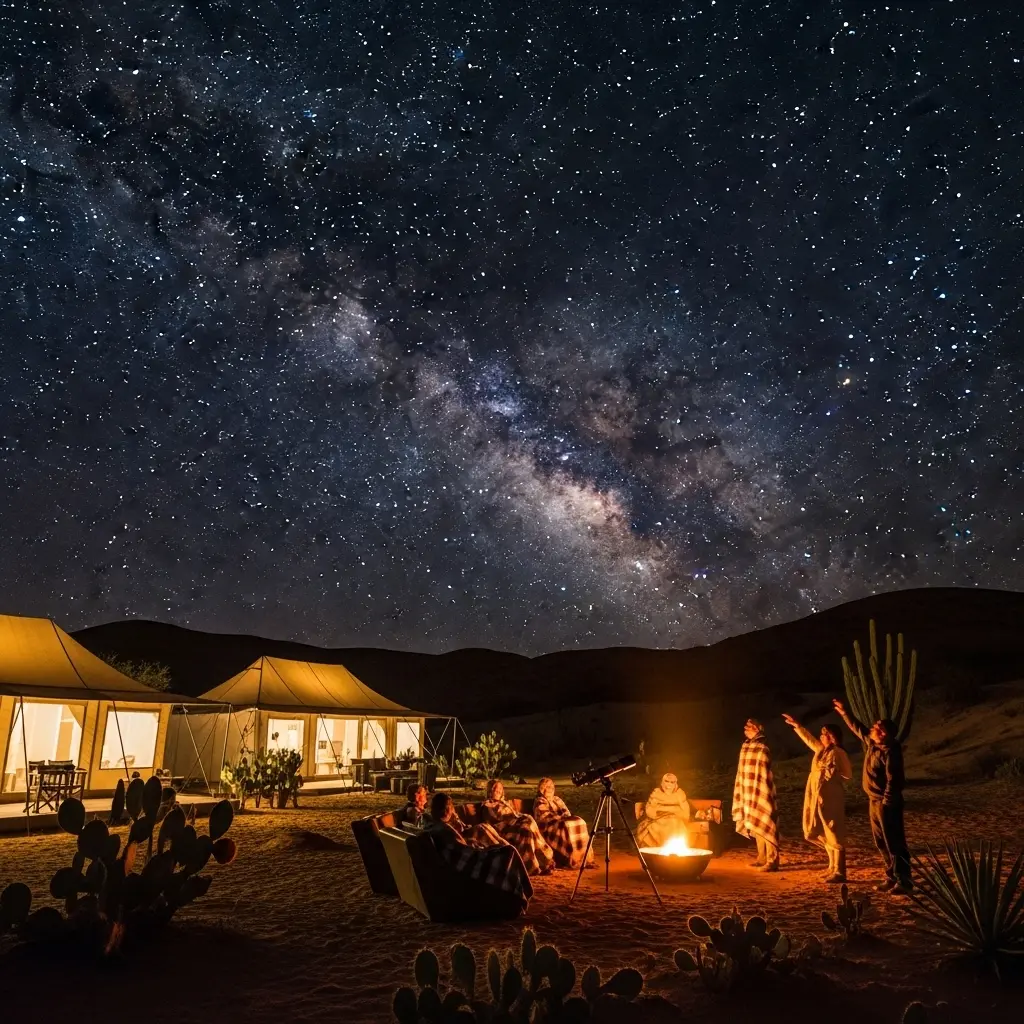
A Journey into the Cosmos: Stargazing in the Desert – A Magical Safari Experience
In the heart of the Arabian Peninsula, far from the glittering glow of the city, an ancient and breathtaking spectacle unfolds every single night. This is your ultimate guide to Stargazing in the Desert, a deep dive into the magical and profoundly moving safari experience that connects you with the vast, silent beauty of the cosmos.
This in-depth exploration will take you on a journey beyond the standard desert tour and into the heart of a true celestial adventure. We will discover why the Arabian desert is one of the best places on Earth for astronomy, what incredible wonders you can see with your own eyes, and what a powerful telescope will reveal. This is a comprehensive look at Stargazing in the Desert, designed to help you plan the perfect, awe-inspiring adventure for 2025.
We will delve into the different types of stargazing tours available, from dedicated astronomy sessions to immersive overnight safaris. We will also provide you with all the essential insider tips, from the best time of year to visit to the apps you need on your phone.
Prepare to be captivated by one of the most serene, beautiful, and unforgettable journeys you can take. This guide to Stargazing in the Desert is your key to unlocking a world of cosmic wonder and creating a memory that is, quite literally, out of this world.
The Perfect Celestial Theater: Why the Arabian Desert is a Stargazer’s Paradise
To have a truly magical experience of Stargazing in the Desert, the location is everything. The Arabian desert, especially on a dedicated safari, offers a perfect and powerful combination of environmental factors that make it a world-class destination for astronomy.
The Battle Against Light Pollution: The Magic of Dark Skies
The single biggest enemy of stargazing is light pollution. The bright, ambient light from our cities creates a “sky glow” that washes out the faint, beautiful light of the stars and the Milky Way.
A desert safari is the perfect antidote. It takes you far away from the city, deep into the heart of the desert where the light pollution is minimal. It is only in these truly dark skies that the night reveals its full, breathtaking majesty, with thousands of stars becoming visible to the naked eye.
The Advantage of Dry, Clear Air: A Sharper View of the Cosmos
The desert’s arid climate is another huge advantage for anyone interested in Stargazing in the Desert. The low humidity in the air means there is less atmospheric moisture and haze to interfere with the starlight as it travels down to Earth. This results in a much clearer, sharper, and more vibrant view of the stars, planets, and other celestial objects.
The Profound Silence and Connection: A Meditative Experience
There is a profound and almost spiritual feeling that comes with standing in the deep, silent desert at night and looking up at the vast, star-filled sky. The serene and ancient landscape creates a powerful sense of connection to the cosmos and to the generations of Bedouin travelers who navigated by these very same stars for thousands of years. This is what transforms Stargazing in the Desert from a simple activity into a truly magical safari experience.
A Journey Through the Cosmos: What You’ll See on a Stargazing Safari
The Arabian desert night sky is a treasure trove of celestial wonders. A good Stargazing in the Desert tour will allow you to see a breathtaking variety of objects, both with your own eyes and through a powerful telescope.
The Magnificent Naked-Eye Wonders
- The Milky Way: On a clear, moonless night in the deep desert, you will be able to see the magnificent, hazy band of the Milky Way galaxy stretching across the sky. Seeing our own galaxy from this perspective is a truly humbling and awe-inspiring sight.
- The Key Constellations: Your guide will point out the major constellations that are visible from the Northern Hemisphere. You will learn to identify famous patterns like Orion (the Hunter), Ursa Major (the Great Bear) with its famous Big Dipper, and Cassiopeia. A good guide will also share the stories of these constellations from ancient Arabian astronomy.
- The Planets: Depending on the time of year, you will be able to clearly see several planets with the naked eye. Venus, Mars, Jupiter, and Saturn are often visible as bright, steady points of light that do not twinkle like the stars.
- Meteor Showers: If you time your visit to coincide with one of the major annual meteor showers, such as the Perseids in August or the Geminids in December, you will be treated to the spectacular sight of “shooting stars” streaking across the dark sky.
The Breathtaking View Through the Telescope
The true magic of a dedicated Stargazing in the Desert tour comes when you look through a powerful, professional-grade telescope.
- The Moon’s Craters in Intricate Detail: If the moon is visible, a view through the telescope will transform it from a flat, white disc into a stunning, three-dimensional world of magnificent craters, mountains, and vast, dark “seas.”
- The Rings of Saturn and the Moons of Jupiter: A view of the planets is a jaw-dropping experience. You will be able to clearly see the magnificent, iconic rings of Saturn and to spot the four largest of Jupiter’s moons, the Galilean moons, appearing as tiny pinpricks of light orbiting the giant planet.
- A Glimpse into Deep Space: Your guide will also point the telescope towards some of the wonders of deep space. You might get to see the ethereal, glowing gas clouds of the Orion Nebula, the beautiful, glittering cluster of stars known as the Pleiades, or even the faint, fuzzy light of the distant Andromeda Galaxy.
The Safari Experience: Choosing the Right Tour for Stargazing in the Desert
To have the best possible experience of Stargazing in the Desert, the choice of your safari is crucial.
The Dedicated Astronomy Tour: The Ultimate Celestial Journey
This is the ultimate choice for the serious enthusiast.
- The Focus: These tours are designed with astronomy as the main event. They are often led by professional astronomers or highly trained guides who have a deep knowledge of the night sky.
- The Equipment: They will have a range of high-quality, professional-grade telescopes for you to use.
- The Location: A dedicated astronomy tour will take you to a carefully selected location in the desert that is known for having the darkest skies and the least amount of light pollution. The Mleiha Archaeological Centre in Sharjah is a fantastic destination for this kind of specialized tour.
The Heritage Safari with a Stargazing Component
This is a fantastic option that combines culture with the cosmos.
- The Experience: A premium, “heritage-style” desert safari focuses on providing a more authentic and educational experience. After a gentle, wildlife-focused drive and a cultural evening at an exclusive camp, the experience often culminates in a dedicated stargazing session.
- The Advantage: The guides on these tours are often highly trained in the basics of astronomy and will use a telescope to show you the main highlights of the night sky, away from the main camp lights. This is a key part of the Stargazing in the Desert experience.
The Standard Safari vs. a Stargazing Tour: An Important Comparison
It is important to note that a standard, budget-friendly evening safari is not designed for serious stargazing. While you will be in the desert, the large, brightly lit camps create their own local light pollution, and the focus is on the dinner and the entertainment shows, not on the night sky.
A Practical Guide for Your Celestial Adventure
The Best Time of Year and Moon Phase
- The Season: The best time of year for Stargazing in the Desert is during the cooler, drier winter months, from October to April. The skies are generally clearer, and the temperatures are much more comfortable for a long night outdoors.
- The Moon Phase: The most important factor is the phase of the moon. To see the faintest stars and the magnificent Milky Way, you must plan your trip for a night with a new moon, or on a night when the moon has already set or has not yet risen. A bright, full moon acts like a giant streetlamp in the sky, washing out the beautiful, faint light of the deep-space objects.
What to Wear and What to Bring
- Warm Clothing: The desert gets surprisingly cold at night, even in the winter. It is absolutely essential to bring warm clothing, including a fleece or a jacket, long trousers, and a beanie.
- Sturdy Shoes: Wear comfortable, closed-toe shoes.
- A Headlamp with a Red Light: A headlamp is essential for seeing your camera settings or your star chart in the dark. A red light is crucial because it will preserve your night vision.
Essential Stargazing Apps
Before you go, it is a great idea to download a stargazing app on your smartphone. Apps like Star Walk, SkyView, or PhotoPills use augmented reality to help you to identify the stars, planets, and constellations in real-time.
Integrating Your Stargazing Tour with a Fuller Desert Experience
The experience of Stargazing in the Desert is the perfect, magical culmination to a wider UAE adventure.
To have a truly premium and unforgettable adventure, you can book a private, overnight safari with a company like https://royaldesertadventures.ae/. They are experts in crafting bespoke, exclusive experiences. This allows you to enjoy the thrill of a desert safari, a private gourmet dinner, and then to have the entire, silent, star-filled desert to yourself for a long and peaceful night of stargazing.
To craft a complete and seamless itinerary that combines the best of the UAE’s attractions, it is wise to work with experienced local tour operators. Reputable providers such as https://dubaidesertsafarie.com/ offer a comprehensive range of city tours and desert adventures. For planning diverse excursions across the Emirates, https://hafiztourism.com/ is another excellent and trusted partner that can help you organize your perfect trip.
Frequently Asked Questions (FAQs)
1. What is the single best location in the UAE for stargazing? While there are several fantastic spots, the Mleiha desert in Sharjah, particularly on a tour from the Mleiha Archaeological Centre, and the protected Dubai Desert Conservation Reserve (DDCR) are widely considered to be two of the best and most accessible “dark-sky” locations for a magical Stargazing in the Desert experience.
2. I don’t know anything about astronomy. Is a stargazing tour still for me? Yes, absolutely. A guided stargazing tour is the perfect introduction to the wonders of the night sky. The professional guides are experts at making astronomy accessible and exciting for complete beginners. They will use a laser pointer to trace the constellations and will share fascinating stories and facts that will bring the cosmos to life.
3. Will I really be able to see the Milky Way with my own eyes? Yes, on a clear, moonless night in a dark-sky location in the desert, you will be able to see the beautiful, hazy, cloud-like band of the Milky Way stretching across the sky. It is a truly breathtaking and unforgettable sight.
4. What is the difference between a star and a planet when I am looking at the night sky? The easiest way to tell the difference is that stars twinkle, while planets do not. Because stars are so far away, their light is a single point that is easily disturbed by the Earth’s atmosphere, which makes them appear to twinkle. Planets are much closer, so their light is a more stable, steady disc.
5. Is a stargazing tour suitable for families with children? Yes, it is a fantastic and incredibly educational experience for families with school-aged children. A journey of Stargazing in the Desert can ignite a child’s curiosity about science and the universe. The experience of looking through a powerful telescope and seeing the rings of Saturn for the first time is a “wow” moment that they will never forget.
6. Do I need to bring my own telescope? No, not at all. A professional, guided stargazing tour will provide a high-quality, professional-grade telescope for you to use, along with an expert guide who knows how to operate it and where to point it.
7. Why is it so important to avoid a full moon for a stargazing trip? A full moon is beautiful, but it is also very bright. Its bright light acts like a giant streetlamp in the sky, creating a lot of “light pollution” that washes out the faint light of the more distant stars, the nebulae, and the magnificent Milky Way. For the best experience of Stargazing in the Desert, a new moon is ideal.
8. What is a “heritage safari” and is it good for stargazing? A heritage safari is a premium tour that focuses on the authentic culture and the natural environment of the desert. These tours are often conducted in the protected Dubai Desert Conservation Reserve and culminate in a visit to an exclusive, intimate camp. Because these camps are smaller and less brightly lit than the standard safari camps, they offer a much better and more authentic environment for stargazing.
9. Can I do astrophotography on one of these tours? Yes, these tours are a fantastic opportunity for astrophotography. If you are a serious photographer, it is a good idea to book a private, overnight tour. This will give you the time and the freedom to set up your camera gear and to take the long-exposure shots that are needed to capture the beauty of the night sky.
10. What is a “Ramsar Site” like the Wasit Wetland Centre? A Ramsar Site is a wetland that has been designated as being of international importance under an environmental treaty. The Wasit Wetland Centre in Sharjah is a Ramsar site, which recognizes its crucial role as a habitat for migratory water birds.
11. What is the most impressive thing I can see through a telescope? For most first-time observers, the most jaw-dropping and unforgettable sight is the planet Saturn. To see its magnificent, iconic rings with your own eyes, clearly separated from the planet itself, is a truly magical and almost unbelievable moment.
12. What are the “shooting stars” that I might see? “Shooting stars” are not actually stars; they are tiny particles of space dust and rock called meteoroids that burn up as they enter the Earth’s atmosphere at high speed. During a meteor shower, you can see dozens of these beautiful streaks of light every hour.
13. What should I wear for a stargazing safari? The desert gets surprisingly cold at night, even in the winter. It is absolutely essential to wear warm clothing. You should dress in layers and bring a warm jacket, a fleece, and even a beanie to stay comfortable while you are outside for several hours.
14. Are there any specific apps that can help me to identify the stars? Yes, there are several fantastic and user-friendly stargazing apps for your smartphone. Apps like Star Walk, SkyView, and Stellarium use your phone’s GPS and compass to provide a real-time, augmented reality map of the night sky, making it very easy to identify the stars, planets, and constellations.
15. How does the silence of the desert enhance the experience? The profound silence of the desert is a key part of the magic. It allows you to feel completely immersed in the experience, with no distractions. The quiet, contemplative atmosphere enhances the sense of awe and wonder as you look up at the vastness of the cosmos.
16. What is the cultural significance of the stars in Bedouin heritage? For the Bedouin people, the stars were a vital and practical tool. They were the original GPS, used for navigating the vast and often featureless desert at night. The constellations were also a key part of their folklore and their storytelling traditions.
17. What is the “Milky Way”? The Milky Way is the galaxy that contains our Solar System. The beautiful, hazy, cloud-like band of light that you can see stretching across the night sky from a dark location is the combined light of billions of distant stars in the plane of our own galaxy.
18. Will the lights from the safari camp interfere with the stargazing? A good, dedicated stargazing tour will be conducted in a location that is a significant distance away from the main, brightly lit safari camps. A premium, heritage safari will often have a more intimate and less brightly lit camp, and the stargazing session will take place in a designated, dark area away from the main campfire.
19. Can I combine a stargazing experience with a desert safari that includes dune bashing? Yes, many of the premium and heritage safari packages offer the perfect combination. They will include a thrilling sunset dune bashing session, a cultural evening with a barbecue dinner at a camp, and then a dedicated, post-dinner stargazing session with a guide and a telescope.
20. What is the single most magical thing about the Stargazing in the Desert experience? The single most magical thing is the profound sense of perspective and connection it provides. The experience of standing in the deep, peaceful silence of the ancient Arabian desert and looking up at the breathtaking, infinite beauty of the cosmos is a truly humbling, spiritual, and unforgettable journey that connects you with the very fabric of the universe.
An Unforgettable and Celestial Journey into the Heart of the Desert
This guide to Stargazing in the Desert reveals an experience that is far more than just a simple tour; it is a deep and meaningful connection with the natural world and the universe itself. It is a journey that will soothe your soul, ignite your curiosity, and leave you with a profound sense of awe and wonder.
The Arabian desert, with its dark, clear skies and its timeless, majestic beauty, is the perfect theater for this incredible celestial spectacle. The experience of witnessing the magnificent sweep of the Milky Way and the distant, glittering worlds through a telescope is a powerful reminder of our place in the cosmos and is, without a doubt, one of the most magical and unforgettable adventures you can have.