Henna Painting Safari Dubai 19 Artistic Secrets for Perfect Desert Tattoos
You go to Dubai for the thrill.
You go for the fast cars.
You go for the tall towers.
But there is a softer side to this city.
There is a side steeped in history.
It smells of earth and eucalyptus.
It marks your skin with beauty.
This is the Henna Painting Safari Dubai experience.
Most tourists treat this as an afterthought.
They rush through the dune bashing.
They eat the BBQ quickly.
They get a tiny dot of henna on their hand.
They miss the point entirely.
Henna is not just a freebie.
It is an ancient art form.
It is a blessing.
It is a symbol of celebration in the UAE.
If you treat it with respect, you get a masterpiece.
If you rush it, you get a smudge.
This guide is your cultural handbook.
We will teach you the history.
We will explain the chemistry of the dye.
We will show you how to distinguish safe henna from dangerous chemicals.
We will ensure you leave the desert with a design you love.
We are going to explore every line and curve of this tradition.
Get ready to wear the culture on your skin.
The Ancient Roots of Desert Art
To understand the ink, you must understand the people.
The Bedouins lived a hard life.
The desert was unforgiving.
Beauty was found in small things.
Henna was a luxury.
It came from the Lawsonia inermis plant.
They crushed the leaves.
They mixed it with lemon and oil.
It was used to cool the body.
It protected the skin from the sun.
Over centuries, it became decorative.
It became a language of joy.
When you book a Henna Painting Safari Dubai, you are stepping into this lineage.
You are participating in a ritual that is thousands of years old.
It is usually reserved for weddings.
It is used for Eid celebrations.
But in the safari camp, they share it with you.
It is a gesture of hospitality.
1. The Chemistry of the Paste
What is that brown mud?
It looks messy.
But it is pure science.
Natural henna contains lawsone.
This is a red-orange dye molecule.
It binds to the keratin in your skin.
It stains the top layers.
The paste must be fresh.
It smells distinct.
It smells like dried grass.
It smells of essential oils like lavender or tea tree.
These oils help release the dye.
If the paste smells like gasoline, run away.
That is chemical henna.
On a quality Henna Painting Safari Dubai, the paste is organic.
It is safe.
It feels cool when applied.
It is a soothing sensation after the heat of the day.
2. Arabic vs Indian Designs
Not all henna is the same.
There are different styles.
Indian designs are dense.
They cover the whole palm.
They feature peacocks and faces.
They are intricate like lace.
Arabic designs are different.
They are more open.
They feature large floral patterns.
They use negative space.
They flow across the hand like a vine.
In a Dubai safari, you will get Arabic designs.
They are bolder.
They are faster to apply.
They look stunning against the desert backdrop.
Understand the style before you sit down.
Don’t ask for an Indian bride design.
Ask for the desert flower.
3. The Artist’s Speed and Skill
Watch the artist.
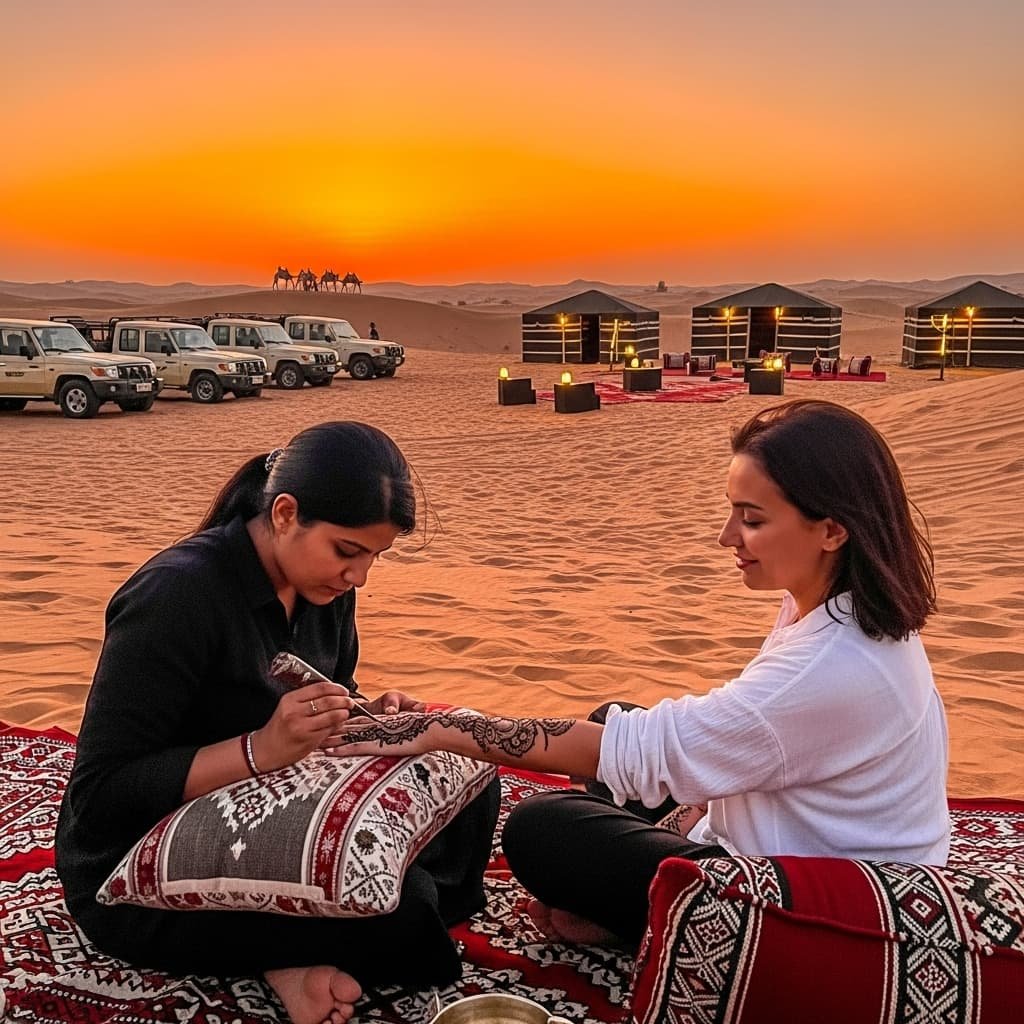
She works with a cone.
It looks like a piping bag for icing.
She does not use a stencil.
She does not draw a sketch first.
She works freehand.
Her speed is incredible.
She can finish a design in 3 minutes.
This skill comes from years of practice.
Many artists at the camps have done thousands of hands.
They have a library of patterns in their heads.
Trust their judgment.
Let them choose the flow.
When you trust the artist on your Henna Painting Safari Dubai, you get the best results.
If you micromanage, the lines get shaky.
Sit still.
Let the art happen.
4. The “Free” vs “Paid” Experience
Here is a secret.
Most safaris include henna.
But it is a “small” design.
Usually a simple line on the back of the hand.
Or a small flower on the wrist.
This is free.
It is part of the ticket.
If you want a full arm design.
If you want both hands done.
If you want feet designs.
You have to pay extra.
Do not argue with the artist.
This is their livelihood.
The free tattoo is a sample.
The paid tattoo is the masterpiece.
Bring some cash.
50 AED can get you a stunning, complex design.
It is worth the upgrade.
5. Dangerous Black Henna Warning
This is the most important section.
Read this twice.
Real henna is never black.
Real henna is green paste that turns red-brown.
“Black Henna” contains PPD.
Para-phenylenediamine.
This is a chemical found in hair dye.
It can cause severe burns.
It can cause permanent scarring.
It can cause life-long allergies.
Some unethical places use it because it stains instantly.
If the artist offers “Black Henna,” say no.
Say it loudly.
Trusted operators like https://royaldesertadventures.ae/ ban black henna.
They prioritize safety.
Your Henna Painting Safari Dubai should be safe.
Stick to the brown paste.
It is the only natural option.
6. Preparation Before the Safari
You want the stain to be dark.
You want it to last.
Preparation starts at your hotel.
Exfoliate your skin.
Scrub your hands and arms.
Remove the dead skin cells.
Do not apply lotion.
Lotion creates a barrier.
The henna cannot penetrate oil.
Wash your hands well before the safari pickup.
Keep your skin dry and clean.
This ensures the dye bites deep.
It ensures your Henna Painting Safari Dubai souvenir lasts for weeks.
7. The Drying Game
You have the design.
Now comes the hard part.
Waiting.
The paste is wet.
If you touch your dress, it stains the dress.
If you touch your face, you get a tattoo on your face.
You must sit like a statue.
It takes about 20 to 30 minutes to dry.
The paste will crack.
It will start to fall off.
Do not pick it yet.
Let it stay as long as possible.
The longer it stays, the darker the color.
Use this time to relax.
Smoke some shisha.
Watch the show.
Just don’t clap your hands during the dance!
8. The Lemon and Sugar Sealant
This is a pro trick.
The artist might dab a sticky liquid on you.
It is lemon juice and sugar.
Why?
The sugar makes the paste stick to the skin.
It prevents it from flaking off.
The lemon juice adds acidity.
This helps release the dye.
It creates a darker stain.
If the camp doesn’t offer this, you can ask.
Or just accept the natural drying process.
But if they do it, accept it.
It feels sticky.
But the result is a rich, mahogany color.
This technique elevates your Henna Painting Safari Dubai result.
9. Removing the Paste
The night is over.
You are back at the hotel.
How do you take it off?
Do not wash it with water.
Water stops the oxidation process.
Scrape the dry paste off.
Use a butter knife.
Use a credit card.
Or just rub your hands together.
You will see an orange stain.
Don’t panic.
It is supposed to be orange at first.
It will darken over the next 24 hours.
Avoid water for as long as possible.
Put oil on it before you shower.
Coconut oil or olive oil protects the stain.
10. The Color Evolution
Henna is alive.
It changes color.
Hour 1: Bright Orange.
Hour 12: Deep Red.
Hour 24: Chocolate Brown.
Hour 48: Dark Burgundy.
This maturation is magical.
It depends on your body heat.
It depends on your skin chemistry.
Palms stain the darkest.
Arms stain lighter.
This natural gradient is beautiful.
Watch your Henna Painting Safari Dubai art transform.
It is a slow-motion reveal.
11. Photography and Posing
You have fresh art.
You need a photo.
The lighting in the camp is dim.
Use the firelight.
Or use the flash on your phone.
Hold your hand against the dark sky.
Or rest it on the red carpets.
Show the contrast.
Pose with a cup of Arabic coffee.
Pose with the falcon.
The henna adds a cultural layer to your photos.
It proves you were there.
It proves you embraced the tradition.
Tag your location.
Share the beauty.
12. Cultural Etiquette
The henna artist is usually a woman.
She is working hard.
Be polite.
Do not grab her hand.
Offer your hand gently.
Do not criticize her work while she is doing it.
It is rude.
If you are a man, ask if it is okay.
Henna is traditionally for women.
But men can get it too.
Usually small designs or initials.
However, respect the cultural norms.
If the line is women-only, respect that.
Ask the guide.
Your Henna Painting Safari Dubai is a cultural exchange.
Treat it with dignity.
13. Safety for Children
Kids love henna.
They want the flower.
They want the butterfly.
Is it safe?
Yes, natural henna is safe for kids.
However, kids are wiggly.
They smear the paste.
They wipe it on their clothes.
Make sure you supervise them.
Wait until the end of the night.
If you do it too early, they will mess it up.
Do it just before you leave.
This way it dries in the car on the way home.
The car AC helps dry it fast.
14. Combining with Traditional Dress
There is a photo booth in the camp.
You can wear Arabic clothes.
Put on the Abaya.
Put on the Burqa (face mask).
Show your henna hand.
This creates the ultimate authentic portrait.
It looks like a National Geographic cover.
You look like a local princess.
This combination of dress and ink is powerful.
It immerses you fully.
Check https://htdesertsafari.com/ to ensure the camp has a costume corner.
Most do.
But checking is smart.
15. Allergic Reactions
Natural henna allergies are rare.
Very rare.
But they exist.
If you have G6PD deficiency (a blood condition), avoid henna.
It can cause a reaction.
If you feel burning, wash it off immediately.
Real henna should feel cool.
It should feel like mud.
If it tingles or stings, it might have chemicals.
Trust your body.
Safety first.
Always book with reputable operators like https://dubaidesertsafarie.com/.
They vet their artists.
They use safe ingredients.
16. The Souvenir That Fades
Henna is impermanent.
That is its beauty.
It lasts for 1 to 2 weeks.
It fades slowly.
It reminds you of the trip every time you look at your hand.
It is not a commitment like a tattoo.
It is a memory that travels with you.
As it fades, it exfoliates away.
Don’t scrub it to remove it.
Let it go naturally.
It is part of the cycle.
Your Henna Painting Safari Dubai is a fleeting joy.
Enjoy it while it lasts.
17. Tipping the Artist
The henna artist is often a freelancer.
She relies on tips.
The free design is her gift.
If you like it, tip her.
10 or 20 AED is a nice gesture.
It makes her smile.
It shows appreciation for her art.
She is sitting in a difficult position all night.
She is focusing on tiny lines.
Rewarding her skill is good karma.
It supports the local economy.
18. Henna on Feet
Feet designs are traditional for brides.
They are beautiful.
But in a safari camp, they are tricky.
You have to take off your shoes.
You have to walk on sand.
Sand sticks to wet henna.
It ruins the design.
If you get feet henna, do it last.
Carry your shoes.
Or sit on the cushions until it is bone dry.
It requires logistics.
But the result is stunning.
It looks great with sandals the next day.
19. Booking the Right Camp
Not all camps have good artists.
Some budget camps have unskilled staff.
They draw messy blobs.
Premium camps hire professional artists.
They use high-quality paste.
They have comfortable seating areas.
When you book, ask about the henna station.
Is it a professional artist?
Is it included?
Your Henna Painting Safari Dubai quality depends on the operator.
Don’t save 10 AED to get a bad tattoo.
Go for the quality camp.
Go for the art.
Detailed FAQs: Henna Painting Safari Dubai
We have compiled the 20 most detailed questions about the henna experience. These answers will ensure you know exactly what to expect and how to stay safe.
1. Is henna painting included in the ticket price?
Yes, in almost all standard evening desert safari packages, a small henna painting is included for free. This is typically a simple design on the back of one hand or a finger design. It is meant as a sample of the experience. If you want a more elaborate design, such as a full hand, arm, or leg pattern, this is considered an “extra” service. You will need to negotiate the price with the artist directly at the camp. Prices for larger designs usually range from 20 AED to 100 AED depending on complexity.
2. Is the henna used in safaris safe for sensitive skin?
Reputable safari operators use natural, organic henna derived from the Lawsonia inermis plant. This paste is generally very safe and hypoallergenic. However, if you have extremely sensitive skin or a condition known as G6PD deficiency, you should avoid henna. Also, beware of “Black Henna” which contains PPD (a chemical dye). If the paste is jet black and smells chemical, refuse it. Real henna is greenish-brown and smells earthy. Always check with the guide or stick to trusted providers like https://royaldesertadventures.ae/ who enforce safety standards.
3. How long does the henna tattoo last?
A natural henna stain typically lasts between 7 to 14 days. The longevity depends on several factors: your skin type, body heat, how long you left the paste on, and where it is applied. Henna on the palms stains the darkest and lasts the longest because the skin is thicker. Henna on the back of the hand or arm fades faster. Frequent washing, swimming, and scrubbing will also cause the design to fade more quickly. To make it last, moisturize the area daily with oil.
4. Can men get henna tattoos?
Culturally, henna is a form of adornment for women in the Arab world, used for weddings and celebrations. However, in the context of a tourist safari, there are no strict rules. Men can get henna if they wish. Usually, men opt for smaller, geometric designs or initials rather than the floral patterns used by women. Some artists might be hesitant due to tradition, but most are happy to oblige a polite request. It is a fun cultural experience for everyone.
5. Can I swim with a fresh henna tattoo?
You should avoid water for the first 24 hours to allow the color to oxidize and darken fully. Chlorine in swimming pools and salt in the ocean are natural exfoliants. They will strip the top layer of your skin and cause the henna to fade very quickly. If you plan to swim the next day, try to keep your hand out of the water or apply a thick layer of waterproof barrier cream or Vaseline to protect the design. For the best Henna Painting Safari Dubai result, stay dry for a day.
6. What should I wear to get henna done?
Wear clothing with short sleeves or sleeves that can be easily rolled up. You do not want your clothes to touch the wet paste. Henna stains fabric instantly and permanently. If you are wearing a long-sleeved white shirt, you are taking a risk. Loose, comfortable clothing is best. If you plan to get henna on your feet or ankles, wear flip-flops or sandals so you don’t have to put socks and shoes back on immediately, which would smudge the art.
7. Does henna painting hurt?
Not at all. The application is completely painless. The artist squeezes the paste from a plastic cone onto your skin. There are no needles involved. In fact, the sensation is often described as pleasant and cooling. The paste draws heat away from the body, which is refreshing in the desert climate. If you feel any burning or stinging sensation, wipe it off immediately, as this indicates an allergic reaction or the presence of chemical additives.
8. How do I remove henna if I don’t like it?
Henna stains the epidermis (top layer of skin). You cannot wash it off instantly like ink. It has to fade as your skin naturally exfoliates. However, you can speed up the process. Soaking in saltwater, scrubbing with a loofah, using whitening toothpaste, or applying lemon juice can help fade it faster. But be gentle; scrubbing too hard can damage your skin. The best approach is patience. It will naturally disappear in a week or two.
9. Can I choose my own design?
Yes. The artists usually have a book of designs or photos on their phone that you can choose from. If you have a specific design in mind (like a symbol or a name), you can show them a picture on your phone. They are very skilled at copying visuals. However, keep in mind that custom or complex requests will likely fall into the “Paid” category rather than the free service. Negotiate the price before they start painting to avoid awkwardness later.
10. Is henna safe for pregnant women?
Natural henna is generally considered safe for pregnant women and is even used in some cultures for “belly blessings” during the third trimester. However, during pregnancy, skin can be more sensitive. It is crucial to ensure the henna is 100% natural with no chemical additives. Avoid it in the first trimester just to be safe. Always consult your doctor if you are unsure. If you choose to do it, do a small patch test on your wrist first to check for sensitivity.
11. What is the difference between Red and Black Henna?
Red (Natural) Henna comes from a plant. It takes hours to develop color, stains orange-brown, and is safe. Black Henna is synthetic. It contains PPD (hair dye chemicals). It stains black instantly. It is dangerous and can cause chemical burns, blisters, and long-term scarring. The Dubai Municipality bans the use of Black Henna in salons and camps, but some illegal operators might still have it. Always insist on “Natural Brown Henna” for your Henna Painting Safari Dubai experience.
12. Do I need to book the henna in advance?
For the standard free henna, no booking is required. It is a walk-in station at the camp. You just join the queue. However, if you have a large group and everyone wants extensive paid designs, it is polite to inform the operator or guide so they can alert the artist. This ensures she has enough supplies and time to accommodate you without rushing. Mention it when booking via https://htdesertsafari.com/.
13. How long does it take to apply?
The artists are incredibly fast. A simple free design takes about 1 to 2 minutes. A full hand design (paid) might take 5 to 10 minutes. The speed is mesmerizing to watch. The main time consumption is the drying process, which takes 20 to 30 minutes. You need to budget this time into your evening. Don’t get henna right before the belly dance show starts if you want to clap or take photos. Timing is key.
14. Can I buy henna cones to take home?
Often, yes. The artists or the souvenir shop at the camp usually sell fresh henna cones. They are cheap (around 5 to 10 AED). However, be aware that fresh natural henna is perishable. It needs to be kept cool. If you leave it in a hot car or a suitcase for days, the dye will degrade and it won’t stain well. If you buy it, put it in a fridge as soon as you get back to your hotel.
15. Why did my henna turn out orange?
This is normal. When the paste first comes off, the stain is bright pumpkin orange. This is the initial oxidation phase. Do not panic. Over the next 24 to 48 hours, the lawsone molecules continue to oxidize with the air, deepening the color to a rich reddish-brown. The warmer you keep your body, the darker it will get. It is a process that requires patience.
16. Are there specific designs with meanings?
Yes. In traditional culture, certain patterns symbolize health, fertility, wisdom, or protection against the evil eye. The “Hamsa” (hand of Fatima) is for protection. Floral patterns represent joy and happiness. Vines represent longevity. You can ask the artist about the meaning of the design she is applying. It adds a layer of depth to the experience, transforming it from a cosmetic application to a storytelling session.
17. Can children get henna?
Yes, children can get henna. It is safe and natural. Most little girls love getting a small flower or butterfly. However, the challenge is getting them to sit still while it dries. If they smudge it while it is wet, it will stain their clothes or face. We recommend doing it right before leaving the camp so they can sit still in the car ride home while it dries.
18. What if I am allergic to lemon or eucalyptus?
The henna paste is a mixture. It contains henna powder, water, sugar, and essential oils (usually eucalyptus, tea tree, or lavender) and lemon juice. If you have a known allergy to citrus or essential oils, you must tell the artist. They might have a “sensitive mix” without the oils, or they might advise you to skip it. An allergic reaction to the additives is more common than an allergy to the plant itself.
19. Is the henna station open during Ramadan?
Yes, the henna station typically operates year-round, including during Ramadan. While entertainment like belly dancing is suspended during the Holy Month, cultural activities like henna painting, camel riding, and falconry continue. In fact, henna is very popular during Eid (the festival at the end of Ramadan), so the artists might be extra busy during that time.
20. Why is the henna artist wearing a mask?
Traditionally, some Bedouin women wear a “Burqa” (a metallic-looking face mask) for modesty and cultural identity. It is not a medical mask. It is a symbol of heritage. Or, she might be wearing a medical mask for hygiene. Do not be intimidated. It is respectful to acknowledge her culture. She is sharing a very intimate art form with you. A smile (even behind a mask) and a “Shukran” (Thank you) go a long way.
The smell of the paste.
The cool touch on the skin.
The intricate lines forming a garden on your hand.
This is more than a souvenir.
It is a connection.
A connection to the women of the desert.
A connection to history.
Do not overlook this art.
Sit down.
Be patient.
Let the desert mark you.
Your Henna Painting Safari Dubai is waiting.
Book your journey with https://dubaidesertsafarie.com/.
Wear the culture.
Own the beauty.