Dubai Safari Photography: 19 Shocking Secrets to Capture 1,000 Stunning Images
Dubai Safari Photography is an adventure tailored for the lens. The unique light and vast landscapes offer unparalleled visual opportunities.
The desert provides a dramatic, ever-changing backdrop, moving from soft gold to deep, saturated crimson.
Achieving stunning, professional-grade images requires planning and insider knowledge.
This extensive guide reveals 19 powerful secrets. These tips ensure your Dubai Safari Photography experience yields truly spectacular results.
Every angle, every moment, is a chance for an award-winning shot. This guide helps you seize those moments.
1. Golden Hour Secrets: Mastering Desert Light
Light is the single most critical element in high-quality desert imagery. Timing the light is everything.
Golden Hour Shooting: Timing is Crucial
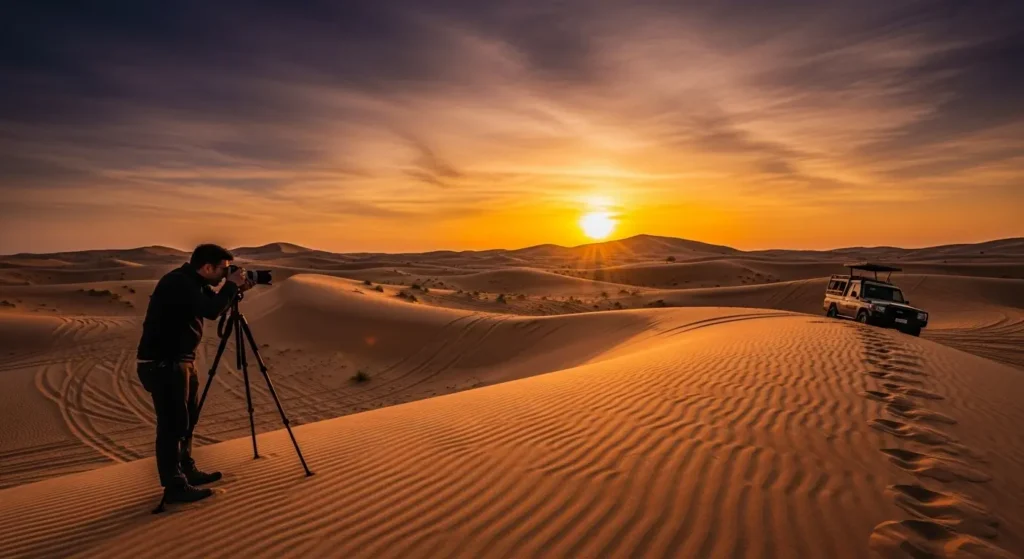
The ‘Golden Hour Shooting’ window is incredibly short in the desert. You must be positioned 30 minutes before sunset.
The soft, warm light slants across the dunes, defining their texture and creating long, dramatic shadows.
Arriving early ensures you secure the best elevated position for this prime shooting time.
The Magic of Blue Hour
The ‘Blue Hour’ follows immediately after sunset. It offers cool, deep tones.
This is the perfect time for silhouettes of camels or the camp against a vibrant, cobalt sky.
Adjust your white balance slightly cooler to enhance this effect.
High Noon and Harsh Light
Avoid shooting portraits under the direct, harsh sun of high noon. The light creates deep, unflattering shadows.
If you must shoot, seek the shade of a vehicle or tent. Alternatively, use a powerful flash to overcome the sun.
Only shoot landscapes with high noon light if you intentionally seek stark contrast and deep shadows.
Exposure Bracketing Technique
Use exposure bracketing during Golden Hour Shooting. This captures three images (normal, under, over) for maximum dynamic range.
Combining these exposures in post-processing ensures no detail is lost in the bright sky or deep shadows.
This technique is a professional staple for serious Dubai Safari Photography.
2. The Best Shooting Locations: Red Dune Photography Zones
Not all desert terrain is equal for photography. Specific areas offer superior color and composition.
Red Dune Photography: The Al Lahbab Difference
The Al Lahbab region is famous for its towering, reddish-orange dunes. These provide the most saturated backdrop.
The height of these dunes allows for superior ‘dune sea’ shots, capturing miles of uninterrupted sand.
This is the prime location for dramatic Red Dune Photography.
Composition: Leading Lines
Use the natural crests of the dunes as leading lines in your composition. These lines guide the viewer’s eye into the frame.
The sweeping curves of the sand are naturally photogenic elements. Focus on the horizon line.
A low camera angle often exaggerates the height and scale of the dunes.
Vehicle Convoy Shots
Position yourself on the edge of the dune field to capture the convoy of 4x4s. This shows scale and action.
The dust kicked up by the lead vehicle creates a dramatic haze. This adds atmosphere to the image.
Communicate with your driver to ensure you stop at visually compelling points.
Safari Camera Gear for Dunes
Carry a wide-angle lens (16-35mm) to capture the vastness of the Red Dune Photography landscape.
A polarizing filter is essential for darkening the sky and reducing haze.
Protect your Safari Camera Gear meticulously from the fine, abrasive desert sand.
3. Essential Gear Guide: Safari Camera Gear Protection
The desert environment is hazardous for sensitive electronics. Preparation is the key to protecting your investment.
Safari Camera Gear: Dust and Sand Protection
The single greatest threat is fine sand dust. It can penetrate camera bodies and lenses, causing permanent damage.
Carry multiple sealed plastic bags (Ziploc type) for your camera when not actively shooting.
Use a dedicated, waterproof camera bag with sealed zippers.
Lens Changing Protocol
Never change lenses in open air when the wind is blowing. This is how sand enters the sensor cavity.
Change lenses inside the vehicle or inside the camp tent where dust is minimized.
Carry a specialized sensor cleaning kit, but use it sparingly and with great care.
Tripods and Stability
A stable tripod is necessary for long exposure shots, especially during the Blue Hour or for Low Light Desert Shots.
Choose a lightweight carbon fiber tripod for easy carrying over the soft sand.
Ensure the tripod has rubber feet or spikes for maximum stability on uneven terrain.
Battery Management
The heat and cold fluctuations of the desert can quickly drain camera batteries. Carry at least three spare batteries.
Keep spare batteries in an inner pocket or insulated bag to maintain their temperature.
A power bank for charging phones and smaller devices is always a wise inclusion.
Water and Hydration
While not strictly Safari Camera Gear, staying hydrated is essential for concentration and focus. A tired photographer misses key moments.
Ensure your tour provides ample chilled water throughout the Desert Photo Tour.
4. Action and Thrill Shots: Action Photo Techniques
Capturing the dynamic energy of the safari requires specific settings and anticipation.
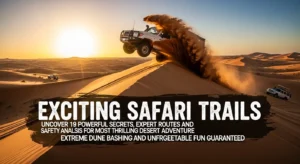
Action Photo Techniques: Dune Bashing
To freeze the action of dune bashing, use a fast shutter speed (1/1000th of a second or faster).
Use continuous autofocus (AF-C or Servo AF) to track the fast-moving 4×4 vehicles.
Burst mode is essential here; take a sequence of shots to ensure you capture the peak moment.
Buggy Safari Adventure Shots
The Buggy Safari Adventure offers a chaotic, high-speed subject. Position yourself well ahead of the buggies.
Shoot with a wide aperture (f/2.8 to f/4.0) to slightly blur the background. This emphasizes the speed of the buggy.
Wear protective goggles to keep your eyes free of sand while setting up the shot.
Sandboarding Action
For sandboarding, shoot low to the ground to exaggerate the steepness of the dune and the speed of the boarder.
Anticipate the direction of movement and compose the shot to give the boarder room to ‘move’ into the frame.
Use a slightly slower shutter speed (1/250th) to introduce a slight motion blur to the sand trail for drama.
Vehicle Photography Logistics
For a private or bespoke Desert Photo Tour arranged via https://royaldesertadventures.ae/, you can coordinate specific stunts.
A dedicated driver will position the vehicle for the ideal shot, allowing for superior Action Photo Techniques.
This level of control maximizes the quality of your dynamic photographs.
5. Cultural Captures: Cultural Camp Shots and Portraiture
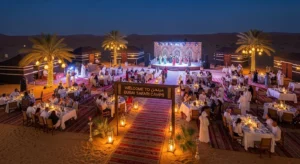
The evening camp is the cultural heart of the safari. It offers rich opportunities for portrait and ambient light photography.
Cultural Camp Shots: People and Privacy
Always ask permission before taking close-up portraits of performers or other guests. Respect the privacy of the participants.
Focus on capturing candid moments: the henna artist at work, the chef at the Live Grilling Station, or people enjoying the Traditional Arabian Feast.
Use a slightly longer lens (50mm or 85mm) to isolate your subjects from the busy background.
Low Light Desert Shots: Fire and Light
The Tanoura dance and fire show present challenging Low Light Desert Shots scenarios.
Use a wide aperture (f/1.8 to f/4.0) to gather maximum light. Increase your ISO (800–3200) carefully to avoid excessive noise.
Experiment with slow shutter speeds (1/15 to 1/60) to capture the fluid movement of the dancer’s skirts.
Camel Shots and Silhouettes
The classic Camel Shots are best taken at sunset as silhouettes against the vibrant sky.
Set your exposure to meter off the bright sky, deliberately underexposing the camel and rider to render them as dark shapes.
Shoot the camel train from a distance to emphasize the vastness of the desert and the smallness of the riders.
Attire and Detail
Capture the vibrant colors of the traditional attire worn by performers. Focus on the intricate details of their costumes and accessories.
These details provide essential cultural context for your Dubai Safari Photography collection.
6. Post-Processing Workflow: Enhancing Your Safari Images
The work continues long after you leave the desert. Editing is crucial for bringing out the colors and textures.
Color Grading and Saturation
Desert images often benefit from enhanced saturation, particularly in the reds and oranges.
Carefully boost the saturation of the sky and the sand using HSL (Hue, Saturation, Luminance) sliders in your editing software.
Avoid over-processing; the image should look vibrant, not artificial.
Texture and Detail
The fine texture of the sand is a defining characteristic of Red Dune Photography.
Use the ‘Clarity’ or ‘Texture’ tools to subtly enhance the contrast in the sand, making the dune lines pop.
Apply a slight sharpening to the final image, focusing on the foreground elements.
Removing Sensor Dust Spots
Sensor dust is inevitable after a Desert Photo Tour. Carefully inspect every image for small, dark spots.
Use the spot removal or healing brush tool to seamlessly remove these blemishes from the sky and smooth dune areas.
A high-quality image requires meticulous cleaning in post-production.
Portfolio and Sharing
Curate only your absolute best images for your final portfolio. Be ruthless in your selection process.
Consider using platforms like https://hafiztourism.com/ for inspiration on professional presentation and lighting techniques.
The consistency of your editing style across the entire set is key to a professional look.
7. Booking and Logistics: Photo Tour Logistics
Choosing the right tour package directly impacts your photographic success.
Best Photography Safari: Dedicated Tours
Look for operators who offer dedicated Best Photography Safari tours. These tours prioritize photographers’ needs over standard tourist schedules.
A specialized tour provides longer stops for shooting and prioritizes locations with the best light.
Contact https://royaldesertadventures.ae/ to inquire about private, photographer-focused charters and optimal timings.
Vehicle Positioning and Access
Ensure the tour vehicle allows for clear, unobstructed views. Avoid sitting in the middle row if the vehicle is fully booked.
A specialized tour will allow the photographer to sit in the front or rear window for the best access.
The location of the internal link https://royaldesertadventures.ae/ guarantees a private, flexible itinerary.
Low Light Desert Shots Preparation
Confirm the tour returns after dark, allowing time for true Low Light Desert Shots (stargazing).
This means the logistics are organized for a later return time, which is essential for night-sky photography.
The return timing is a key indicator of a truly comprehensive Best Photography Safari.
Photo Tour Logistics and Equipment Management
Communicate your Safari Camera Gear requirements to the operator. A dedicated area for gear storage is a major plus.
They should understand the need for quick, careful access to equipment throughout the tour.
Efficient Photo Tour Logistics reduce stress and maximize shooting time.
8. Safety and Ethics: Protecting Gear and Culture
Responsible photography means prioritizing safety for yourself, your equipment, and the people and culture you document.
Personal Safety and Awareness
The terrain can be tricky. Stay aware of your footing on the steep slopes of the dunes.
Always follow the instructions of the Expert Dune Drivers and guides, especially near active driving areas.
Never climb a dune alone at night for Low Light Desert Shots.
Cultural Respect
When capturing Cultural Camp Shots, be respectful of the performers and their space. Do not use blinding flash photography during their acts.
The cultural element is an integral part of the Dubai Safari Photography experience. Treat it with reverence.
Ensure you do not photograph local women or families without explicit consent.
Gear Protection Final Check
After every dune bashing segment, perform a quick external check of your camera and lens for sand.
Wipe down surfaces with a microfibre cloth, being careful not to rub grit into the glass.
This continuous maintenance is non-negotiable for the longevity of your Safari Camera Gear.
External Review Checks
Before booking any Desert Photo Tour, check reviews on sites like https://hafiztourism.com/ for feedback on safety records and guide professionalism.
A high safety rating ensures your mind is focused on composition, not on potential hazards.
9. Composition and Creativity: Breaking the Rules
Once you know the rules of Dubai Safari Photography, you must learn how to break them creatively.
Intentional Motion Blur
Instead of freezing action, use slow shutter speeds (1/8 to 1/30) while panning. This blurs the background but keeps the subject relatively sharp.
This technique is excellent for capturing the feeling of speed during Dune Bashing Thrills.
It adds a dynamic, artistic element to your action shots.
Negative Space in Red Dune Photography
Utilize the vast expanse of the dunes as negative space. Place your subject (a camel, a tree) small in the frame.
This compositional choice emphasizes the sheer scale and isolation of the desert environment.
The negative space can be particularly powerful in Red Dune Photography.
Foreground Interest
Use elements in the foreground (ripples in the sand, a patch of desert grass) to add depth to your landscape shots.
This grounds the image and provides context for the expansive background.
Always focus-stack if necessary to ensure both the near foreground and far background are sharp.
The Use of Filters
Beyond the polarizing filter, experiment with neutral density (ND) filters. These allow for extremely long exposures in daylight.
Long exposures can turn fast-moving clouds into streaks or smooth the sand texture, adding an ethereal quality.
ND filters are advanced Safari Camera Gear accessories for specialized effects.
10. The Ultimate Photography Package: Desert Photo Tour Value
Securing a high-value package ensures both superior quality and dedicated photographic time.
Dedicated Desert Photo Tour Access
A dedicated Desert Photo Tour often includes access to private or restricted dune areas.
This isolation ensures cleaner, untouched sand and no competing photographers in your frame.
Check the package details for confirmed Exclusive Dune Access.
Editing Workshop Inclusion
Some premium Best Photography Safari tours include a short post-processing workshop.
This immediate feedback loop helps you refine your editing skills specific to desert light and color.
The inclusion of an editing session maximizes the value of the Desert Photo Tour.
Internal Link Resource for Booking
For the most specialized, high-end, photographer-focused experiences, consult the offerings at https://royaldesertadventures.ae/.
Their customized options cater specifically to the demanding needs of professional and serious amateur photographers.
This ensures your Dubai Safari Photography experience is truly bespoke.
Photography Planning Table
| Activity | Recommended Gear & Setting | Ideal Light | Focus Keyword Relevance |
| Dune Bashing | Fast Shutter (1/1000s+), AF-C | Late Afternoon | Action Photo Techniques |
| Landscapes | Wide Angle (16-35mm), Tripod | Sunrise/Sunset (Golden Hour) | Red Dune Photography |
| Portraits | Prime Lens (50mm/85mm), Flash | Shaded Areas/Blue Hour | Cultural Camp Shots |
| Night Sky | Wide Angle, f/2.8, Long Exposure | Late Night (Post-Camp) | Low Light Desert Shots |
| Camp Ambience | High ISO (800-3200), f/4.0 | Campfire Light | Best Photography Safari |
Frequently Asked Questions (FAQs) – Dubai Safari Photography
1. What is the most crucial piece of Safari Camera Gear to bring, and how should it be protected during a Dubai Safari Photography tour?
The most crucial piece of Safari Camera Gear is a sealed, weather-resistant camera body. Protection is achieved by placing the camera inside a sealed plastic bag (Ziploc) or a dedicated, dust-proof camera dry bag when it is not actively being used. Never change lenses in the open air, and ensure all zippers are sealed, as fine desert sand is highly corrosive.
2. How do I ensure my images captured during the Golden Hour Shooting period have maximum dynamic range and rich colors?
To ensure maximum dynamic range during Golden Hour Shooting, you should use Exposure Bracketing (taking three shots: -1, 0, +1 EV). These can be merged in post-production (HDR technique) to preserve detail in both the bright sky and the deep shadows of the dunes. Proper white balance (sunny or cloudy preset) will enhance the warm colors naturally.
3. What is the primary advantage of booking a specialized Desert Photo Tour over a standard safari package for serious photographers?
The primary advantage of a specialized Desert Photo Tour is flexibility and location priority. Standard tours prioritize rigid schedules (dune bashing then camp). A photo tour provides longer, dedicated stops at ideal locations (like the Red Dune Photography zones) during the exact Golden Hour, and the driver is briefed to position the vehicle for the best shots, maximizing the chances of great images.
4. What are the recommended camera settings for capturing fast-paced action during Dune Bashing Thrills while avoiding motion blur?
For capturing Dune Bashing Thrills without motion blur, you must prioritize a fast shutter speed. Recommended settings are a minimum shutter speed of 1/1000th of a second, continuous autofocus mode (AF-C or Servo AF), and a high frame rate (burst mode). Use Auto ISO or a higher ISO (400-800) to compensate for the fast shutter speed while shooting.
5. How should a photographer approach capturing the Cultural Camp Shots respectfully, particularly the performers and other guests, during the evening?
To approach Cultural Camp Shots respectfully, a photographer must always seek permission for close-up portraits of performers and other guests. Use a longer focal length (70-200mm) to capture candid moments from a distance, minimizing intrusion. During performances, avoid using a harsh, direct flash that might distract the artists or other attendees.
6. What essential information should I confirm with the operator regarding Photo Tour Logistics before I finalize my booking for a Best Photography Safari?
Essential information to confirm includes: 1. Vehicle Seating: Guaranteed window seating. 2. Stop Duration: Agreed time for stops at key locations. 3. Return Time: Confirmation the return is late enough for true Low Light Desert Shots. 4. Private Access: Whether the tour utilizes private or less-crowded routes to maximize the Best Photography Safari experience.
7. How can I capture stunning, noise-free Low Light Desert Shots of the night sky or star trails during the safari experience?
To capture noise-free Low Light Desert Shots, use a wide-angle, fast lens (f/2.8 or wider), set your camera to manual mode, and focus to infinity. Use a stable tripod and a long exposure (20-30 seconds) with a high ISO (1600-3200). Shooting in RAW format and using noise reduction in post-processing are also essential steps.
8. What is the most effective way to use the sun to create dramatic silhouettes of camels or riders during a Desert Photo Tour?
The most effective way is to position the subject directly between you and the setting or rising sun. Set your camera’s exposure to meter off the brightest part of the sky, which will automatically underexpose the subject, rendering it as a pure, dramatic silhouette. This technique is mandatory for classic, high-impact Desert Photo Tour images.
9. What specific techniques are used in post-processing to enhance the texture and saturation of the red sand in Red Dune Photography images?
In post-processing for Red Dune Photography, use the Clarity or Texture sliders to enhance the definition of the sand ripples and lines. Use the HSL (Hue, Saturation, Luminance) panel to specifically boost the saturation and luminance of the orange and red tones, making the sand color more vibrant without over-saturating the entire image.
10. How can I use the external resource https://dubaidesertsafarie.com/ to vet the claims of a tour operator offering a premium Dubai Safari Photography experience?
Use https://dubaidesertsafarie.com/ to vet claims by filtering reviews for keywords related to photography. Look for feedback that mentions driver patience, clean vehicles, dedicated photo stops, and high-quality equipment. Consistent praise from other photographers confirms the tour is truly geared toward Dubai Safari Photography and not just standard sightseeing.
11. What simple and inexpensive item should every photographer bring to a Desert Photo Tour to maintain their lens quality throughout the day?
Every photographer must bring an inexpensive, large, microfibre cleaning cloth dedicated solely to removing the dust from the exterior of the lens barrel and filter. This prevents the abrasive sand from scratching the lens and keeps the glass clean. A small, portable blower brush is also invaluable for safely removing loose grit from the camera body.
12. How does a premium operator (like those at https://royaldesertadventures.ae/) manage the logistics of a Best Photography Safari to maximize shooting time?
A premium operator manages logistics by using private, high-speed transfers and securing private dune access (often bypassing public convoy wait times). They eliminate unnecessary stops and work off a flexible, photography-focused timeline, ensuring the maximum amount of time is spent shooting during the prime light windows, maximizing the value of the Best Photography Safari.
13. What is the most effective composition technique for shooting a vast landscape to emphasize the scale of the Red Dune Photography environment?
The most effective technique for emphasizing scale is to include a small, recognizable element in the foreground or middle ground. This small element (a solitary Ghaf tree, a tiny figure, or a camel) provides a point of reference that highlights the towering height of the dunes and the overwhelming scale of the Red Dune Photography landscape.
14. Should I use a fast zoom lens or a fixed prime lens for capturing high-quality Cultural Camp Shots in the low-light evening setting?
A fast prime lens (e.g., 50mm f/1.8 or 85mm f/1.4) is generally superior for high-quality Cultural Camp Shots. Primes have wider apertures, allowing them to gather more light (essential for low light) and create a shallower depth of field (bokeh), which helps isolate the subject (performer or food) from the busy camp background.
15. Besides the camera, what is the one most essential item of Safari Camera Gear required for taking sharp, professional-quality Low Light Desert Shots?
The one most essential item, besides the camera, is a stable tripod. Taking sharp, professional Low Light Desert Shots (especially star photography or long exposures) requires the camera to be absolutely still for 20-30 seconds. No human can hold a camera steady enough for this duration, making the tripod indispensable.