Desert Storytelling Traditions: Whispers of the Past Under the Stars
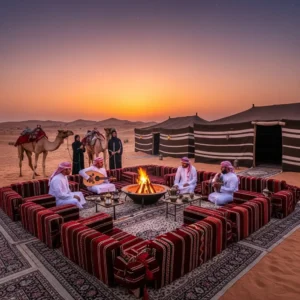
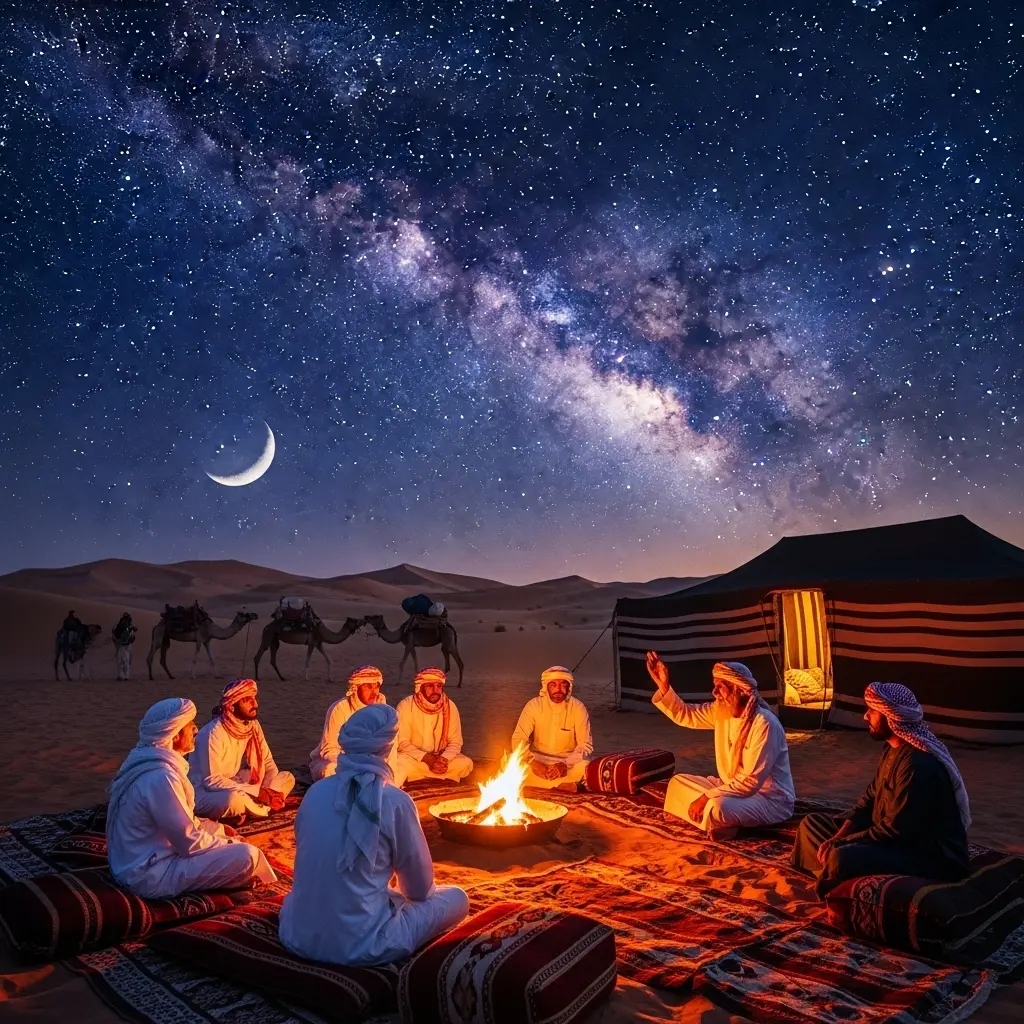
As the energy of the desert safari evening settles, the exhilarating shows end, and the remnants of the delicious BBQ dinner are cleared away, a different kind of magic begins. The warm glow of a crackling bonfire becomes the center of the world, drawing people closer. Above, a brilliant canopy of stars blankets the silent desert. It is in this intimate, timeless setting that you can connect with one of the most ancient and cherished of all human experiences: storytelling.
The fireside gathering at a desert camp is a modern homage to the rich Desert Storytelling Traditions of the Bedouin people. For millennia, before the age of screens and books, the spoken word was the sole vessel for history, culture, entertainment, and wisdom. Listening to tales under the vast desert sky is to participate in a ritual that has bound communities together in this very landscape for countless generations.
This is more than just hearing a few old myths. It is an invitation to understand the soul of a people whose identity was shaped by the desert. This guide explores the deep-rooted history of Arabian oral traditions, the epic tales and poems that were told, the esteemed role of the storyteller, and how this beautiful heritage is kept alive today in the heart of a modern desert safari.
The Oral Library: Why Storytelling Was Essential for the Bedouins
In the pre-literate, nomadic world of the Arabian Peninsula, a person’s memory was their library, and the spoken word was the most valuable currency. Desert Storytelling Traditions were not a pastime; they were the essential mechanism for survival and cultural continuity.
A Culture Preserved in Memory
Without written records, everything from tribal genealogies and historical events to moral codes and survival techniques had to be committed to memory. Stories and poems, with their natural rhythm and rhyme, were far easier to remember and recite accurately than dry prose. A well-told story could ensure that the lessons of the past were not forgotten by the next generation.
The Esteemed Role of the Storyteller
In this society, the storyteller, known as the Al-Rawi, was one of the most respected figures in the tribe. The Rawi was a living archive, a historian, and a master entertainer. They were the keepers of the tribe’s lineage and epic poems, known as qasidas. Their ability to captivate an audience for hours, reciting complex tales from memory, was a highly valued and almost magical skill.
The Majlis: The Original Theatre
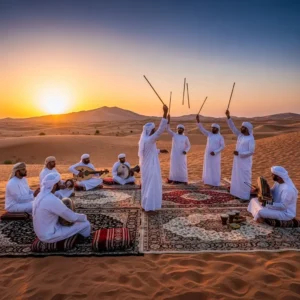
The storytelling sessions would take place in a majlis, a communal gathering space. Here, tribe members and travelers would gather around a fire, brew and drink coffee in a ritualistic manner, and listen to the Rawi. The majlis was the center of social and cultural life, and the modern desert camp’s fireside gathering is a direct tribute to this foundational tradition of Arabian hospitality and shared culture.
The Tapestry of Tales: Genres of Arabian Folklore
The Desert Storytelling Traditions are a rich and diverse tapestry, weaving together tales of the supernatural, legendary heroes, and profound wisdom.
Legends of the Jinn
Long before the “genie in a bottle” of popular fiction, the Jinn were a powerful and complex part of Arabian folklore. These supernatural beings, said to be created from smokeless fire, were believed to inhabit the desolate places of the world, especially the desert. Unlike angels or demons, Jinn had free will and could be good, evil, or neutrally mischievous. Tales of encounters with the Jinn, who could be tricksters, helpers, or terrifying ghouls, were a thrilling and cautionary staple of campfire stories.
Epics of Heroes and Knights
The oral tradition was filled with epic poems celebrating the lives of legendary heroes. The most famous of these is the story of Antarah ibn Shaddad, a pre-Islamic warrior-poet of mixed heritage who rose from being a slave to become a celebrated knight. His tales of courage in battle and his beautiful love poetry were recited across the peninsula and represent the highest ideals of chivalry and honor in Bedouin culture.
Fables and Wisdom Stories
Many traditional stories were short, clever fables, similar to Aesop’s fables. These tales often featured desert animals—the cunning fox, the patient camel, the swift gazelle—and were used to impart wisdom and moral lessons to the young in an entertaining way. They taught the values of patience, cunning, loyalty, and the importance of community.
The Thousand and One Nights
No discussion of Desert Storytelling Traditions is complete without mentioning Alf Layla wa-Layla, or One Thousand and One Nights. While this is a collection of tales gathered over centuries from Persia, India, and across the Arab world, it has become the most famous repository of Arabian folklore. The frame story of Scheherazade telling tales to save her life is a testament to the power of storytelling itself. It gave the world the immortal characters of Aladdin, Sinbad the Sailor, and Ali Baba.
The Supreme Art Form: The Power of Poetry
In Bedouin culture, poetry was considered the highest and most refined art form, even more so than storytelling. The two were often inextricably linked, with many stories being told in the form of long, epic poems.
Nabati: The Poetry of the People
The most prominent form of poetry in the peninsula is Nabati poetry. Composed in the vernacular dialect rather than classical Arabic, it is the authentic voice of the Bedouin people. Nabati poems are known for their intricate rhyme schemes and rhythmic structure, making them ideal for recitation. The themes cover all aspects of desert life: praise for a sheikh, satires of rival tribes, descriptions of the beauty of a beloved camel, and declarations of love.
Al-Taghrooda: The Chant of the Caravan
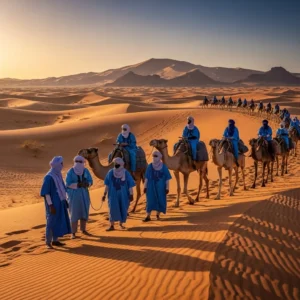
A unique form of chanted poetry, Al-Taghrooda, is so important that it is recognized by UNESCO as an Intangible Cultural Heritage. This is a tradition of improvised, call-and-response poetry that was chanted by men traveling on camelback to entertain each other and encourage their animals. It is a perfect example of how Desert Storytelling Traditions were woven into the very fabric of daily life.
The Tradition Continues: Storytelling in a Modern Desert Safari
While the role of the Rawi has changed in the modern, literate world, the spirit of storytelling is being kept alive. The desert safari camp has become a new kind of majlis, one that welcomes a global audience.
The Campfire as a Cultural Stage
Today, the experience of a fireside story is a cherished part of many heritage-focused desert safaris. Tour operators who prioritize cultural authenticity, such as those you can find on https://royaldesertadventures.ae/, often include a dedicated segment for this. A guide or a professional storyteller will gather guests around the fire and share a piece of this oral heritage.
What to Expect in a Modern Telling
The modern retelling is adapted for an international audience. You might not hear a three-hour epic poem, but you will hear fascinating insights and tales. A guide might share a short legend about a particular constellation visible in the sky above. They might tell a clever fable about a desert fox, or recount a Bedouin survival technique that has been passed down through generations. These moments provide a quiet, intimate, and deeply memorable counterpoint to the high-energy entertainment of the evening, and are the modern face of the ancient Desert Storytelling Traditions. Finding a tour that includes this special element is worth the research on platforms like https://dubaidesertsafarie.com/ or https://hafiztourism.com/.
A Comparison of Arabian Oral Traditions
The world of Arabian storytelling is vast. This table highlights the key features of the different forms.
Frequently Asked Questions (FAQs)
1. What is a Jinn, and is it the same as a genie? In Arabian folklore, a Jinn is a type of supernatural being, created from smokeless fire, that co-exists with humans. They have free will and can be good, evil, or neutral. The anglicized word “genie” comes from Jinn, but the popular image of a friendly being trapped in a lamp is a specific trope popularized by the story of Aladdin. In traditional Desert Storytelling Traditions, Jinn are far more complex, powerful, and often dangerous figures to be respected and feared.
2. Who was Antarah ibn Shaddad, the famous hero? Antarah was a real historical figure from pre-Islamic Arabia, a celebrated poet and warrior. Born the son of a tribal leader and an Ethiopian slave, he faced prejudice but proved his worth through his incredible bravery in battle and his sublime poetic skill. His epic story, the Sirat ‘Antar, which blends historical facts with legendary exploits, became one of the most beloved heroic tales in the Arab world, recited by storytellers for centuries.
3. Are the stories from “One Thousand and One Nights” from the UAE? No, the stories in this collection are not originally from the specific region of the UAE. They are a compilation of tales from across the Middle East, Persia, and India, gathered over many centuries. However, they have been so influential that they now form a core part of the popular imagination of “Arabian” folklore and are an important part of the wider context of regional Desert Storytelling Traditions.
4. What is the role of coffee in a traditional storytelling majlis? The preparation and serving of coffee (gahwa) is a deeply symbolic ritual of hospitality in Bedouin culture. In a traditional majlis, the host would roast, grind, and brew the coffee in front of the guests. The coffee would be served in small, handleless cups, starting with the most important guest. This ritual created a welcoming and respectful atmosphere, setting the stage for conversation and storytelling.
5. Do professional storytellers still exist in the UAE today? While the traditional role of the tribal Rawi has faded, the art of storytelling is being actively preserved. There are modern professional storytellers and poets who perform at cultural festivals, heritage events, and educational institutions. They are dedicated to studying the old tales and poetic forms and presenting them to contemporary audiences, ensuring the Desert Storytelling Traditions do not disappear.
6. How did ancient storytellers remember such long and complex tales? This was a remarkable feat of memory training. Storytellers would often learn from a master, spending years as an apprentice. The rhythmic and rhyming nature of poetry made it much easier to memorize than prose. They also used mnemonic devices and stock phrases. The ability to recite thousands of lines of poetry or a multi-hour story from memory was the mark of a true master.
7. Are the stories told at a desert safari scary for children? No, the stories shared at a family-friendly desert safari are carefully chosen to be suitable for all ages. A guide will typically share a lighthearted fable, a simple legend about the stars, or an interesting piece of cultural history. The frightening tales of ghouls and evil Jinn are reserved for a more traditional, adult context and are not part of the modern tourist experience.
8. What is Nabati poetry, and is it still popular? Nabati is poetry composed in the colloquial dialects of the Arabian Peninsula, as opposed to formal classical Arabic. It is often called “the people’s poetry.” It remains incredibly popular today and is a vibrant, living art form. There are major poetry competitions, such as “Million’s Poet” in Abu Dhabi, which are massive televised events with huge prizes, demonstrating the continued prestige of poetry in modern Emirati culture.
9. Is it true that Bedouins could tell stories just by looking at tracks in the sand? This refers to the incredible skill of tracking, known as qiyyafa. An expert Bedouin tracker could read footprints in the sand like a book. They could identify the tribe, the specific person, the type of animal, how fast it was moving, and how long ago it passed. While not storytelling in a narrative sense, it was a way of reading the “story” of what had recently happened in the desert, a vital survival skill.
10. What is a “ghoul” in Arabian folklore? In the rich tapestry of Desert Storytelling Traditions, the ghul (ghoul) is a type of monstrous, malevolent Jinn or demon. They were believed to haunt desolate places like deserts and graveyards. Stories often depicted them as shapeshifters that could lure unwary travelers to their doom. Tales of ghouls were a popular type of horror story told around the campfire.
11. Do all desert safaris include a storytelling session? No, a dedicated storytelling segment is a special feature and is not included in all safari packages. It is most often found in more premium, heritage-focused, or overnight safari experiences where the focus is more on cultural immersion. If this is an experience you really want, you should carefully read the itinerary or ask the operator before booking your tour.
12. What makes the desert a good setting for storytelling? The desert at night is a naturally atmospheric and immersive setting. The combination of the vast, silent landscape, the darkness beyond the campfire, and the brilliant clarity of the stars creates a sense of mystery and intimacy. This environment strips away modern distractions, allowing listeners to focus completely on the power of the spoken word, just as the Bedouins did for centuries.
13. Was poetry only for men in Bedouin culture? While men were the public performers of epic poetry, women had their own rich and distinct oral traditions. They composed and recited poems and songs related to domestic life, love, loss, and lullabies for their children. These traditions were an equally important part of preserving the culture’s emotional and social fabric.
14. What are some of the main themes in Bedouin stories and poems? The main themes are deeply connected to their environment and values. Common themes include the importance of hospitality, tribal loyalty and honor, the courage of warriors, the beauty and endurance of their camels, the hardship and beauty of the desert landscape, tales of lost love, and the wisdom gained from experience.
15. Can I read these traditional stories anywhere? Yes, many of the famous collections, especially One Thousand and One Nights, are widely available in English translation. There are also academic books and collections of translated Nabati poetry and Bedouin folk tales. Reading some of these before your trip can greatly enhance your appreciation for the live Desert Storytelling Traditions you might experience.
16. How did storytellers use music? Music and storytelling were often intertwined. A storyteller might use a simple instrument like a rebab (a single-stringed fiddle) to create a musical accompaniment to their recitation. The music would enhance the mood of the story—becoming tense during a battle scene or soulful during a sad moment—making the experience even more immersive for the audience.
17. What is the most famous story from “One Thousand and One Nights”? While there are many famous stories, the tale of “Aladdin and the Magic Lamp” is arguably the most famous worldwide, largely due to its popular adaptations. Interestingly, the story of Aladdin was not part of the original Arabic manuscripts but was added to the collection in the 18th century by its French translator, who claimed to have heard it from a Syrian storyteller.
18. How does storytelling connect to the other safari activities? Storytelling provides the cultural and historical context for everything else you do. The tales of Bedouin survival give you a deeper respect for the harshness of the environment you witnessed during dune bashing. The poems about the beauty of a beloved camel make your own short camel ride feel more significant. It is the narrative thread that ties the entire desert experience together.
19. Is there a specific etiquette for listening to a storyteller? In a traditional majlis, listening was an active and respectful process. It was considered polite to be attentive, to show emotion in response to the story, and to offer words of encouragement to the storyteller. In the modern safari setting, the same etiquette applies—giving the storyteller your quiet, focused attention is the best way to show respect for this ancient art form.
20. Why is preserving these Desert Storytelling Traditions so important? Preserving these traditions is crucial because they are a direct link to the identity and soul of the Emirati people. In a country that has undergone such rapid modernization, the oral traditions hold the wisdom, values, and history of the ancestors. They are a reminder of the resilience, creativity, and deep connection to the land that defined the Bedouin people. By experiencing them, visitors gain a much richer and more authentic understanding of the UAE.