Desert Safari Photography Hotspots: 19 Powerful Secrets to Capturing the Ultimate Dubai Shot
The Arabian Desert is a cinematographer’s dream. Its vast scale and dynamic light offer the perfect canvas for photography.
Knowing the Desert Safari Photography Hotspots is the key to transforming average photos into stunning, professional-grade images.
This requires more than just a good camera. It demands precise timing, expert guidance, and knowledge of the desert’s best locations.
This extensive guide reveals 19 powerful secrets. We detail how to master light and composition for the Ultimate Dubai Shot.
Following these Desert Photography Hotspots secrets guarantees unforgettable visual memories.
1. The Core Secret: Timing the Golden Hour Safari
Light quality is the single most critical factor for successful Desert Safari Photography Hotspots.
H3: The Golden Hour Safari Window
The Golden Hour Safari is the optimal time. It occurs just before sunset and shortly after sunrise.
This low-angle light is soft, warm, and highly directional. It emphasizes texture and shape perfectly.
Always prioritize booking a safari that guarantees ample time during this crucial window.
H3: The Blue Hour Contrast
The “Blue Hour” follows the sunset. The sky turns a deep indigo color.
This cool light provides a dramatic contrast for silhouettes and camp light photography.
This dual lighting ensures a diverse portfolio of shots.
H4: Avoiding Midday Damage
Never attempt to shoot major landscapes between 11:00 AM and 3:00 PM. The light is harsh and flat.
The severe overhead light creates unflattering shadows and minimizes the visual depth of the dunes.
2. Location Vetting: Best Photo Spots Dubai and Red Dune Photography
The specific location dictates the aesthetic of your Desert Safari Photography Hotspots.
H3: Red Dune Photography at Al Badayer
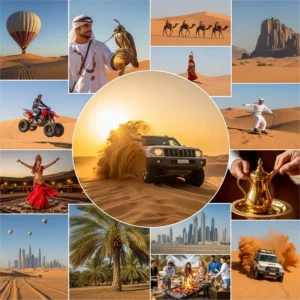
The Red Dunes are the most famous Desert Photography Hotspots. The high iron oxide content creates a deep crimson sand color.
This unique, saturated backdrop is ideal for vibrant Red Dune Photography.
The soft, steep slopes offer challenging and rewarding compositions.
H3: Secluded Crests and Untouched Sand
The Best Photo Spots Dubai are often found on untouched, pristine dune crests.
The lack of footprints and tire tracks elevates the image quality.
Seek operators who use private routes or travel far from the main convoy to secure these clean spots.
H4: Contrasting Textures
The presence of small, resilient desert flora (Ghaf trees) provides a welcome contrast.
Use the texture of the rough foliage against the smooth sand for visual interest.
3. Gear Protocol: Safari Photography Gear and Protection
Protecting your equipment from the fine desert sand is mandatory for every Desert Safari Photography Hotspots trip.
H3: Sand Management
Keep your camera and lenses sealed in plastic bags when not actively shooting. Sand is abrasive and damaging.
Use a rubber blower bulb (never canned air or your breath) to remove dust from the lens surface.
This rigorous protocol protects your Safari Photography Gear.
H3: Essential Safari Photography Gear
A sturdy tripod is essential for low-light Night Sky Safari Photos.
A wide-angle lens (16–35mm) captures the scale of the dunes and sky.
A telephoto lens (70–200mm) is perfect for compressed landscape shots and detailed portraits.
H4: The UV Filter Mandate
Always use a UV filter on your lens. It acts as a sacrificial barrier against sand abrasion.
It is cheaper to replace a scratched filter than an entire lens element.
4. Composition Secrets: The Ultimate Dubai Shot
Composition transforms a snapshot into the Ultimate Dubai Shot.
H3: The Rule of Thirds and Leading Lines
Apply the Rule of Thirds by placing the horizon on the upper or lower line.
Utilize the sharp lines of the dune crests as leading lines. These draw the viewer’s eye into the frame.
These techniques add depth and visual power to the scene.
H3: Silhouettes and Scale
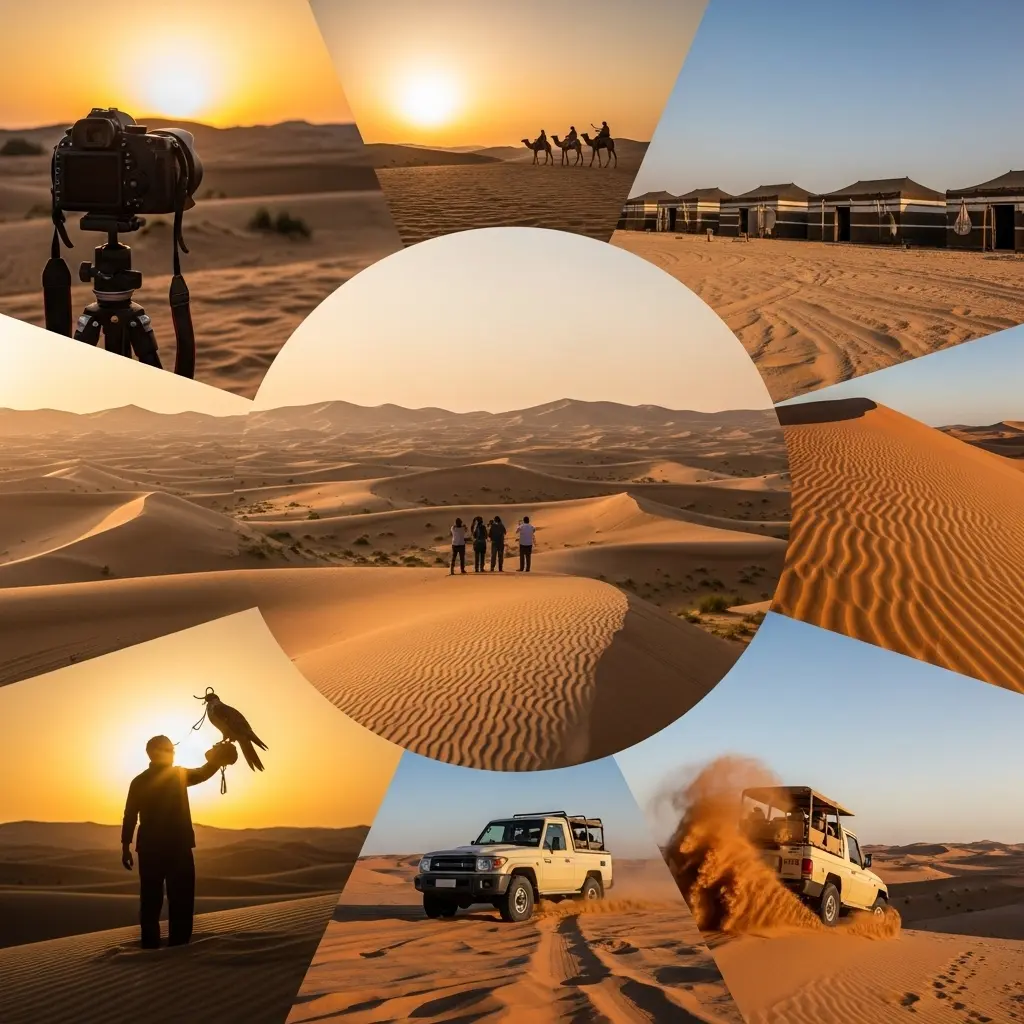
Shoot silhouettes during the Golden Hour. Position your subject (camel, person) against the brightest sky.
Include a small subject in the distance to emphasize the immense scale of the Arabian Desert.
The sense of isolation enhances the drama of the Ultimate Dubai Shot.
H4: Focusing Techniques
Focus manually on the subject or the dune crest for maximum sharpness. Autofocus often struggles in the low light of Golden Hour Safari.
Zoom in for powerful portraits, minimizing distracting backgrounds.
5. Activity Focus: Capturing Camel Ride Photography and Dune Bashing
The activities provide dynamic subjects for your Desert Safari Photography Hotspots session.
H3: Capturing the Dune Bashing Thrill
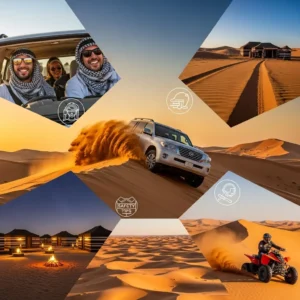
Use a fast shutter speed (1/1000th of a second or faster) to freeze the motion of the 4×4 and the spray of sand.
This technique is necessary for high-impact Action Shots.
Position yourself safely on a stable dune, away from the vehicle’s path.
H3: Camel Ride Photography
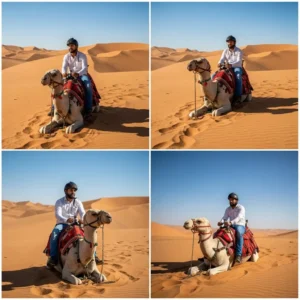
The Camel Ride offers rhythmic, iconic images. Use a slightly slower shutter speed (1/60th) and pan with the subject.
This creates a beautiful motion blur in the background, conveying movement and rhythm.
Ask the guide to position the camels against the sunset for the classic silhouette.
H4: Sandboarding Action
Shoot sandboarding from a low angle at the bottom of the dune. This exaggerates the height and speed of the descent.
This provides unique action material for the Desert Photography Hotspots.
6. Post-Processing: Editing Tips and Color Grading
Editing is where you refine the Desert Safari Photography Hotspots colors and textures.
H3: Enhancing Red Dune Photography Color
For Red Dune Photography, slightly increase the Saturation and Warmth (temperature) in the orange and red channels.
This intensifies the unique crimson hue of the sand.
Use the Dehaze tool to reduce atmospheric haze and increase clarity.
H3: Tonal Adjustments
Slightly lift the shadows to reveal detail in the dark areas of the dunes.
Boost contrast to ensure the textures of the sand ripples stand out sharply.
This refinement enhances the professionalism of your images.
H4: Night Sky Correction
Use a cool white balance for Night Sky Safari Photos to emphasize the deep blues and purples of the night.
Apply noise reduction carefully to maintain the sharp definition of the stars.
7. Strategic Booking: Expert Photo Guide Access
Securing an Expert Photo Guide is the most effective way to guarantee success.
H3: Private Tour Access
Booking a private tour through specialists (e.g., https://royaldesertadventures.ae/) guarantees exclusive access to untouched dunes.
Your guide serves as a dedicated Expert Photo Guide and assistant.
This ensures the best Desert Safari Photography Hotspots are yours alone.
H3: Vetting Guide Skills
Check reviews on platforms like https://dubaidesertsafarie.com/ and https://hafiztourism.com/ for feedback on guide knowledge of photography.
The best guides understand composition and timing.
This vetting process is essential for high-quality results.
H4: Timing Punctuality
Confirm the operator’s punctuality, as missing the Golden Hour by just a few minutes ruins the shoot.
8. Final Preparation: Ultimate Dubai Shot Checklist
A final checklist ensures you are ready to capture the Ultimate Dubai Shot.
| Gear | Check Status | Importance | Desert Safari Photography Hotspots |
| Tripod | Charged/Packed | Mandatory for Night Sky Safari Photos | |
| Blower/Brush | Packed | Essential for sand removal | |
| Extra Battery | Fully Charged | Necessary (Heat drains battery fast) | |
| Sunscreen | Applied/Packed | Crucial for Safety |
FAQs: Dubai Desert Safari Photography Hotspots 2025
1. What is the single most important time of day for capturing the Desert Safari Photography Hotspots, and how long does it typically last?
The single most important time is the Golden Hour, which occurs just before and during sunset. Duration: The prime light lasts approximately 30 to 45 minutes. This period is crucial because the low sun angle creates long, dramatic shadows and bathes the Desert Safari Photography Hotspots in warm, soft light, which is ideal for portraiture and landscape photography. Missing this window significantly diminishes the visual quality of the Ultimate Dubai Shot.
2. How does the unique color of the Red Dune Photography sand affect the required camera settings compared to regular desert photography?
The intense color of the Red Dune Photography sand requires careful white balance adjustment. Photographers should manually set the white balance to ‘Cloudy’ or ‘Shade’ to enhance the natural red and orange tones. This prevents the camera from automatically neutralizing the warm colors, ensuring the crimson hue of the sand is fully saturated in the final Desert Photography image.
3. What specific Safari Photography Gear is mandatory for a photographer attempting to capture high-quality Night Sky Safari Photos?
Mandatory gear for capturing high-quality Night Sky Safari Photos includes a sturdy tripod (essential for long exposures), a wide-angle lens with a fast aperture (f/2.8 or wider), and a remote shutter release (or self-timer) to prevent camera shake. These items allow the photographer to gather maximum light over a long duration without capturing blurry star trails, which is a common challenge in Night Sky Safari Photos.
4. How can a traveler use the external link https://dubaidesertsafarie.com/ to vet an operator’s commitment to providing access to the Best Photo Spots Dubai?
A traveler can use the external link https://dubaidesertsafarie.com/ to vet an operator’s commitment by checking verified customer reviews. Look for specific feedback confirming the guide was patient, knowledgeable about the light, and willing to stop at secluded dune crests. Positive comments on the quality of the sunset viewing spot indicate a high priority for the photographic experience, confirming access to the Best Photo Spots Dubai.
5. What are the key distinctions in safety protocol when capturing dynamic Dune Bashing Photos versus a peaceful Camel Ride photo session?
The key safety distinction is proximity and shutter speed. Dune Bashing Photos: The photographer must shoot from a safe, stationary distance and use a very fast shutter speed (1/1000s+) to freeze the action. Camel Ride Photos: The photographer can get closer but must secure their camera with a strap due to the camel’s movement. The shutter speed can be slower (1/60s) to convey motion blur in the background.
6. Why should photographers be wary of changing lenses in the desert, and what Safari Photography Gear should be used to prevent sand damage?
Photographers should be wary of changing lenses because the fine desert sand is highly abrasive and can easily contaminate the camera’s sensor, leading to expensive damage. Prevention: Use sealed plastic bags (Ziploc) to create a makeshift clean zone for lens changes, or only change lenses inside the air-conditioned vehicle. A rubber blower bulb is essential Safari Photography Gear for non-contact cleaning of the lens surface.
7. What specific post-processing techniques should be applied to Red Dune Photography to maximize the unique crimson color of the sand?
To maximize the crimson color in Red Dune Photography, specific post-processing techniques must be applied. 1. Color Boost: Increase the Saturation and Vibrancy sliders, focusing primarily on the orange and red channels. 2. White Balance: Adjust the temperature slightly warmer to enhance the natural red pigments. 3. Clarity: Use the Clarity or Texture sliders to bring out the subtle ripples and definition in the sand, enhancing the visual impact.
8. How does booking a private photo tour through https://royaldesertadventures.ae/ enhance the Luxury Safari Photography experience compared to a standard tour?
Booking through https://royaldesertadventures.ae/ enhances Luxury Safari Photography by guaranteeing exclusivity and personalized time. Enhancement: The private tour guarantees a secluded dune crest for the sunset (no crowds), direct collaboration with an expert guide on posing and timing, and high-quality props, ensuring the captured images are unique, professional, and intimate.
9. What unique Desert Photography Spots are available in the desert that are overlooked by most standard tourist safaris?
Unique Desert Photography Spots overlooked by most standard tours include pristine, untracked sand dunes located far from the main convoy, and subtle desert flora or animal tracks (lizard, beetle) used as foreground interest. Accessing these secluded spots usually requires a private 4×4 or a dedicated photography-focused tour.
10. How can a photographer use Dune Photography Tips and the Rule of Thirds to effectively capture the immense scale of the desert landscape?
A photographer can use Dune Photography Tips and the Rule of Thirds by including a small subject in the composition. Technique: Place the subject (a person or a small camel) on one of the intersecting lines of the Rule of Thirds. This placement, combined with a wide-angle lens capturing the vast sky and sweeping sand, immediately emphasizes the overwhelming scale of the desert landscape.
11. What is the value proposition of a Desert Safari Photography Hotspots package that includes an Expert Photo Guide in the price?
The value proposition of a package that includes an Expert Photo Guide is guaranteed optimal results and efficiency. The guide ensures the traveler is positioned perfectly at the Desert Safari Photography Hotspots during the narrow window of the Golden Hour. Their expertise saves valuable time that would otherwise be wasted searching for the right angle or struggling with camera settings.
12. What attire choices are best for Desert Safari Photography Hotspots to create contrast and dynamic movement in portrait shots?
The best attire choices for Desert Safari Photography Hotspots involve flowing fabrics and contrasting colors. Style: Long, flowing dresses, skirts, or shawls catch the desert wind, creating dramatic movement and shape. Color: Stark neutrals (white, black) or deep jewel tones (red, turquoise) contrast beautifully against the golden or crimson sand, making the subject stand out.
13. How does checking the operator’s reputation on https://hafiztourism.com/ help confirm they will allow sufficient time for Sunset Photography Tips?
Checking the operator’s reputation on https://hafiztourism.com/ helps confirm they allow sufficient time by reviewing customer feedback on punctuality and schedule flexibility. Look for comments that confirm the guide was patient and allotted at least 15–20 minutes at the dune crest. Operators who are chronically late often rush the sunset stop, which is a major red flag for photography-focused travelers.
14. What are the key differences in mood and aesthetic between images captured during the Golden Hour Safari and the Blue Hour?
Golden Hour Safari: The mood is warm, romantic, and adventurous. The aesthetic is defined by long, defined shadows and intense gold/orange color saturation. Blue Hour: The mood is cool, serene, and dramatic. The aesthetic is defined by rich blue and purple tones, and images are often used for clean silhouettes or low-light atmospheric shots of the camp. Both are essential for a complete visual story.
15. What are the safety precautions a photographer must take when attempting low-angle shots for a Desert Safari Photography Hotspots session?
Safety precautions for low-angle shots are essential for both the equipment and the photographer. 1. Equipment: Never place the camera directly on the sand. Use a plastic sheet or a small cloth to protect the body and lens. 2. Personal: Be aware of your surroundings, especially behind you, and watch for small, concealed dangers like sharp debris or insects that may be active near the ground. 3. Movement: Always ensure the vehicle is completely shut off before positioning the camera low to the ground.