Desert Safari Entertainment 11 Thrilling Shows You Must See
The sun has set.
The golden dunes are now dark.
The air is cool and crisp.
You have finished the dune bashing.
Your heart is still racing.
But the night is just beginning.
Welcome to the world of desert safari entertainment.
This is not just a dinner.
It is a festival of culture.
It is a showcase of talent.
Many tourists do not expect this.
They think it is just a drive.
But the camp is full of life.
The lights turn on.
The music starts playing.
The smell of BBQ fills the air.
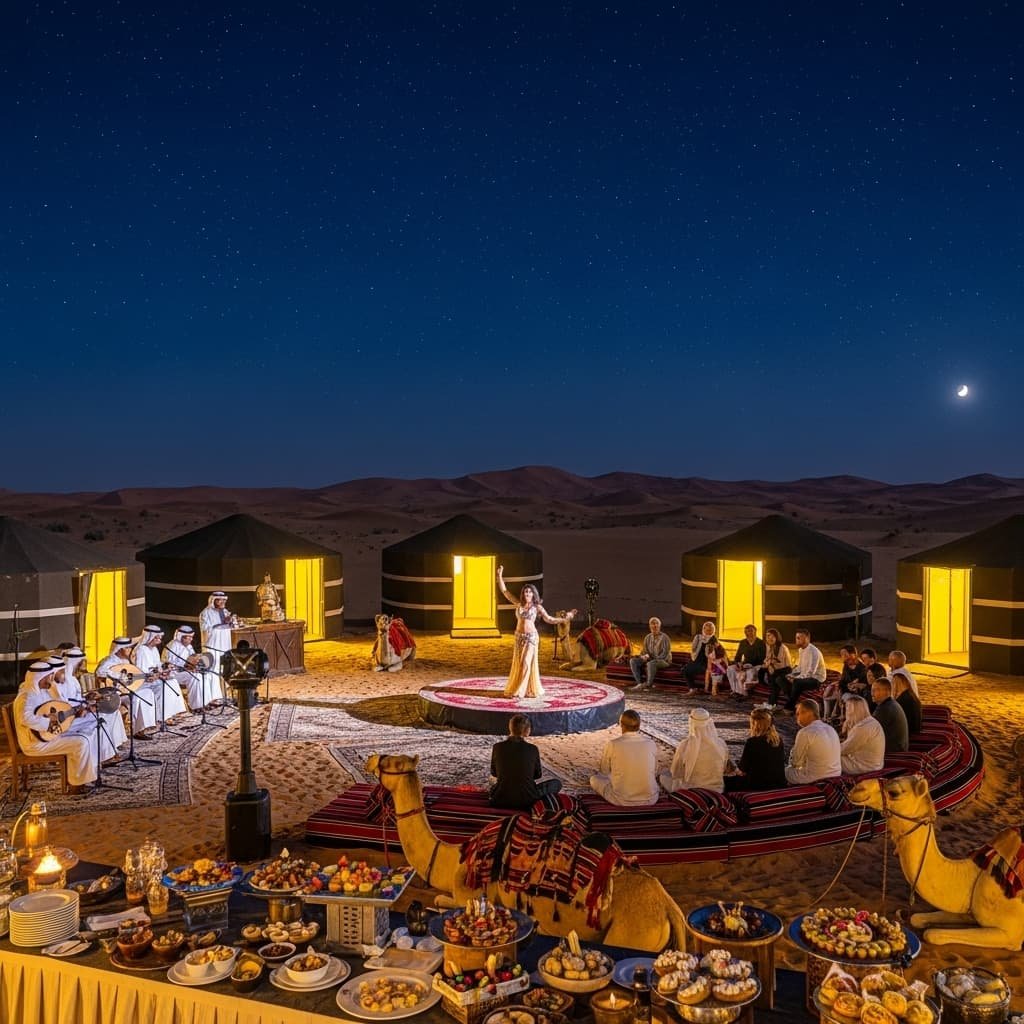
You sit on comfortable cushions.
You are surrounded by tradition.
The stage is set in the center.
Everyone is watching.
What happens next is magical.
This guide explores every detail.
We will talk about the dances.
We will explain the history.
We will help you understand the art.
Desert safari entertainment is unique.
It mixes danger with grace.
It mixes noise with silence.
You will see things here you cannot see elsewhere.
Get ready for the show.
The Magic of the Tanoura Dance
The first act is usually the Tanoura.
This is a favorite for many.
It originates from Egypt.
It is a Sufi folk dance.
The word Tanoura means skirt.
The dancer wears a colorful skirt.
It is very heavy.
It has many layers.
The music begins with a drum beat.
The dancer starts to spin.
He spins in circles.
He does not stop.
He spins for ten minutes or more.
It is dizzying to watch.
But he is perfectly balanced.
This represents the universe.
The dancer is the sun.
The skirt represents the planets.
It is a spiritual connection.
The colors blur together.
It looks like a human kaleidoscope.
The desert safari entertainment highlights this skill.
Suddenly, the lights go out.
The skirt lights up.
It has LEDs inside.
The crowd gasps in amazement.
It looks like a spinning UFO.
He creates patterns with the skirt.
He lifts it over his head.
He spins it like a baby.
It is pure skill.
It takes years to practice.
If you try it, you will fall.
But he stands tall.
He smiles at the crowd.
He might invite you to try.
Go ahead and try.
It is harder than it looks.
You will respect him more.
This is the soul of the evening.
The Grace of Belly Dancing
Next comes the belly dancer.
This is very famous.
It is known worldwide.
But seeing it here is special.
The dancer enters with energy.
She wears a sparkling costume.
The music is fast and rhythmic.
It is traditional Arabic music.
She moves with the beat.
Her movements are fluid.
She isolates her muscles.
It is very difficult to do.
She balances a sword sometimes.
Or she balances a cane.
Or a candelabra on her head.
This adds to the thrill.
Desert safari entertainment relies on her energy.
She interacts with the guests.
She smiles and waves.
She walks around the tables.
She encourages people to clap.
The atmosphere becomes lively.
Everyone starts moving.
It is a celebration of life.
It is not just for men.
Women enjoy the art too.
It empowers the female spirit.
The costumes are beautiful.
They are hand-embroidered.
They shine under the spotlights.
It is a visual treat.
She performs for about 20 minutes.
It feels short because it is fun.
She ends with a fast drum solo.
Her hips move incredibly fast.
Then she takes a bow.
The crowd cheers loudly.
It is a classic Arabian moment.
The Danger of the Fire Show
Now things get hot.
The lights dim again.
The music changes.
It becomes intense and dramatic.
A man enters with fire.
He holds burning batons.
He spins them fast.
The fire makes a whooshing sound.
You can feel the heat.
Even from your seat.
This is the most exciting part of desert safari entertainment.
He throws the fire in the air.
He catches it behind his back.
He does not flinch.
He is fearless.
He takes a sip of fuel.
He blows it onto the torch.
A huge ball of fire erupts.
It lights up the whole camp.
It looks like a dragon.
The kids love this part.
They watch with wide eyes.
It is dangerous but controlled.
Safety is a priority.
The performer is a professional.
He knows the wind direction.
He knows the limits.
He spins fire ropes.
They create circles of light.
It is great for photos.
Use a fast shutter speed.
Capture the trail of the fire.
It looks artistic.
He might eat the fire.
He puts the torch in his mouth.
The flame goes out.
The crowd screams.
It is pure adrenaline.
It wakes everyone up.
It is the climax of the night.
Live Oud Music
Not all entertainment is loud.
Some of it is quiet.
There might be an Oud player.
The Oud is an instrument.
It looks like a guitar.
But it has a short neck.
It has a pear shape.
It is very old.
It is the grandfather of the guitar.
The sound is deep and sad.
It is very beautiful.
The musician sits on a carpet.
He plays traditional songs.
It sets a relaxed mood.
This is the background of desert safari entertainment.
You listen while you eat.
It helps you digest.
It helps you relax.
The notes float in the air.
They mix with the wind.
It feels authentic.
It feels like the old days.
Before electricity.
When Bedouins sang by the fire.
Request a song if you know one.
He might play it.
He is usually very skilled.
He improvises the melodies.
It is not recorded music.
It is live and raw.
It touches the heart.
The Welcome Ritual
Entertainment starts at the door.
When you arrive, you are a guest.
Hospitality is an art here.
You are greeted with smiles.
You are offered Ghawa.
This is Arabic coffee.
It is served in small cups.
It is spiced with cardamom.
It is bitter and strong.
You are offered fresh dates.
They are sweet and soft.
The mix of bitter and sweet is perfect.
This is a form of desert safari entertainment.
It entertains your taste buds.
It teaches you culture.
You are offered rose water.
To wash your hands.
It smells lovely.
You feel like a royal.
The staff wears traditional clothes.
They look elegant.
They guide you to your seat.
They make sure you are comfortable.
This service is a show in itself.
It shows the generosity of Arabs.
It breaks the ice.
You feel welcome immediately.
Visit https://htdesertsafari.com/ for this experience.
They excel at hospitality.
They treat you like family.
Henna Painting Art
Look at the corner of the camp.
There is a lady sitting there.
She has tubes of paste.
This is the Henna artist.
Henna is a plant dye.
It is used for decoration.
It is a temporary tattoo.
This is interactive desert safari entertainment.
You sit with her.
She holds your hand.
She draws beautiful patterns.
She works very fast.
She does not use a stencil.
It is all freehand.
Flowers, vines, and dots.
It feels cool on the skin.
It smells earthy.
You have to let it dry.
Don’t touch it for 20 minutes.
The paste will crumble off.
It leaves an orange mark.
Over time it turns brown.
It lasts for two weeks.
It is a souvenir you wear.
It is very popular with ladies.
But men can try it too.
Maybe a small design.
It is part of the wedding culture.
Brides wear henna for luck.
Now you wear it for fun.
Take a photo of your hand.
Against the sand background.
It looks very aesthetic.
Smoking Shisha
In another corner is the Shisha area.
This is the hubbly bubbly.
It is a water pipe.
It is for smoking flavored tobacco.
It is a social activity.
People sit in a circle.
They share the pipe.
They talk and laugh.
The smoke smells sweet.
Apple, mint, or grape.
It is very relaxing.
The bubbling sound is soothing.
This is passive desert safari entertainment.
You don’t watch a show.
You are the show.
You make smoke rings.
You relax on the bean bags.
It is very traditional.
Coffee shops in the city have this.
But in the desert, it is better.
The open air clears the smoke.
It feels fresher.
If you don’t smoke, just watch.
The pipes are beautiful.
They are made of glass and metal.
They are intricate.
You can ask for your own pipe.
At your table.
This usually costs extra.
But in the designated area, it is free.
Check the rules with https://royaldesertadventures.ae/.
They have nice Shisha lounges.
It adds to the vibe.
Traditional Costume Photography
Do you want to dress up?
There is a costume booth.
You can wear Arab clothes.
For men, it is the Kandura.
It is a long white robe.
And the Guthra for the head.
For women, it is the Abaya.
It is a long black robe.
There are colorful ones too.
They have embroidery.
Put them on over your clothes.
Stand in front of the camera.
Feel like a local.
This is fun desert safari entertainment.
You can act the part.
Look serious or look happy.
The photos come out great.
It is a nice memory.
You can laugh at yourself.
It is not disrespectful.
Locals love sharing their culture.
They want you to try it.
It helps you understand them.
The clothes are practical.
They protect from the sun.
They protect from the sand.
You realize why they wear them.
It is cool and airy.
Take a family photo.
Everyone dressed up.
It will be your holiday card.
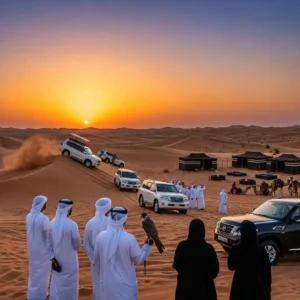
The Falconry Experience
Falcons are majestic birds.
They are the hunters of the sky.
They are symbols of the UAE.
You might see a falconer.
He holds the bird on his arm.
He wears a thick leather glove.
The bird has sharp claws.
But it is calm.
It wears a small hood.
This keeps it relaxed.
You can hold the bird.
Put on the glove.
Feel the weight of it.
Look at its feathers.
They are perfect.
This is educational desert safari entertainment.
Ask the handler questions.
He knows everything about them.
How fast they fly.
What they eat.
How they are trained.
It is a bond between man and bird.
It is thousands of years old.
Bedouins used them for food.
Now it is a sport.
It is a privilege to be close.
Take a selfie with the falcon.
But be gentle.
Do not startle it.
It is a living creature.
Respect the animal.
Stargazing as Entertainment
The show ends.
The lights dim down.
The music stops.
Walk away from the camp.
Just a few meters.
Look up.
The sky is full of stars.
This is nature’s desert safari entertainment.
It is silent.
It is vast.
In the city, you see nothing.
Here, you see everything.
You might see Orion’s Belt.
You might see a planet.
You might see a shooting star.
It is a moment of peace.
After the loud music.
After the fire show.
This contrast is beautiful.
It calms your soul.
You feel small.
The universe is big.
This is the real desert.
The entertainment of the cosmos.
You don’t need a ticket.
You don’t need a seat.
Just your eyes.
And a clear mind.
Breathe in the cool air.
Let the moment sink in.
It is the best way to end the night.
The Buffet as a Show
Food is also entertainment.
The buffet is huge.
It is a visual feast.
There are long tables.
Piles of fresh salad.
Bowls of hummus.
Baskets of bread.
The BBQ station is live.
You watch the chefs cook.
Flames lick the meat.
Smoke rises up.
The smell makes you hungry.
This is culinary desert safari entertainment.
You wait in line.
You chat with the chefs.
“One kebab please.”
“More chicken please.”
They serve you hot food.
There is Shawarma too.
They shave the meat off the spit.
It is an art form.
Making the perfect roll.
Adding the garlic sauce.
It is delicious.
There are desserts too.
Om Ali is a pudding.
It is warm and sweet.
There are fresh fruits.
Melons and pineapples.
It refreshes you.
Eating under the stars.
It is a unique dining experience.
The food is part of the show.
Check the menu at https://dubaidesertsafarie.com/.
They have great variety.
Audience Interaction
The best part is you.
The audience makes the show.
The dancers interact with you.
They pull you on stage.
Don’t be shy.
Go up and dance.
Shake your hips.
Spin around.
Everyone will clap.
It is fun desert safari entertainment.
Laugh at yourself.
Enjoy the moment.
It builds a community.
Strangers become friends.
You are all in this together.
In the middle of nowhere.
Sharing a laugh.
Sharing a meal.
The MC (Master of Ceremonies) helps.
He tells jokes.
He organizes games.
He announces the shows.
He keeps the energy high.
Without the audience, it is nothing.
So participate.
Clap your hands.
Cheer loudly.
Make the performers happy.
They work hard for you.
Give them energy back.
Timing of the Shows
When does it happen?
The timeline is important.
You arrive at sunset.
You settle in.
First is the starters.
Then the first show.
Usually the Tanoura.
Then the main dinner opens.
You eat while listening to music.
Then the Belly Dancer.
She performs while you finish eating.
Then the lights go out.
The Fire Show is the finale.
It ends with a bang.
This flow is designed perfectly.
It keeps you engaged.
You are never bored.
There is always something happening.
The desert safari entertainment is paced well.
It lasts about 2 hours.
From 7:00 PM to 9:00 PM.
Then it is time to go.
The driver waits for you.
You are full and happy.
You have seen so much.
In just a few hours.
Safety Measures
Is it safe?
Yes, absolutely.
The fire show is controlled.
There is a safe distance.
You are not too close.
Fire extinguishers are nearby.
The dancers are professionals.
They practice every day.
The stage is stable.
The equipment is checked.
Companies take safety seriously.
Especially https://royaldesertadventures.ae/.
They have strict protocols.
Crowd control is managed.
Kids are kept away from fire.
Security guards are present.
To ensure peace.
To help if needed.
You can relax.
You are in good hands.
Just follow instructions.
Don’t run onto the stage uninvited.
Respect the boundaries.
Enjoy the show safely.
Photography Tips
You want to capture this.
It is tricky lighting.
It is dark.
The subjects are moving fast.
Use “Sports Mode” on your camera.
It freezes the action.
For the fire show, use slow shutter.
It blurs the fire.
It looks artistic.
For the belly dancer, use flash.
Or a high ISO.
She moves very fast.
Don’t use flash for the Tanoura.
His lights are bright enough.
Flash ruins the LED effect.
Take videos too.
The music is part of it.
Capture the sound of the drums.
Capture the cheers.
Selfies are hard in the dark.
Find a light source.
Stand near a lantern.
Let the light hit your face.
The desert safari entertainment is photogenic.
Share it on Instagram.
Your friends will be jealous.
It looks exotic.
It looks exciting.
Because it is.
What to Wear
Dress comfortably.
You sit on low cushions.
Or on the floor.
Tight jeans are bad.
Short skirts are awkward.
Wear loose trousers.
Wear a long skirt.
You can move easily.
You can sit cross-legged.
Bring a jacket.
The night gets cold.
While watching the show, you sit still.
You might shiver.
A hoodie is perfect.
Shoes don’t matter much.
You can take them off.
Feel the carpet.
Feel the sand.
It is casual.
No need for a suit.
No need for high heels.
Be practical.
Be cozy.
You are there to relax.
Not to impress.
Unless you get on stage.
Then wear your smile.
Kids and Entertainment
Is it good for kids?
Yes, they love it.
The colors excite them.
The fire fascinates them.
The music makes them dance.
They can run in the sand.
They can get henna too.
They can ride the camel.
It is family-friendly desert safari entertainment.
The dancers are respectful.
It is not inappropriate.
It is cultural.
Kids learn about other countries.
They see new instruments.
They taste new food.
It opens their minds.
But watch them near the fire.
Keep them seated during the show.
They might want to run to the dancer.
Hold them back.
Unless invited.
By the end, they will be tired.
They will sleep in the car.
Dreaming of spinning skirts.
Private Entertainment
Do you want exclusivity?
You can book a private safari.
You can request a private show.
Just for your group.
This is expensive.
But it is luxury.
You can hire an Oud player.
To play at your private camp.
You can have a private fire show.
It is very romantic.
It is VIP desert safari entertainment.
Perfect for weddings.
Perfect for corporate events.
Impress your boss.
Impress your partner.
You control the schedule.
You choose the music.
It is customizable.
Check with https://htdesertsafari.com/.
They arrange VIP services.
They make it happen.
Whatever you dream of.
Comparing Shows
Every camp is different.
Some have 3 shows.
Some have 5 shows.
Some have live singers.
Some have magic shows.
Budget camps have simple shows.
Luxury camps have top talent.
The quality varies.
A good dancer costs money.
A good fire artist costs money.
If you pay very little.
Expect a simple show.
If you pay a fair price.
Expect a spectacle.
Do your research.
Read reviews.
“Was the show good?”
“Was it boring?”
Look for these comments.
Choose a reputable company.
Like https://dubaidesertsafarie.com/.
They maintain standards.
They hire professionals.
Don’t waste your night on a bad show.
Go for the best.
The Sound System
The audio matters.
The music must be loud.
But not too loud.
It must be clear.
You want to hear the beat.
You want to feel the bass.
Good camps have good speakers.
They surround the stage.
The sound is immersive.
If the sound is bad.
It ruins the show.
Crackling speakers are annoying.
Ideally, the volume allows talking.
You want to chat with friends.
While watching.
It is a balance.
The DJ controls the mood.
He plays upbeat songs.
He plays slow songs.
He knows the crowd.
He reads the room.
It is a skill.
He is part of the desert safari entertainment team.
Cultural Sensitivity
Remember where you are.
You are in the UAE.
It is a Muslim country.
The entertainment is respectful.
Belly dancing is art.
It is not vulgar here.
It is family entertainment.
During Ramadan, it changes.
There is no belly dancing.
There is no loud music.
This is out of respect.
The desert safari entertainment becomes quiet.
Only Oud music maybe.
Or just the fire show.
And the Tanoura.
Check the dates.
If you want the full party.
Don’t go during Ramadan.
If you want peace.
Ramadan is perfect.
Be aware of this.
Don’t be disappointed.
It is the law.
And it is the culture.
Respect it.
Souvenirs and Memories
You can buy memories.
Photographers walk around.
They take photos of you.
With the dancers.
With the falcon.
They print them instantly.
Put them in a frame.
It costs extra.
But it is high quality.
Better than a phone selfie.
You can buy sand art.
Sand in a bottle.
With your name on it.
You can buy scarves.
Or small camels.
Support the local artists.
Take a piece of the desert home.
Every time you look at it.
You will remember the night.
The fire.
The dance.
The music.
It keeps the memory alive.
Conclusion
Desert safari entertainment is a highlight.
It transforms a dinner into an event.
It brings culture to life.
It engages all your senses.
Sight, sound, taste, touch.
From the spinning Tanoura.
To the thrilling fire.
Every moment is planned.
To give you joy.
To give you a story.
Don’t skip the evening safari.
The morning is for dunes.
The evening is for the soul.
Book your tickets.
Experience the magic.
Visit https://htdesertsafari.com/.
Or https://royaldesertadventures.ae/.
Or https://dubaidesertsafarie.com/.
Get the best seats.
Sit back.
And let the show begin.
Dubai nights are waiting for you.
Frequently Asked Questions (FAQs)
1. What types of entertainment are included in a standard desert safari? A standard evening desert safari typically includes three main live performances. These are the Tanoura Dance (a spinning Sufi dancer with a lighted skirt), the Belly Dance (a traditional Arabian dance performance), and the Fire Show (an acrobat performing with flaming batons and breathing fire). In addition to the stage shows, there are ongoing activities like Henna painting for ladies, Shisha smoking in a designated area, Camel riding for short distances, and opportunities to dress in traditional Arabic costumes (Kandura and Abaya) for photography. Background music, often live Oud or recorded Arabic tracks, plays throughout the evening to set the atmosphere.
2. Is the belly dance performance suitable for children and families? Yes, absolutely. The belly dance performances in Dubai desert camps are designed to be family-friendly and culturally respectful. It is considered an art form and a cultural expression rather than something inappropriate. The dancers are professional and wear costumes that are modest compared to western nightclub standards. Children often enjoy the rhythm and the visual spectacle. However, during the holy month of Ramadan and certain religious holidays, belly dancing is prohibited by law and will not be performed.
3. Are the entertainment shows available during Ramadan? During the holy month of Ramadan, the entertainment lineup changes significantly out of respect for the religious period. Loud music and dancing, specifically the Belly Dance, are strictly prohibited by UAE government regulations. The Tanoura dance and the Fire show usually continue as they are considered cultural or acrobatic performances rather than “dance parties.” Background music will be soft or non-existent. No alcohol is served. If you want the full entertainment experience with loud music and dancing, you should avoid booking during Ramadan.
4. Can I participate in the shows? Yes, audience participation is highly encouraged! The performers, especially the Tanoura dancer and the Belly dancer, often invite guests onto the stage to try the moves. It is a fun and lighthearted part of the desert safari entertainment. You might be asked to try spinning like the Tanoura artist (which is very hard!) or shake your hips with the belly dancer. It is a great photo opportunity and makes for hilarious memories with your friends and family. Don’t be shy; the crowd is always supportive.
5. Is the entertainment safe? Safety is a top priority for reputable tour operators. The Fire Show, which carries the most risk, is performed by trained professionals who maintain a safe distance from the audience. Fire extinguishers and safety blankets are always on standby near the stage. The stages are secure, and crowd control is managed to keep children away from dangerous areas. Activities like camel riding are supervised by handlers. However, always follow the instructions of the staff and keep an eye on your children, especially near the fire performance area.
6. Do I have to pay extra for the entertainment? Generally, no. The standard live shows (Tanoura, Belly Dance, Fire Show), Henna painting (small designs), Camel riding (short loop), and Costume photography are all included in the price of your Evening Desert Safari ticket. However, there are some exceptions. Large or intricate Henna designs might cost extra. Having a Shisha pipe brought to your private table usually incurs a charge (though it is often free in the shared Shisha lounge). Taking photos with a falcon often costs a small fee. Always check your specific package inclusions on https://htdesertsafari.com/.
7. How long do the shows last? The entertainment segment of the evening usually spans about 2 hours. It typically starts after sunset, around 7:00 PM, and concludes by 9:00 PM. The shows are interspersed with the dinner service. For example, the Tanoura dance might happen during appetizers, soft music during the main course, and the Belly Dance and Fire Show towards the end of the meal. Each individual performance lasts between 15 to 20 minutes. The flow is designed to keep you entertained while you eat and relax.
8. What happens if it rains? Rain is rare in the desert, but it does happen, especially in winter. Most desert camps are open-air venues. If there is light rain, the show might continue, or guests might be moved to covered areas (majlis tents) if available. However, heavy rain can make the stage slippery and dangerous for dancers, especially the fire performer and the spinning Tanoura artist. In cases of severe weather, the entertainment might be cancelled or modified for safety reasons. Refunds depend on the company’s policy, so check with https://royaldesertadventures.ae/ before booking.
9. Can I request a specific song? In a shared camp setting, the music is controlled by a DJ who follows a set playlist designed to cater to a diverse international crowd. It is unlikely they will play a specific request unless it fits the vibe. However, if there is a live Oud player or singer, you can certainly ask them politely if they know a particular traditional song. In a private safari or corporate event where you have booked the entire camp, you have full control over the music and can request whatever playlist you prefer.
10. Is the Henna tattoo permanent? No, Henna is a temporary natural dye made from the crushed leaves of the henna plant. When applied, it is a dark paste. After it dries and crumbles off (usually after 20-30 minutes), it leaves an orange stain on the skin which darkens to a reddish-brown color over the next 24 hours. The stain typically lasts for 1 to 2 weeks depending on how often you wash the area and your skin type. It is completely painless and safe for most people, but if you have sensitive skin, do a patch test first.
11. Can men get Henna? Traditionally, Henna is a female adornment used for weddings and celebrations in Arab culture. However, there is no strict rule against men getting it. Some men get small tribal designs or symbols. However, it is overwhelmingly popular with women. If you are a man and want to try it, the artists will usually oblige, but be aware that it will stay on your hand for two weeks!
12. What is the Tanoura dance significance? The Tanoura dance is more than just entertainment; it has deep spiritual roots in Sufism. The continuous spinning represents the rotation of the planets around the sun and the soul’s journey towards God. The dancer enters a trance-like state. The lifting of the skirt represents the shedding of worldly burdens. One hand is raised to receive blessings from heaven, and the other points down to pass them to earth. Watching it with this knowledge makes the desert safari entertainment much more meaningful.
13. Are the performers local Emiratis? Usually, no. The performers in desert camps are typically professional artists from other countries. The Belly Dancers are often from Eastern Europe, South America, or other Arab countries like Lebanon or Egypt. The Tanoura dancers are almost exclusively Egyptian, as the dance originates there. The Fire performers can be from anywhere. While they are not Emirati, they are experts in these specific regional arts and provide a high-quality performance that celebrates the broader Middle Eastern culture.
14. Can I take photos and videos of the show? Yes, photography and videography are encouraged. The performers love the attention. However, please be respectful. Do not use flash excessively in the dancers’ faces, as it can distract them or be dangerous during the fire show. Also, be mindful of other guests’ privacy. If you are taking photos of the general crowd, try not to intrude on families or local women who might prefer not to be photographed. But for the stage shows, snap away!
15. Is Shisha safe to try? Shisha involves smoking tobacco through water. While the water cools the smoke and makes it feel smoother, it is still tobacco and contains nicotine. It is not “safe” in a health sense, just like cigarettes are not safe. However, trying it once for a few puffs as a cultural experience is common for tourists. If you are a non-smoker, be careful as it might make you feel lightheaded. There are herbal, tobacco-free shisha options available at some camps if you ask.
16. What is the best seat for the show? The stage is usually in the center of the camp (a circular stage), with tables arranged around it. The best seats are the ones in the front row or “VIP” section. These seats give you an unobstructed view of the dancers’ footwork and the fire details. Standard seating might be a bit further back. If photography is important to you, arrive early to claim a seat near the stage or book a VIP package with https://dubaidesertsafarie.com/ to guarantee a prime spot.
17. Do I need to tip the performers? Tipping is not mandatory, but it is appreciated. If a dancer pulls you on stage and you have a great time, or if the Henna artist does a beautiful design, a small tip is a nice gesture. There are no tip jars on stage, but you can approach them after the show. Sometimes, the photographers or falcon handlers rely on tips or sales of photos for their income, so support them if you liked the service.
18. Is there entertainment for VIP guests? VIP guests usually get the best seats in the house, often on raised platforms or sofas right next to the stage. They also get table service, so they don’t have to stand in the buffet line and miss the show. Some ultra-luxury VIP experiences might include a private performance at their table, like a magician or a private musician, but this is rare in standard camps. The main stage show is shared by everyone, VIP or standard.
19. What should I do if the music is too loud? Desert camps are open-air, but the sound systems can be powerful to reach the back rows. If you are sensitive to loud noise, try to sit further away from the speakers (usually located near the stage pillars). The “Standard” seating area is often quieter than the VIP area which is right next to the stage. You can also bring earplugs for children if you think it might be overwhelming for them.
20. Why is the Fire Show last? The Fire Show is the finale because it is the most visually striking and high-energy performance. It requires total darkness to be effective, so it must happen late in the evening. It wakes the crowd up after a heavy dinner and leaves everyone on a high note before they head back to the buses. It signals the end of the desert safari entertainment program and the beginning of the journey home.
Feature Image Prompt
Prompt: A vibrant night scene at a Dubai desert safari camp. Center stage features a male Tanoura dancer spinning with a glowing, multi-colored LED skirt creating a light trail effect. To the side, a fire breather blows a plume of orange fire into the dark starry sky. In the foreground, silhouettes of tourists sitting on traditional Arabic floor cushions and carpets, watching in awe. Warm lanterns glow on low wooden tables. Background shows dark sand dune outlines against a deep blue cosmos sky with bright stars. No text on image.
Alt Text: Desert safari entertainment Dubai featuring LED Tanoura dancer and fire show at night camp with tourists watching.