A Desert Reptile Guide: Uncovering the Desert’s Secret Inhabitants
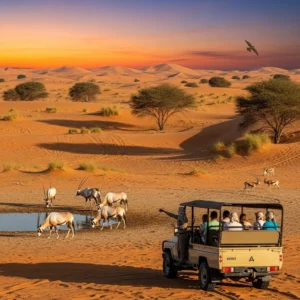
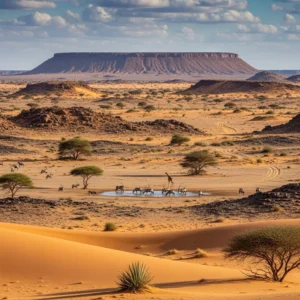
The Arabian Desert holds its secrets close. While the magnificent Oryx and graceful gazelles are the celebrated icons of the landscape, a far more ancient and mysterious community of creatures thrives just beneath the surface, under the rocks, and within the deep shadows of the night. This is the world of reptiles, arachnids, and other rare creatures—the true masters of desert survival.
To catch a glimpse of this hidden realm is to experience the desert on an entirely different level. It requires a shift in perspective, from the grand scale of the dunes to the intricate details of the desert floor. This in-depth Desert Reptile Guide is your passport to this secret world. We will explore the fascinating adaptations of these elusive animals, from snakes that move like sidewinders to lizards that swim through sand.
Embarking on a specialized nature safari, particularly after dark, is your best chance to meet these inhabitants. This journey is not about speed, but about patience and discovery. Prepare to uncover the stories written in the sand by the desert’s most resilient and remarkable survivors.
The World of Desert Lizards: Sun Worshippers and Sand Swimmers
Lizards are the most visible and diverse group covered in this Desert Reptile Guide. They have evolved an incredible array of tools to thrive in the heat.
Spiny-tailed Lizard (Uromastyx aegyptia microlepis)
Known locally as the Dhub, this is a large, herbivorous lizard that looks like a miniature dinosaur. Its most prominent feature is its thick, powerful tail covered in rings of sharp spines, which it uses as a defensive weapon. They are primarily active during the day (diurnal) and can often be seen basking near the entrance to their extensive burrows.
Desert Monitor (Varanus griseus)
The largest lizard in the Arabian desert, the Desert Monitor is an impressive and active predator. It can grow to over a meter in length and spends its days hunting for rodents, birds, eggs, and other small animals. They are powerful diggers and fast runners, a truly impressive sight for any wildlife enthusiast.
The Sandfish Skink (Scincus mitranus)
The “Sandfish” is one of the desert’s most magical creatures. This small, smooth-scaled lizard has a remarkable ability to “swim” through loose sand as if it were water. Its shovel-shaped snout, streamlined body, and the ability to vibrate its body at high speed allow it to dive into the sand and move effortlessly beneath the surface to escape predators or the heat.
Wonder Gecko (Teratoscincus keyserlingii)
A star of the nocturnal safari, the Wonder Gecko is a beautiful lizard with large, captivating eyes and skin so delicate it is almost translucent. They are known for their ability to make a surprisingly loud rasping sound by rubbing the large scales on their tail together, a tactic used to ward off predators.
The Snakes of the Sands: Myths and Realities
Snakes are a source of both fear and fascination. While the desert is home to several venomous species, sightings are very rare, and they pose virtually no threat on a guided tour. This Desert Reptile Guide helps you appreciate them from a safe distance.
Arabian Horned Viper (Cerastes gasperettii)
This is the iconic snake of the Arabian Desert, famous for the distinctive horn-like scales above its eyes. It is a master of camouflage, often burying itself in the sand with only its eyes and horns exposed, waiting to ambush prey. It moves across the sand using a unique and efficient “sidewinding” motion.
Saw-scaled Viper (Echis carinatus)
This is one of the most medically significant snakes in the region. It gets its name not from its bite, but from the sound it makes as a warning. By rubbing the serrated scales on its sides together, it produces a loud, rasping, sizzling sound. Like other vipers, it is a venomous ambush predator.
The Invertebrates: The Desert’s Tiny Architects and Hunters
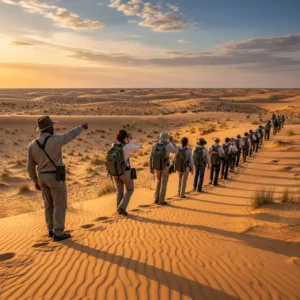
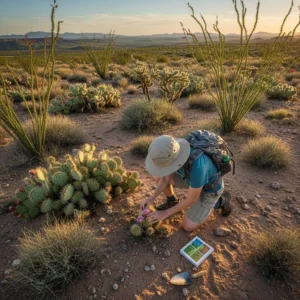
The desert floor is teeming with the intricate lives of insects and arachnids, a world best explored on a Desert Walking Safari.
Scorpions
The Arabian desert is home to several species of scorpions, including the highly venomous Deathstalker. These nocturnal arachnids are expert survivors. A fascinating feature is that their exoskeletons contain fluorescent chemicals that cause them to glow a brilliant green or blue under an ultraviolet (UV) light, a trick that guides on night safaris use to spot them safely.
The “Camel Spider” (Solifugae)
This creature is the subject of wild myths and legends. A Camel Spider is not a true spider, nor is it a scorpion. It is a separate order of arachnid called Solifugae. They are not venomous and, while they can run fast, they cannot outrun a human. They often seek shade, which is why they sometimes appear to “chase” people, when in fact they are just trying to get into their shadow.
Rare and Elusive Mammals of the Night
Beyond the reptiles, a night-time Desert Conservation Safari offers the rare chance to spot some of the desert’s most secretive mammals.
- Gordon’s Wildcat: This small, nocturnal feline is the ancestor of the domestic cat. It is perfectly adapted to the desert, with sandy-colored fur for camouflage and furry paws to protect against the hot sand.
- Arabian Red Fox: A small, agile fox with large ears that help it to dissipate heat and listen for the faintest sounds of its prey under the sand.
- Brandt’s Hedgehog: This small, insect-eating hedgehog is a master of the nocturnal world, emerging after dark to forage for beetles, scorpions, and other invertebrates.
A Practical Guide to Finding these Creatures
Spotting these elusive animals requires a specific approach.
Why a Night Safari is Essential
The vast majority of the creatures in this Desert Reptile Guide are nocturnal. They have adapted to the desert’s extreme daytime temperatures by being most active at night. Therefore, your best chance of seeing them is on a dedicated nocturnal nature drive or an overnight safari with a guided night walk.
The Indispensable Role of the Expert Guide
You cannot and should not go looking for these animals on your own. A professional naturalist guide is absolutely essential. They have the expert knowledge to know where to look and how to find these creatures. Crucially, they know how to do it safely, for both you and the animals. They will use special techniques, like using UV lights to find scorpions, and will ensure all interactions are respectful and non-intrusive.
The Importance of Protected Areas
The best place to find a healthy and diverse population of these animals is in a protected area like the Dubai Desert Conservation Reserve (DDCR). Here, the ecosystem is pristine and the animals are safe from the disturbances of regular traffic and development. Booking a specialized tour with a licensed DDCR operator, which you can research on platforms like https://royaldesertadventures.ae/, https://dubaidesertsafarie.com/, and https://hafiztourism.com/, is your ticket to this exclusive natural world.
Desert Creature Fact File
Frequently Asked Questions (FAQs)
1. What is the most venomous snake in the Dubai desert? The Saw-scaled Viper is often considered one of the most medically significant snakes in the region due to the potency of its venom and its sometimes-aggressive nature. However, it is important to remember that they are shy, avoid humans, and will only bite as a last resort in self-defense. On a guided tour, the risk of an encounter is virtually zero.
2. How do scorpions glow under a UV light? Scorpions have fluorescent chemicals in the hyaline layer of their cuticle (part of their exoskeleton). When ultraviolet light from a blacklight hits these chemicals, it causes them to absorb the UV light and re-emit it as visible, blue-green light, making them glow brightly. Scientists are still not entirely sure what the evolutionary purpose of this is, but it makes them much easier to find on a guided night walk.
3. Is the “Camel Spider” actually dangerous to humans or camels? No. The Camel Spider is the subject of countless myths, but it is not dangerous to humans or camels. It is not venomous. While a large one could deliver a painful pinch with its powerful jaws (chelicerae), they are not aggressive towards humans. All the stories about them being huge, disemboweling camels, or laying eggs under the skin are completely false.
4. What is “sidewinding,” and why do some desert snakes use it? Sidewinding is a unique and highly efficient way of moving across loose, soft sand. The snake throws its body forward in S-shaped loops, with only two points of its body touching the hot sand at any one time. This minimizes contact with the hot surface and allows for surprisingly fast and efficient movement where other forms of slithering would fail.
5. How does the Sandfish lizard “swim” through sand? The Sandfish has several amazing adaptations for this. It has a shovel-shaped snout to slice into the sand, a streamlined body to reduce friction, and incredibly smooth, shiny scales. To move, it tucks its legs against its body and wriggles in a serpentine motion, vibrating its body to fluidize the sand around it, allowing it to move effortlessly beneath the surface.
6. What is a “nocturnal safari,” and what is it like? A nocturnal safari is a specialized tour that takes place after dark. You will be in a 4×4 vehicle, often with open sides for better viewing, and your guide will use powerful spotlights and UV lights to search for the desert’s nocturnal creatures. It is a quiet, patient, and incredibly exciting experience, as you get to see a world that is completely hidden during the day. This is the best way to use this Desert Reptile Guide.
7. What should I do if I encounter a snake on my own in the desert? The first rule is to stay calm. Do not approach it or try to handle it. Slowly back away and give the snake a very wide berth. The snake wants to avoid a confrontation just as much as you do. If you are on a guided walk, alert your guide immediately. It is not advisable to hike alone in the desert without an expert.
8. Are there any amphibians, like frogs, in the Arabian desert? It may sound impossible, but yes. The Arabian Toad has adapted to the desert. It spends most of its life dormant, buried deep in the sand in a state of estivation. After a rare, heavy rain, these toads will emerge en masse to breed in the temporary pools of water, completing their life cycle very quickly before burrowing back into the sand to wait for the next rain, which could be years away.
9. What is the difference between a venomous and a poisonous animal? These terms are often confused. A venomous animal (like a viper or scorpion) injects its toxins into you, usually through a bite or a sting. A poisonous animal (like a poison dart frog or some types of pufferfish) is toxic if you eat or touch it. All the dangerous creatures in this Desert Reptile Guide are venomous.
10. How do these cold-blooded reptiles survive the cold desert nights? Reptiles are “ectothermic,” meaning they rely on the external environment to regulate their body temperature. During the day, they bask to warm up. To survive the cold desert nights, they take shelter in deep burrows, under rocks, or bury themselves in the sand. The sand below the surface retains some of the day’s heat, providing a much more stable temperature and protecting them from the cold.
11. Why do so many desert animals have such large ears? Large ears, like those on the Rueppell’s Fox, serve two crucial purposes. Firstly, they provide a large surface area packed with blood vessels, which helps to radiate body heat away and keep the animal cool. Secondly, they provide an exceptional sense of hearing, allowing the animal to detect the faint sounds of prey (like insects or rodents) moving under the sand.
12. What is the best season for spotting reptiles? The shoulder seasons—spring (March-May) and autumn (September-November)—are often the best. During these times, the temperatures are warm enough for the reptiles to be active, but not as extreme as the deep summer. During the coolest parts of winter, they may be less active and spend more time in their burrows.
13. What is the Spiny-tailed Lizard’s (Dhub) role in Bedouin culture? The Dhub was a historically important animal for the Bedouins. In the protein-scarce desert, this large, herbivorous lizard was a source of food. It was also a source of leather, and its fat was believed to have various medicinal properties. It is a classic example of how the Bedouins sustainably used every resource the desert provided.
14. Are the geckos I see on the walls in the city the same as in the desert? While they are related, the species are usually different. The geckos you see in the city are often “house geckos,” which have adapted to urban environments. The desert is home to specialized species like the Wonder Gecko, which have unique adaptations for a sandy, arid environment that are different from their city cousins.
15. What do desert monitors eat? Desert monitors are formidable predators with a very varied diet. They are carnivores and will eat almost anything they can overpower. This includes other lizards, snakes, the eggs of ground-nesting birds, rodents, small birds, and large insects like beetles.
16. How dangerous is a scorpion sting? The severity of a scorpion sting depends on the species, the amount of venom injected, and the age and health of the person stung. While many scorpion stings are only as painful as a bee sting, a sting from a species like the Deathstalker can be life-threatening, especially for children or the elderly, and requires immediate medical attention. However, they are shy, and stings are extremely rare.
17. Do I need any special clothing for a nocturnal safari? Even on a warm day, the desert can get surprisingly cool at night. It is always a good idea to bring a light jacket or fleece with you. Closed-toe shoes are also essential for protecting your feet.
18. Why is a professional guide so important for this kind of tour? A guide’s expertise is what brings the nocturnal desert to life. Without a guide, you would likely see nothing but sand and stars. A guide has the trained eye to spot camouflaged animals, the knowledge to interpret their behavior, and the tools (like UV lights) to reveal hidden creatures. Most importantly, they ensure the entire experience is conducted safely.
19. Can I find these creatures on a standard evening safari? It is very unlikely. A standard safari is focused on the camp and dune bashing and usually finishes before the desert becomes truly active for nocturnal creatures. To see the animals in this Desert Reptile Guide, you must book a specialized nocturnal safari, an overnight safari with a night walk, or a dedicated wildlife tour.
20. What is the most rewarding part of exploring the desert’s rare creatures? The most rewarding part is the radical shift in perspective. It makes you realize that the desert is not an empty space but a complex and thriving ecosystem, full of incredible life forms that have evolved ingenious solutions for survival. It fosters a deep sense of awe and a profound respect for the resilience of nature.