Dubai Desert Safari with Sandboarding 27 Thrilling Secrets for the Perfect Slide
You have seen the photos.
You have seen the videos on Instagram.
People gliding down massive mountains of gold.
It looks like snowboarding.
But it is warmer.
It is grittier.
It is one of the most exciting sports in the UAE.
A Dubai Desert Safari with Sandboarding is not just a tour.
It is a physical challenge.
It is a rush of adrenaline.
However, many tourists get it wrong.
They stand on the board incorrectly.
They fall immediately.
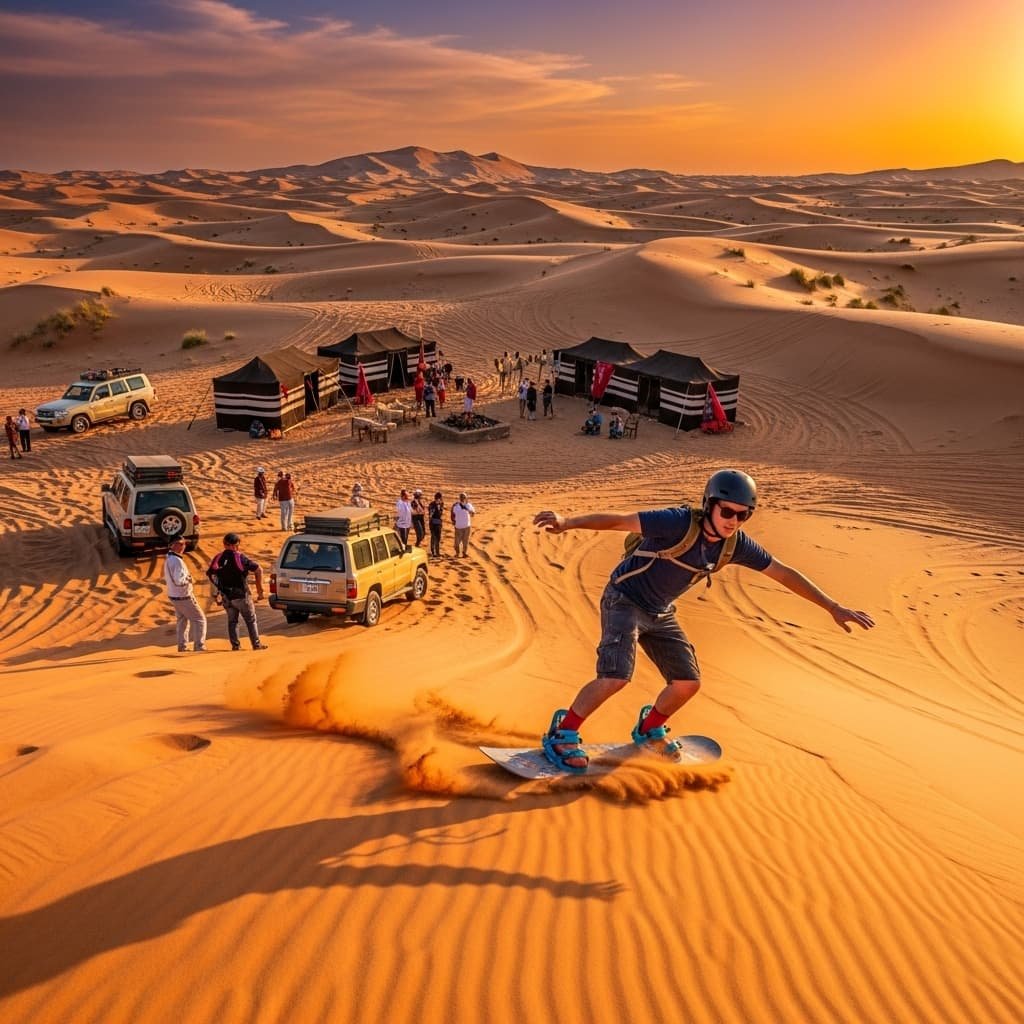
They get sand in places sand should never be.
They book the wrong tour and end up on a small, boring hill.
You need to be prepared.
You need to know the physics of the sand.
You need to know the right location.
This guide is your instructor.
We will teach you how to stand.
We will teach you how to slide.
We will teach you how to book the best experience.
We are going to cover absolutely everything.
From the wax on the board to the type of socks you need.
Get ready to surf the earth.
Why Sandboarding is the Ultimate Desert Sport
Dune bashing is great.
But you are sitting in a car.
Camel riding is traditional.
But it is slow.
Sandboarding is different.
You are in control.
It is just you, a piece of wood, and gravity.
There is no engine.
There is no noise.
Just the sound of the board slicing through the grains.
It is pure.
A Dubai Desert Safari with Sandboarding puts you in touch with nature.
You feel the texture of the desert.
You feel the heat of the slope.
It is an active experience.
You have to climb the dune.
That is a workout.
Then you slide down.
That is the reward.
It connects you to the landscape in a way that driving cannot.
1. The Physics: Sand vs Snow
If you are a snowboarder, listen up.
Sand is not snow.
Snow melts.
It creates a layer of water under the board.
That makes it slippery.
Sand does not melt.
It creates friction.
Lots of friction.
This means you need a steeper slope to move.
On snow, a gentle hill works.
On a Dubai Desert Safari with Sandboarding, a gentle hill means you get stuck.
You need a “Black Diamond” equivalent dune.
You need gravity to overcome the friction.
You also need to lean back more.
On snow, you use your edges to turn.
On sand, edges will dig in and flip you.
You have to surf the surface.
Think of it like powder skiing.
Keep the nose up.
Keep your weight on your back leg.
This is the secret to speed.
2. Choosing the Right Location: The Red Dunes
Not all sand is the same.
The sand near the coast is white and flat.
It is useless for boarding.
You need the deep desert.
You need the Al Lahbab region.
These are the “Red Dunes”.
They are high.
Some are 300 feet tall.
They are steep.
They offer the long runs you want.
When you book, verify the location.
Ask the operator: “Is this at Big Red?”
“Is this in Al Lahbab?”
If they say Al Aweer, be careful.
Al Aweer is flatter.
It is good for camps, but bad for boarding.
Your Dubai Desert Safari with Sandboarding depends on the height of the dune.
Don’t settle for a molehill.
Go for the mountain.
3. The Board Equipment Explained
What are you standing on?
Sandboards are tougher than snowboards.
They have a harder base.
They usually have formica or laminex bottoms.
This resists abrasion.
Bindings are simpler.
Most rental boards use velcro straps.
Or simple slip-in bindings.
You do not need special boots.
You wear your own sneakers.
Or you go barefoot.
However, barefoot is risky in summer.
The sand is hot.
We recommend socks.
Just thick socks.
This protects your feet from the heat.
It gives you a better feel for the board.
Check the board before you climb.
Is the base smooth?
Is it waxed?
A scratched base is slow.
A waxed base is fast.
4. The Importance of Wax
Wax is your best friend.
Without wax, you stick.
Sand friction is high.
Professional sandboarders use specialized wax.
It is usually paraffin-based.
Before every run, you must wax.
Rub the block of wax on the base.
Cover every inch.
Make it slippery.
Most tour guides carry wax.
If they don’t, ask for it.
“Where is the wax?”
If the board is dry, your Dubai Desert Safari with Sandboarding will be a walk, not a ride.
Speed comes from preparation.
Lubrication is key.
5. The Climb Up: The Hardest Part
There are no ski lifts in the desert.
There are no magic carpets.
You have to walk up.
Walking up a sand dune is hard.
For every two steps up, you slide one step back.
It is exhausting.
Your heart rate will spike.
Your legs will burn.
This is the price of the thrill.
To make it easier, follow the footsteps of others.
Step where the sand is packed.
Do not walk straight up the steep face.
Walk up the ridge.
The ridge is firmer.
It is less steep.
Take your time.
Drink water before you start the climb.
Do not rush.
The view from the top is worth the effort.
6. The Stance: How to Stand
You are at the top.
You strap in.
Which foot goes forward?
If you skate or surf, you know.
Left foot forward is “Regular”.
Right foot forward is “Goofy”.
If you don’t know, have someone push you gently from behind.
The foot you step out with to catch yourself is your lead foot.
Strap that foot in front.
Bend your knees.
This is crucial.
Do not lock your legs.
Keep your center of gravity low.
Look where you want to go.
Do not look at your feet.
If you look at your feet, you will fall.
Look at the horizon.
7. The Drop In: Overcoming Fear
The edge looks steep.
It looks like a cliff.
Your brain says “Stop”.
You have to override your brain.
To start, you have to shift your weight.
Lean forward slightly to initiate.
Then immediately shift weight back.
It is a commitment.
Once you start sliding, you accelerate fast.
Don’t panic.
Enjoy the rush.
The sand is soft.
If you fall, it doesn’t hurt much.
It just gets messy.
Embrace the drop.
This is the peak of your Dubai Desert Safari with Sandboarding.
8. Steering and Stopping
Steering on sand is hard.
You cannot carve sharp turns.
You make wide arcs.
You use your body weight.
Lean on your heels to go left (if Regular).
Lean on your toes to go right.
But be gentle.
If you dig the edge too hard, the board stops dead.
And you keep going.
That is called a “Face Plant”.
To stop, simply turn the board sideways.
Or just sit down.
Sitting down is the safest emergency brake.
Drag your hands in the sand.
It slows you down instantly.
9. Morning vs Evening: The Temperature Factor
When should you go?
Sand absorbs heat.
In the summer, the sand can reach 60°C.
That burns skin.
If you book a Dubai Desert Safari with Sandboarding in July, go in the morning.
Very early morning.
The sand is cool from the night.
It is firm.
It is fast.
If you go in winter (December to February), the evening is fine.
The sand is warm, not hot.
The sunset looks amazing.
The evening safari also includes dinner.
The morning safari usually does not.
Choose based on your tolerance for heat.
10. Safety Gear: Do You Need It?
Helmets?
Knee pads?
Most tourists don’t wear them.
The sand is the cushion.
However, if you are planning to go very fast.
Or if you are trying jumps.
A helmet is smart.
Sand is soft, but it becomes hard at high speed.
Sunglasses are mandatory.
Not for the sun.
For the sand.
If you fall, sand flies everywhere.
It gets in your eyes.
It hurts.
Wear wrap-around sunglasses.
Or even ski goggles if you have them.
Protect your vision.
11. What to Wear: Fashion vs Function
Don’t wear jeans.
Jeans are heavy.
They get hot.
They trap sand.
Wear athletic shorts.
Or leggings.
Lycra is good.
Sand slides off Lycra.
Avoid pockets.
Sand will fill your pockets.
It will destroy your phone if it is in there.
Wear a tight-fitting t-shirt.
Loose shirts fly up when you slide.
They expose your back to the sun and sand burn.
Apply sunscreen.
The sun reflects off the sand.
You get double the UV radiation.
Burn times are fast in the desert.
12. Photography Hacks for Sandboarding
You want proof you did it.
You want the cool shot.
Ask your friend to stand at the bottom.
Not at the top.
Photos from the top look flat.
Photos from the bottom show the height of the dune.
Use “Burst Mode” on your phone.
Sandboarding is fast.
You need to capture the exact moment of the spray.
Get low.
Put the camera near the sand.
It makes the dune look like a mountain.
It makes you look like a pro.
If you have a GoPro, strap it to your chest.
Or use a selfie stick.
But hold it tight.
If you drop it, it buries itself.
Finding a GoPro in a sand dune is impossible.
13. Sitting vs Standing
You don’t have to stand.
Standing is hard.
It requires balance.
Sitting is easy.
It is accessible to everyone.
You sit on the board.
You hold the straps.
You slide like a sled.
This is great for kids.
It is great for seniors.
It is great if you are scared.
It is actually faster than standing.
You are more aerodynamic.
You are closer to the ground.
Don’t be ashamed to sit.
It is still a thrill.
Many Dubai Desert Safari with Sandboarding tours encourage this.
It is safer.
14. Combining with Dune Bashing
Most tours start with dune bashing.
The 4×4 warms you up.
It gets you to the high dunes.
The driver will stop at the “Sandboarding Spot”.
This is usually a designated high ridge.
Other cars will be there.
It is a social atmosphere.
You watch other people fall.
You cheer for them.
The transition from car to board is seamless.
You are already full of adrenaline.
The boarding keeps the energy high.
Check https://royaldesertadventures.ae/ for combos that time this perfectly.
You don’t want to board after eating.
You want to board before the BBQ.
15. The Role of the Guide
Your safari driver is also your instructor.
He will wax the board.
He will strap you in.
He will give you a push.
Listen to him.
He does this every day.
He knows the sand conditions.
He knows which side of the dune is fastest.
He will also catch you if you slide too far.
Some guides are experts.
They can show you tricks.
They can show you jumps.
Tip them well if they help you.
They are working hard in the heat.
16. Hydration Strategy
Sandboarding is thirsty work.
Climbing dunes dehydrates you fast.
The dry air sucks moisture from your body.
You might not feel sweaty.
That is because the sweat evaporates instantly.
Drink water before you climb.
Drink water after you slide.
Most Dubai Desert Safari with Sandboarding vehicles have a cooler.
It is stocked with water.
Don’t wait until you are thirsty.
Thirst is a sign of dehydration.
Drink constantly.
17. The Environmental Impact
Sandboarding is eco-friendly.
It leaves no trace.
The wind erases your tracks in minutes.
It uses no fuel.
It creates no noise pollution.
However, trash is an issue.
Water bottles.
Wax wrappers.
Do not leave them on the dune.
The desert is a pristine ecosystem.
Animals eat the plastic and die.
Put your trash in your pocket (if it zips).
Or give it to the driver.
Be a responsible tourist.
Keep the dunes clean for the next rider.
18. Booking Channels: Online vs Offline
Don’t buy from a guy on the street.
He will promise you “Big Dunes”.
He will take you to a construction site sand pile.
Book online.
Use reputable aggregators or direct operators.
Websites like https://dubaidesertsafarie.com/ allow you to filter for “Sandboarding Included”.
Read the reviews.
Look for keywords like “High Dunes” or “Good Boards”.
Cheap tours use broken boards.
Broken bindings ruin the experience.
You want quality gear.
Paying 50 AED extra is worth it for a board that actually slides.
19. Private vs Shared Sandboarding
In a shared safari, you share the board.
The driver has 1 or 2 boards for 6 people.
You have to take turns.
This gives you time to rest.
But if you are a serious rider.
You want your own board.
You want to do 10 runs.
In this case, book a Private Safari.
Request extra boards.
Tell them “We are here for the Dubai Desert Safari with Sandboarding focus.”
They will bring a board for everyone.
You maximize your ride time.
You minimize waiting.
20. Sandboarding for Kids
Is it safe for children?
Yes.
If they sit.
Standing is tricky for kids under 10.
Their legs are not strong enough.
The board is too big.
But sitting is a blast.
It is like a giant slide.
Make sure they wear sunglasses.
Make sure they keep their mouths closed.
Sand tastes bad.
The guide will usually hold the board while the kid gets on.
It is a great family memory.
Just watch out for other riders.
Collisions can happen.
21. Health Warnings
Do you have back problems?
Do not sandboard.
The bumps are jarring.
The falls can twist your spine.
Do you have bad knees?
Climbing the dune will be agony.
Do you have a heart condition?
The exertion of the climb is high intensity.
Be honest with yourself.
You can still enjoy the safari.
You can watch your friends board.
You can take the photos.
Don’t risk an injury in a remote desert.
Hospitals are far away.
22. The “Golden Hour” Ride
Timing is aesthetic.
The best photos are at sunset.
The low light shows the ripples in the sand.
The contrast between the red dune and blue sky is sharp.
Try to save your best run for this time.
Ask the driver to park at the top of a west-facing dune.
Slide towards the setting sun.
The silhouette shot is iconic.
It is the cover photo for your Facebook album.
It defines the Dubai Desert Safari with Sandboarding experience.
23. Cleaning Up Afterward
You are finished.
You are happy.
But you are covered in sand.
It is in your ears.
It is in your hair.
It is in your shoes.
Shake everything out before you get in the car.
Take off your shoes.
Bang them together.
The driver has a compressor (air gun) usually.
He will blow the sand off your clothes.
This is a great service.
It stops the car from becoming a beach.
When you get to the hotel, shower immediately.
You will find sand for days.
It is the souvenir that keeps on giving.
24. Solo Traveler Tips
Are you alone?
Sandboarding is a great icebreaker.
You are in a car with strangers.
You might be shy.
But when you all fall in the sand, you laugh together.
It builds camaraderie.
Ask someone to video your run.
Offer to video theirs.
By the time you get to the camp, you are friends.
You have a shared experience.
A shared struggle up the hill.
A shared triumph down the hill.
25. Advanced Tricks
If you are a pro.
You can try jumps.
Build a small kicker with sand.
Pack it down hard.
Use water to make it firm if you have extra.
You can do 180s.
You can do grabs.
But be careful.
The landing is flat.
There is no transition.
It is hard on the knees.
Only try this if you are an experienced snowboarder or skater.
The sand is forgiving, but not infinite.
26. The Cost of the Experience
Standard safaris include sandboarding.
It is usually “Free” with the package.
The package costs around 150-250 AED.
This is incredible value.
In other countries, sandboarding tours cost $100 just for the boarding.
Here you get the drive, the food, the show, and the boarding.
It is the best deal in adventure tourism.
However, verify it is included.
Some ultra-budget tours strip it out.
Check the inclusions list on https://htdesertsafari.com/.
Ensure “Sandboarding” is ticked.
27. Why It Beats Other Activities
Quads are noisy and smelly.
Camels are uncomfortable.
Dune bashing makes you seasick.
Sandboarding is the perfect middle ground.
It is active but safe.
It is thrilling but quiet.
It is natural but accessible.
It gives you a sense of achievement.
“I climbed that dune.”
“I rode that dune.”
It is a physical connection to the UAE.
It turns the landscape into a playground.
That is why a Dubai Desert Safari with Sandboarding is essential.
It changes how you see the desert.
It is not just scenery.
It is an adventure park.
Go ride it.
Detailed FAQs: Dubai Desert Safari with Sandboarding
Here are 20 comprehensive questions and answers to ensure you are fully prepared for your sandboarding adventure.
1. Do I need previous experience to go sandboarding in Dubai?
No, absolutely not. Sandboarding in Dubai is designed for beginners. The majority of tourists have never done it before. The dunes chosen for general tours are safe and manageable. The technique is intuitive—keep your weight back and nose up. If you cannot stand, you can sit. Sitting requires zero skill and is just as fun. The guides are there to help you strap in and give you basic instructions. It is a very accessible sport for anyone with average fitness.
2. Is sandboarding dangerous?
It is considered a low-risk adventure sport. The speeds on beginner dunes are not high enough to cause serious injury usually. The surface (sand) is soft and absorbs impact well. The most common injuries are minor bruises or twists from falling awkwardly. However, like any sport, there is risk. If you try to go too fast on a huge dune without skill, you can tumble. Always start small. Wear sunglasses to protect your eyes. Stay hydrated. If you follow common sense, it is very safe.
3. Can I bring my own snowboard?
Technically, yes, but it is not recommended. Snowboards are designed for snow (water). The base material is different. A snowboard will be slower on sand unless you wax it heavily with sand wax. Also, the sand will scratch and ruin the base of your expensive snowboard. Sand acts like sandpaper. It destroys the P-tex base. It is much better to use the rental boards provided by the operator, which have a harder, laminate base specifically designed for desert abrasion.
4. What is the minimum age for sandboarding?
There is no strict legal minimum age, but practical limits apply. Children under 5 usually struggle to stand on the board because their legs are not strong enough to steer against the sand resistance. However, children as young as 3 or 4 can sit on the board and slide down gentle slopes with a parent watching. For standing, 8-10 years old is a good starting age. Always supervise children, as the dunes can be steep and they might walk into the path of other boarders.
5. Is sandboarding included in every desert safari?
Not every single one, but most “Standard” and “Premium” safaris include it. Budget or “Basic” safaris might cut it to save time and money. Some “Dinner Only” safaris go straight to the camp and skip the high dunes entirely, so no boarding is possible. You must check the specific itinerary. When booking via https://royaldesertadventures.ae/, look for the sandboarding icon or text. If it’s not listed, assume it’s not there. It is usually a highlight of the “Evening Red Dune Safari”.
6. How long do we get to sandboard?
In a typical shared safari, the stop for sandboarding is combined with the sunset photo stop. It lasts about 20 to 30 minutes. This allows for 2 or 3 runs per person, considering the time it takes to climb back up. If you are in a shared car, you share the board. If you want a dedicated sandboarding session of 1 hour or more, you need to book a Private Safari or a specific “Sandboarding Tour” which focuses solely on the sport rather than the general sightseeing.
7. What shoes should I wear?
The best option is to strap your sneakers into the board bindings. This gives you ankle support and protects your feet from hot sand. You can go barefoot, but the straps can chafe your skin, and the sand can be scorching hot in the afternoon. Do not wear heavy hiking boots; they are too clunky. Do not wear flip-flops; they will fall off instantly and you will lose them in the sand. Socks are a secret weapon—wear thick socks without shoes for a good balance of protection and feel.
8. Will the sand ruin my clothes?
Sand is abrasive and gets everywhere, but it usually washes out. However, if you wear white clothes, the red iron-oxide dust from the Al Lahbab dunes can sometimes leave a faint stain, especially if you sweat. It is better to wear dark colors or old athletic clothes. Avoid delicate fabrics like silk. Lycra and polyester are best because the sand slides right off. Empty your pockets completely before riding to avoid ruining your phone or keys.
9. Can I sandboard during a Morning Safari?
Yes, and the morning is often better for it. In the morning, the sand is cool and firm. Firm sand is faster. In the afternoon, the sun heats the air trapped between sand grains, making the sand “fluffy” and slower. A Morning Safari focuses heavily on adventure (dune bashing, quad biking, sandboarding) rather than dining and dancing. If you are a serious rider wanting speed, book the morning slot for the best Dubai Desert Safari with Sandboarding conditions.
10. What happens if I get stuck halfway down?
It happens. You lose momentum and stop. The friction wins. You have two choices: try to “scoot” the board forward by jumping, which is exhausting, or unstrap and walk the rest of the way down. To avoid this, lean back! Keeping your weight on the back foot keeps the nose of the board up, preventing it from digging in. Speed is your friend. If you go too slow, you sink. Commit to the drop to maintain velocity.
11. Are there lifts to take us back up the dune?
No. This is the hardest part. You must hike back up. It is a serious cardio workout. Walking up soft sand is difficult. There are no rope tows or magic carpets in the wild desert. This physical exertion limits how many runs you can do. Most people do 2 or 3 runs and are then exhausted. Take water with you. Pace yourself. If you are not fit, do one good run and then enjoy the view.
12. Is sandboarding better at Red Dunes or regular dunes?
Red Dunes (Al Lahbab) are infinitely better. They are taller (up to 100 meters) and steeper. This allows for a longer, thrilling ride. Regular dunes (like Al Aweer) are smaller and flatter. You slide for 5 seconds and stop. Red Dunes allow for 20-30 second rides. The red sand also looks spectacular in photos. Always prioritize a “Red Dune Safari” for the best Dubai Desert Safari with Sandboarding experience. It is worth the extra travel time.
13. Can I do sandboarding if I am overweight?
Yes. The boards are sturdy. Gravity actually helps; more weight can mean more momentum to overcome friction. However, the limitation is the climb back up. Hiking up a steep dune carrying your own body weight plus the board is strenuous. If you struggle with stairs or cardio, you will find the climb very difficult. You might do one run and decide that is enough. There is no weight limit on the board itself, only on your stamina.
14. Do the boards have professional bindings?
Usually, no. Standard tour boards have simple velcro straps or rubber slip-in bindings. They are designed to fit any foot size with shoes on. They are not the ratchet bindings you see on snowboards. This is for safety—if you crash, your feet can slip out easily, preventing twisted ankles. Professional sandboards do exist with proper bindings, but you usually have to bring your own or book a specialist niche tour to find them.
15. What if I don’t want to stand up?
That is perfectly fine. The guide will encourage you to sit. Sitting is fun and safe. You sit on the center of the board, hold the front strap or the sides of the board, and lean back. You can actually reach higher speeds sitting down because you are more aerodynamic. It feels like sledding. It is the preferred method for anyone feeling nervous or lacking balance. No one will judge you; half the group will likely sit.
16. Is it safe for my camera/phone?
Sand is the enemy of electronics. One grain of sand in your charging port or lens mechanism can ruin the device. If you film while riding, hold the phone in a “death grip” or use a lanyard/strap. If you fall, you will instinctively put your hands out, dropping the phone. It will bury itself in the sand instantly. Finding a buried phone in a vast dune is very, very hard. We recommend a GoPro with a wrist strap or chest mount for the safest filming.
17. Can I rent a quad bike and sandboard at the same time?
Typically, the tour stops at a “Quad Bike Area” first for 20-30 minutes. You ride the bike there. Then you get back in the car and drive into the deep dunes for sandboarding. You don’t usually do them simultaneously because you can’t carry a surfboard on a quad bike easily. They are sequential activities. Both are often part of the same safari package. Check the itinerary on https://dubaidesertsafarie.com/ to ensure both are included.
18. How fast can you go on a sandboard?
On a steep Red Dune with a well-waxed board, you can reach speeds of 20 to 30 km/h (12-18 mph). Professional sandboarders can go much faster (up to 80 km/h), but on a tourist board with basic wax, the speed is thrilling but manageable. It feels faster than it is because you are close to the ground and the sand is rushing past. Friction is the limiter. You won’t break the sound barrier, but you will feel the wind.
19. Is there an instructor?
Your safari driver acts as the instructor. He will show you how to strap in and how to stand. He is not a certified “Sandboarding Coach” usually, but he has done thousands of trips. He knows the basics. He will pick a dune that is appropriate for beginners—steep enough to slide, but not a vertical cliff. If you want professional coaching to learn tricks, you need to hire a private adventure guide, not a general safari driver.
20. Why do I need to book in advance?
Sandboarding requires equipment. The driver needs to know how many boards to put in the trunk. If you book last minute or don’t specify the Dubai Desert Safari with Sandboarding package, he might not bring a board. He might assume you just want to drive. By booking online with https://htdesertsafari.com/, you lock in the equipment allocation. It ensures that when you get to the top of that beautiful dune, there is a waxed board waiting for you.
The dune is waiting.
The wax is ready.
You now have the knowledge to conquer the sand.
Don’t just look at the desert.
Ride it.
Slide it.
Own it.
A Dubai Desert Safari with Sandboarding is the ultimate freedom.
It is the story you will tell for years.
Strap in.
Lean back.
And enjoy the ride.