Dubai Desert Safari Experience 21 Secrets for a Flawless Vacation
The United Arab Emirates is a land of wonders. It holds the tallest towers and the deepest traditions. But there is one adventure that defines the nation.
It is the Dubai Desert Safari Experience. This journey takes you away from the concrete jungle. It brings you into the heart of the golden dunes.
Many travelers arrive in Dubai with a checklist. They want to see the fountains. They want to shop in the malls.
But without the desert, the trip is incomplete. The sands hold the history of the Bedouin people. They offer a silence you cannot find in the city.
However, planning this trip can be confusing. There are so many operators. There are so many packages.
You might be worried about safety. You might be concerned about the food. You might just want to know what to wear.
This guide is here to solve those problems. We have broken down every single step.
We will walk you through the booking. We will explain the thrill of the dunes. We will describe the magic of the camp.
This is not a short overview. This is a deep dive. We want you to be fully prepared.
Read on to discover how to make your vacation unforgettable.
Step 1: Understanding the Different Safari Types
Before you book, you must know your options. Not all safaris are the same.
The time of day changes everything. It changes the temperature. It changes the activities.
The Morning Adventure
The morning Dubai Desert Safari Experience is for the early birds. It usually starts around 8:00 AM.
The weather is cooler at this time. The sun is bright but not punishing.
This slot is perfect for adrenaline junkies. The light is flat and clear. It helps you see the dune contours for sandboarding.
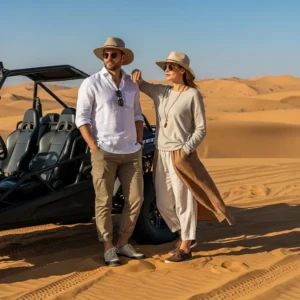
You get to try quad biking while your energy is high.
However, morning tours are often shorter. They might not include the full BBQ dinner. They often lack the entertainment shows.
Choose this if you have a busy evening planned. It gets you back to the city by lunchtime.
The Classic Evening Safari
This is the most popular choice. It offers the complete package.
It starts in the afternoon. You get the thrill of the drive. Then you get the beauty of the sunset.
The transition from day to night is spectacular. The desert changes color. It goes from yellow to orange to deep purple.
The evening includes the camp experience. You get dinner under the stars. You get to watch the live performances.
If you are a first-timer, choose this one. It gives you the most value for your money.
The Overnight Camping
This is for those who love nature. It extends the evening safari.
When other guests leave, you stay. You get a sleeping bag or a tent.
The desert at night is silent. The stars are incredibly bright. There is no light pollution.
You wake up to the sunrise. The air is fresh and cold.
Breakfast is served in the quiet morning. It is a peaceful way to start the day.
For reliable booking options across all these times, check https://htdesertsafari.com/. They have flexible schedules.
Step 2: The Booking Process and Avoiding Scams
Booking can be tricky. The internet is flooded with offers.
Some prices seem too good to be true. Usually, they are.
Cheap tours cut corners. They might use old vehicles. The air conditioning might not work.
The food quality in budget camps is often low. The camp might be overcrowded.
You do not want to stand in long lines for food. You do not want dirty restrooms.
Look for mid-range to luxury providers. You get what you pay for.
Check the inclusions carefully. Does it include pick-up from your hotel? Or do you have to meet at a bus station?
Does it include the quad bike? Or is that an extra cost?
Read the fine print on cancellation policies. Plans change. You need flexibility.
We recommend checking https://dubaidesertsafarie.com/ for clear package details. They list everything upfront.
Step 3: Preparing for the Pickup
On the day of the safari, preparation is key.
Do not eat a heavy meal before you go. The drive is bumpy. A full stomach is a bad idea.
Eat a light lunch. Maybe a sandwich or some fruit.
Hydrate well. The desert air is dry. You will lose moisture quickly.
Dress comfortably. We will cover clothing in detail later. But ensure you can move freely.
Be in your hotel lobby on time. The drivers have a schedule. They have other guests to pick up.
If you are late, you delay everyone. The driver might have to leave you behind.
Double-check your battery. You will take hundreds of photos. Charge your phone to 100%.
Bring a power bank. You will need it by the evening.
Step 4: The Drive to the Desert
The journey to the desert takes about 45 minutes to an hour.
You will leave the skyscrapers behind. The scenery changes slowly.
You will see industrial areas first. Then the landscape opens up.
You might spot camel farms on the way. You will see the sand changing color.
Some tours go to the red dunes of Al Lahbab. These are high and dramatic.
Others go to the Dubai Conservation Reserve. This area is protected. It has more wildlife.
The driver will usually stop at a meeting point. This is where they deflate the tires.
It is a chance to use the restroom. It is a chance to buy a scarf or water.
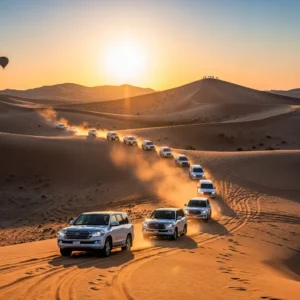
This is also where you might wait for other cars to join the convoy.
Step 5: The Mechanics of Dune Bashing
This is the heart of the Dubai Desert Safari Experience.
The driver lets air out of the tires. This increases the grip. It allows the heavy car to float on the sand.
You get back in the car. The engine roars.
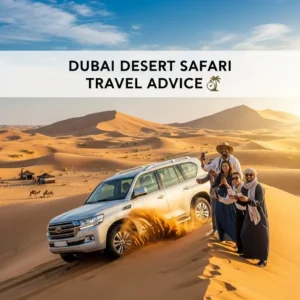
The driver attacks the dunes. They go up steep slopes. They slide sideways.
It feels like the car is going to tip over. But it won’t.
The cars are equipped with roll cages. The drivers are experts. They undergo rigorous training.
The sensation is thrilling. It is a mix of fear and excitement.
You slide down the other side of the dune. Sand sprays over the windows.
The convoy moves together like a snake. It is beautiful to watch.
If you are prone to motion sickness, sit in the front. Keep your eyes on the horizon.
Step 6: The Sunset Stop
After the intense drive, the convoy stops.
You are in the middle of nowhere. The dunes stretch endlessly.
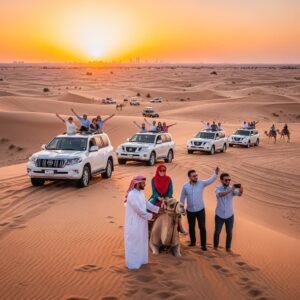
This is the golden hour. The sun sits low on the horizon.
The sand looks like waves in an ocean. The light is soft and flattering.
This is your photo moment. Get out of the car. Take off your shoes.
Feel the sand between your toes. It is fine and cool.
Your driver will help you take photos. They know the best angles. They can make it look like you are holding the sun.
Take a moment to just breathe. The silence is profound.
This pause is a highlight of the Dubai Desert Safari Experience.
Step 7: Sandboarding Fun
While stopped, you can try sandboarding.
It is like snowboarding. But on sand. And in the heat.
You strap a board to your feet. You stand at the edge of a dune.
You push off. You glide down.
It is harder than it looks to stay standing. Many people fall.
Falling is part of the fun. The sand is soft. It does not hurt.
The hard part is walking back up. The sand slips under your feet. It is a serious workout.
If you are not confident, sit on the board. Use it like a sled. It is just as fun.
Step 8: Arrival at the Bedouin Camp
As darkness falls, you head to the camp.
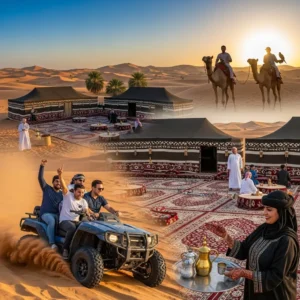
It looks like a fortress in the desert. It is lit by torches and lanterns.
The entrance is welcoming. You are greeted with traditional hospitality.
You are offered Ghawa. This is Arabic coffee. It is spiced with cardamom.
You are offered dates. They are sweet and provide a sugar rush.
This welcome sets the tone. It is about generosity.
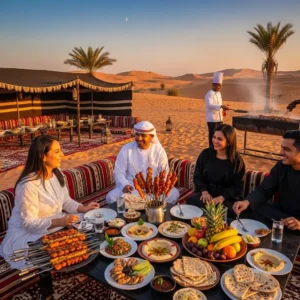
The camp is set up with low tables. There are cushions and carpets on the sand.
There is a stage in the center. The seating surrounds it.
Explore the camp. There are small stalls selling souvenirs.
Step 9: Camel Riding
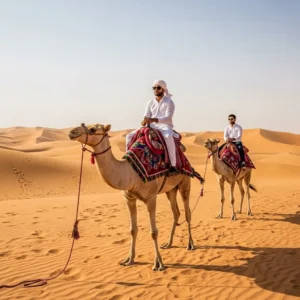
At the entrance, you will usually find the camels.
These gentle giants are iconic. You cannot miss a ride.
The ride is usually short. It is a small loop outside the camp.
The sensation is unique. The camel sways side to side.
Getting on and off is the tricky part. The camel kneels down.
When it stands up, it lifts its back legs first. You feel like you are falling forward.
Then it lifts the front legs. You are thrown back.
Hold on tight to the saddle handle.
The view from the top is great. You are high above the ground.
Be kind to the animal. Do not make loud noises.
Step 10: Falconry Display
Some camps have a falconer. The falcon is the national bird of the UAE.
It represents speed and power. Bedouins used them for hunting.
You can see the bird up close. It wears a leather hood to keep it calm.
The handler will let you hold it. You wear a thick leather glove.
The bird is heavy. Its talons are sharp. But it is well trained.
This is a great photo opportunity. It connects you to the heritage of the region.
Step 11: Henna Painting
Inside the camp, there is a henna artist.
Henna is a natural dye. It is made from a plant.
Women in the region use it for celebration. Weddings and Eid are incomplete without it.
You can get a small design for free. It usually goes on the hand or wrist.
The artist is fast. She draws flowers and swirls in seconds.
The paste is cool on the skin. You must let it dry.
Once it dries, the paste crumbles off. It leaves an orange stain.
Over the next 24 hours, it turns dark brown. It lasts for about a week.
Step 12: Shisha Smoking
In the corner of the camp, there is a Shisha area.
Shisha is a water pipe. It is used to smoke flavored tobacco.
Common flavors are apple, mint, grape, and strawberry.
It is a social activity. Friends sit together and share a pipe.
The smoke passes through water. It is cool and smooth.
Even if you do not smoke cigarettes, you might enjoy this. It is very relaxing.
Sit back on the cushions. Watch the smoke curl up. Enjoy the atmosphere.
Step 13: Dressing in Traditional Attire
There is often a photo booth with local clothes.
Men can wear the Kandura. It is a long white robe. They can wear the Guthra headscarf.
Women can wear the Abaya. It is a long black cloak. They can try the face masks.
It is fun to see yourself in this dress. It helps you understand the culture.
The clothes are designed for the climate. They are loose and airy.
Take a few photos. It makes for a great memory.
Step 14: The BBQ Dinner Buffet
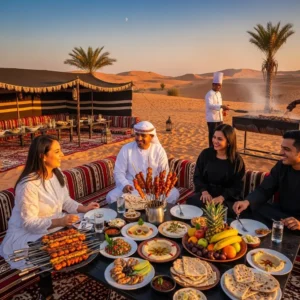
By now, you will be hungry. The smell of charcoal fills the air.
The dinner is a buffet. It caters to all tastes.
There is a salad station. You will find Hummus, Moutabal, and Tabbouleh.
There is fresh Arabic bread. It is soft and warm.
The main course features grilled meats. Chicken Tikka, Lamb Kebabs, and grilled fish.
There are rice dishes. Biryani is a favorite.
Vegetarians are not forgotten. There are vegetable curries, dal, and pasta.
The food is plentiful. You can go back for seconds.
For dessert, try the Luqaimat. These are fried dough balls with date syrup. They are delicious.
For a premium dining experience, consider booking through https://royaldesertadventures.ae/. They are known for higher quality food service.
Step 15: Entertainment and Shows
As you eat, the show begins.
The music gets louder. The lights dim.
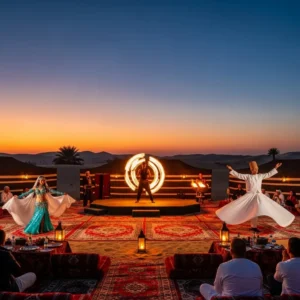
The Belly Dancer enters. This is a classic Middle Eastern performance.
She moves with incredible skill. The dance is graceful and rhythmic.
Next is the Tanoura dancer. This is a male performer.
He wears a heavy, colorful skirt. He spins continuously.
It is a Sufi tradition. It represents the rotation of the universe.
He spins for 10 or 15 minutes. He does not get dizzy.
His skirt lights up with LEDs. It creates beautiful patterns in the dark.
Finally, there is usually a Fire Show. The performer spins fire batons. He breathes fire.
It is high energy. It creates a lot of heat. The crowd loves it.
Step 16: Star Gazing and Silence
After the shows, the lights might be dimmed for a moment.
Look up. The sky is vast.
If you are far enough from the city, you see thousands of stars.
This is the true Dubai Desert Safari Experience. The connection with nature.
Step away from the noise of the camp for a minute. Walk a few meters into the dark (not too far).
Listen to the wind. Feel the vastness of the desert.
It is a moment of peace. It contrasts with the busy life of Dubai.
Step 17: The Drive Back
The evening ends around 8:30 or 9:00 PM.
You get back into the 4×4. The driver re-inflates the tires before hitting the road.
The drive back is quiet. Most people are tired.
The swaying of the car might put you to sleep.
You will see the city lights approaching. The Burj Khalifa sparkles in the distance.
It is a smooth transition back to civilization.
Drop off is at your hotel. Check the car seat before you leave. Do not forget your phone.
Step 18: What to Wear Detailed Guide
We mentioned comfort earlier. Let’s get specific.
Summer (May – September): It is hot. Extremely hot. Wear loose cotton or linen. Light colors are essential. Shorts are okay, but your legs might stick to the car seat. Light trousers are better. They protect you from the sun and sand. Bring a hat. Sunglasses are non-negotiable.
Winter (October – April): The days are pleasant. But nights are cold. The desert temperature drops rapidly after sunset. Bring a hoodie, a cardigan, or a light jacket. You will regret it if you don’t. The wind can be biting. Closed shoes like sneakers are best. Sand in sandals can be annoying and cold at night.
Footwear: Flip flops are easy to take off. But they are hard to walk in on sand. Sneakers offer protection. They are good for sandboarding. Do not wear heels. It is impossible to walk in the sand. You will ruin them.
Step 19: Managing Health and Safety
Safety is paramount.
Motion Sickness: Dune bashing is rough. If you get carsick, take a pill. Dramamine works well. Take it 1 hour before pickup. Do not eat greasy food for lunch.
Hydration: You sweat without realizing it. The dry air evaporates sweat instantly. Drink water constantly. Do not wait until you are thirsty. Avoid too much caffeine before the trip. It dehydrates you.
Sun Protection: The sun is stronger here. Use SPF 50. Apply it before you leave. Reapply if you sweat a lot. Protect your lips with balm.
Injuries: Listen to the driver. Keep your seatbelt on during the bash. Do not stick your hand out of the window. The car can tip against a dune. Be careful with the quad bikes. They are heavy machines.
Step 20: Budgeting and Tipping
How much cash should you bring?
Your package is prepaid. But you need money for extras.
Tips are appreciated. Drivers work long hours. A tip of 20 to 50 AED for the driver is standard if you enjoyed the ride. Camp staff also work hard. Small tips are nice.
Souvenirs cost money. Sand art, scarves, and extra henna designs. Pictures taken by professional photographers at the camp are expensive. Alcohol is not free. A beer can cost 30-40 AED.
Bring about 200-300 AED in cash per person. This covers everything comfortably.
Step 21: Choosing the Right Operator
This is the most critical step.
A bad operator can ruin the experience. They might pack 7 people in a car. It is tight and uncomfortable. They might rush the dune bashing. They might serve cold food.
Read reviews. Look for consistency. Check if they have their own camp or share a large one. Shared camps can be very crowded. Private camps are more intimate.
Trust reliable names. We always suggest https://htdesertsafari.com/ for a balance of quality and price.
For exclusive deals, look at https://dubaidesertsafarie.com/.
Conclusion
The Dubai Desert Safari Experience is more than just a tour. It is a journey into the soul of Arabia.
It combines the thrill of modern adventure with the grace of ancient traditions.
From the roar of the engine on the dunes to the silence of the stars, it engages all your senses.
You taste the spices. You feel the sand. You smell the charcoal. You hear the music.
By following these 21 secrets, you ensure your trip is flawless.
You will be prepared for the weather. You will know what to eat. You will stay safe.
Do not skip this. It will be the highlight of your Dubai vacation.
Book your slot. Pack your bag. The desert is waiting for you.
FAQs
1. How long does the entire Dubai Desert Safari Experience last? A typical evening desert safari lasts approximately 6 to 7 hours. The pickup from your hotel usually happens between 2:30 PM and 3:30 PM, depending on the season and the location of your hotel. You will spend about an hour driving to the desert, 30-45 minutes dune bashing, and then several hours at the camp for dinner and shows. The drop-off back at your hotel is generally between 9:00 PM and 9:30 PM. Morning safaris are shorter, lasting about 4 hours (8:00 AM to 12:00 PM). Overnight safaris last about 18 hours, returning the next morning around 9:00 AM.
2. Is dune bashing safe for children and elderly people? Dune bashing is a high-intensity activity that involves sudden drops, sharp turns, and heavy vibrations. It is generally not recommended for children under 3 years old, as their neck muscles are not strong enough to handle the jerks. It is also not suitable for elderly people with back problems, heart conditions, or osteoporosis. However, this does not mean they cannot visit the desert. You can book a “dinner only” package or a private car that drives directly to the camp on flat sand, bypassing the rough dunes.
3. What should I wear for a desert safari in Dubai? Comfort is the most important factor. During the summer months (May to September), wear light, loose-fitting clothing made of cotton or linen to handle the heat. Shorts and t-shirts are fine. In the winter months (October to April), the desert gets quite cold at night, so bring a light jacket, hoodie, or shawl. Regarding footwear, open sandals are easy to take off for walking on sand, but sneakers provide better protection against hot sand and thorns. Avoid high heels completely as they are impractical in the sand.
4. Can pregnant women go on a desert safari? Pregnant women are strongly advised not to participate in the dune bashing part of the safari. The violent motion of the car can be dangerous for both the mother and the baby. However, pregnant women can still enjoy the camp experience. You should book a private vehicle that can take you gently to the campsite without going over the dunes. Once at the camp, you can relax, enjoy the food, get henna painted, and watch the shows without any risk. Always inform the tour operator of your pregnancy when booking.
5. What kind of food is served at the BBQ dinner? The BBQ dinner is a buffet spread that caters to international and local tastes. It typically includes appetizers like hummus, moutabal, tabbouleh, and fresh salad. The main courses feature grilled meats such as chicken tikka, shish tawook, and lamb kebabs. There are also rice dishes (often Biryani), vegetable curries, dal (lentils), and noodles. Dessert usually includes fresh fruit and local sweets like Luqaimat or Umm Ali. Water and soft drinks are unlimited. Alcohol is available but sold separately.
6. Is the Dubai Desert Safari Experience suitable for vegetarians? Yes, vegetarians are well catered for at the desert safari. The buffet includes several vegetarian options. You will find a variety of salads, dips (hummus is vegan), bread, vegetable rice, pasta or noodles, and vegetable curries (often an Indian style mixed veg or dal). Fruits and desserts are also available. While the highlight is often the BBQ meat, vegetarians will not go hungry. If you have severe allergies or strict vegan requirements, it is safer to inform the operator in advance.
7. Do I need to bring cash with me? Yes, it is highly recommended to carry some cash (UAE Dirhams). While your package likely includes the drive and dinner, there are optional extras. You might want to tip your driver (20-50 AED is standard). You might want to buy souvenirs, sand art, or extra henna designs. Alcohol is not free and must be paid for. Quad biking is often an extra cash payment if not pre-booked. The signal for card machines can be unreliable in the deep desert, so cash is king.
8. Is there a restroom at the desert camp? Yes, all licensed desert camps have restroom facilities. These are separated for men and women. In reputable camps, these are permanent structures with flush toilets, sinks, and running water. They are cleaned regularly by attendants. However, standards can vary. Luxury camps have hotel-standard bathrooms, while budget camps might have simpler facilities. It is always a good idea to carry a small pack of tissues and hand sanitizer for your own comfort and hygiene.
9. Can I bring my luggage on the safari? No, you cannot bring large suitcases. The 4×4 vehicles have limited trunk space, and loose heavy luggage can be dangerous during the dune bashing maneuvering. If you are transiting between hotels or going to the airport, you should arrange to leave your luggage at your hotel concierge or at the tour operator’s office. Small backpacks or handbags with your essentials (camera, wallet, jacket) are perfectly fine and can be kept with you in the car.
10. What happens if I get motion sickness? Motion sickness is very common during dune bashing. To prevent it, avoid eating a heavy or greasy meal immediately before the safari. Eat a light lunch. If you know you are prone to sickness, take an anti-nausea tablet like Dramamine about one hour before the pickup time. During the ride, try to sit in the front seat or by a window and look at the horizon. If you feel unwell, tell the driver immediately. They are trained to handle this and will stop the car to let you recover.
11. Is alcohol available during the safari? Alcohol is served in most desert camps, but it is not part of the standard “all-inclusive” soft drinks package. You must purchase beer, wine, or spirits from the bar. However, there are strict exceptions. No alcohol is served during Islamic religious holidays and the holy month of Ramadan. Additionally, some “dry” camps do not serve alcohol at all. If having a drink is important to your experience, check the specific policy and the calendar dates before you book.
12. Can I drive the car on the dunes? No, tourists are never allowed to drive the Land Cruisers or safari vehicles on the dunes. Desert driving requires a specific license and high-level skills to navigate the soft sand safely. However, you can drive a quad bike or a dune buggy. These are separate rental activities where you can drive yourself in a designated, safe area of the desert. This gives you the thrill of driving without the risk of handling a heavy 4×4 on steep slopes.
13. What is the difference between shared and private safaris? In a shared safari, you book a seat in a car. You will be paired with other tourists (up to 6 or 7 people per car). You have to follow a fixed schedule and wait for others during pickups. In a private safari, you book the entire vehicle for your group. This offers privacy and flexibility. You can choose your pickup time, ask the driver to stop for photos whenever you want, and adjust the intensity of the dune bashing to your comfort level. Private safaris are more expensive but offer a superior experience.
14. Are there charging points for my phone? There are no charging points in the car during the dune bashing, and charging stations at the camp can be scarce or crowded. Since you will be using your phone heavily for photos and videos, your battery will drain faster than usual. It is essential to bring a fully charged power bank with you. This ensures you can capture the sunset, the shows, and the night sky without worrying about a dead battery.
15. What if the weather is bad? It rarely rains in Dubai, but sandstorms can occur. If the weather conditions are severe and deemed unsafe by the authorities, the tour will be cancelled. In this case, reputable operators will offer you a full refund or the option to reschedule for another day. Light wind or heat does not stop the tour. However, heavy fog or a sandstorm makes dune bashing dangerous due to zero visibility. Always check your messages on the day of the tour for updates from the operator.
16. Is the camp wheelchair accessible? Standard desert safaris are difficult for wheelchair users due to the soft sand and the high step into the 4x4s. However, many operators offer specialized accessible tours. They use vehicles that can transport wheelchairs and drive directly to the camp. Some camps have paved pathways or harder packed sand areas where wheelchairs can move. It is crucial to contact the operator in advance to discuss specific accessibility needs and ensure they can accommodate you comfortably.
17. Do I need to know how to sandboard? No, no prior experience is needed for sandboarding. It is a fun, casual activity. You can stand up if you have good balance (like surfing or snowboarding), but many beginners simply sit on the board and slide down like a sled. This is much easier and just as fun. The sand is soft, so falling is not painful. Just remember to keep your mouth closed so you don’t eat sand if you tumble!
18. What is the “Golden Hour” in the desert? The Golden Hour is the period shortly before sunset when the light is redder and softer. In the desert, this is the most magical time. The low sun creates long shadows on the ripples of the dunes, adding depth and texture to the landscape. It is the absolute best time for photography. Your driver will usually time the drive to stop on a high dune exactly during this window so you can take stunning sunset photos.
19. Are there snakes or scorpions in the desert? Yes, snakes and scorpions do live in the desert ecosystem, but it is extremely rare for tourists to see them. They are nocturnal and shy creatures that avoid vibrations and noise. The loud cars and bustling camps keep them far away. The campsites are cleaned and maintained daily to ensure safety. You do not need to worry about them, but as a general rule, do not stick your hands into deep holes in the sand or under rocks.
20. Why should I book with a reputable company? Booking with a reputable company ensures safety, hygiene, and quality. Cheap, unlicensed operators may use unsafe vehicles, employ untrained drivers, or serve food prepared in unhygienic conditions. A good company carries insurance, maintains their fleet, and provides fresh, high-quality food. They also ensure the camp is not dangerously overcrowded. Saving a small amount of money is not worth risking your safety or ruining your holiday experience.