Dubai Desert Stargazing 15 Magical Secrets to the Night Sky
The Dubai Desert Stargazing experience is a journey into the infinite.
It is the complete opposite of the city experience.
Dubai is famous for its bright lights and tall buildings.
The Burj Khalifa shines like a beacon at night.
The highways are rivers of neon and headlights.
But to see the true beauty of the UAE, you must look up in the dark.
You must escape the intense light pollution of the metropolis.
The desert offers a sanctuary of absolute darkness.
Here, the universe reveals itself to you.
When you book a Dubai Desert Stargazing tour, you are booking a ticket to the galaxy.
It is a humbling and grounding experience.
It connects you to the ancient world of the Bedouins.
It connects you to the modern science of astronomy.
This guide is massive and comprehensive.
We will cover every single aspect of the night sky in Dubai.
We will discuss the science, the culture, and the logistics.
We will guide you on how to take professional photos.
We will tell you the absolute best times to go.
Prepare for a deep dive into the cosmos from the golden sands.
The Contrast City Lights vs Desert Dark
In the city, you might see five or six stars.
The glare of streetlights washes out the rest.
It is called light pollution.
It hides the majesty of the cosmos.
But in the prime Dubai Desert Stargazing locations, the sky is ink black.
You see thousands of stars scattered across the dome.
You see the cloudy band of the Milky Way stretching across.
It looks like diamond dust spilled on black velvet.
The contrast is shocking to first-time visitors.
You realize how much we miss in our daily urban lives.
We forget that we live on a planet floating in space.
The desert reminds us of our place in the universe.
It grounds us in reality.
It is silent, unlike the city.
There is no traffic noise here.
Just the sound of the wind and the stars above.
The Best Locations for Stargazing
Where should you go for the best view?
Not all deserts are dark enough.
You need to go far from the city center.
Al Qudra Lakes is a popular spot for many.
It is accessible and close to the city.
But for deeper darkness, go to Al Lisaili.
Or head towards the Al Razeen area.
This is often called the darkest spot in the UAE.
Astronomers flock here for serious observation.
The Dubai Desert Conservation Reserve is also excellent.
It is protected land with restricted access.
There are no bright camps nearby to ruin the view.
If you book with https://htdesertsafari.com/, ask for their remote locations.
They know the hidden spots away from the crowds.
They can take you where the tourist buses don’t go.
The further you drive, the better the view becomes.
Every kilometer away from the city adds a hundred stars to your view.
The Science of the Sky
What exactly will you see up there?
The sky changes with the seasons.
In winter, the Dubai Desert Stargazing highlights include Orion.
You can see Orion’s Belt clearly.
You can see the reddish glow of Betelgeuse.
In summer, you see the core of the Milky Way.
It is the brightest and densest part of our galaxy.
It looks like a storm cloud made of stars.
You can also see planets with the naked eye.
Venus is often the first “star” to appear at sunset.
Jupiter shines like a steady, unblinking beacon.
Saturn is visible with a small telescope.
You might see Mars, the red planet.
It looks like a rusty orange dot in the blackness.
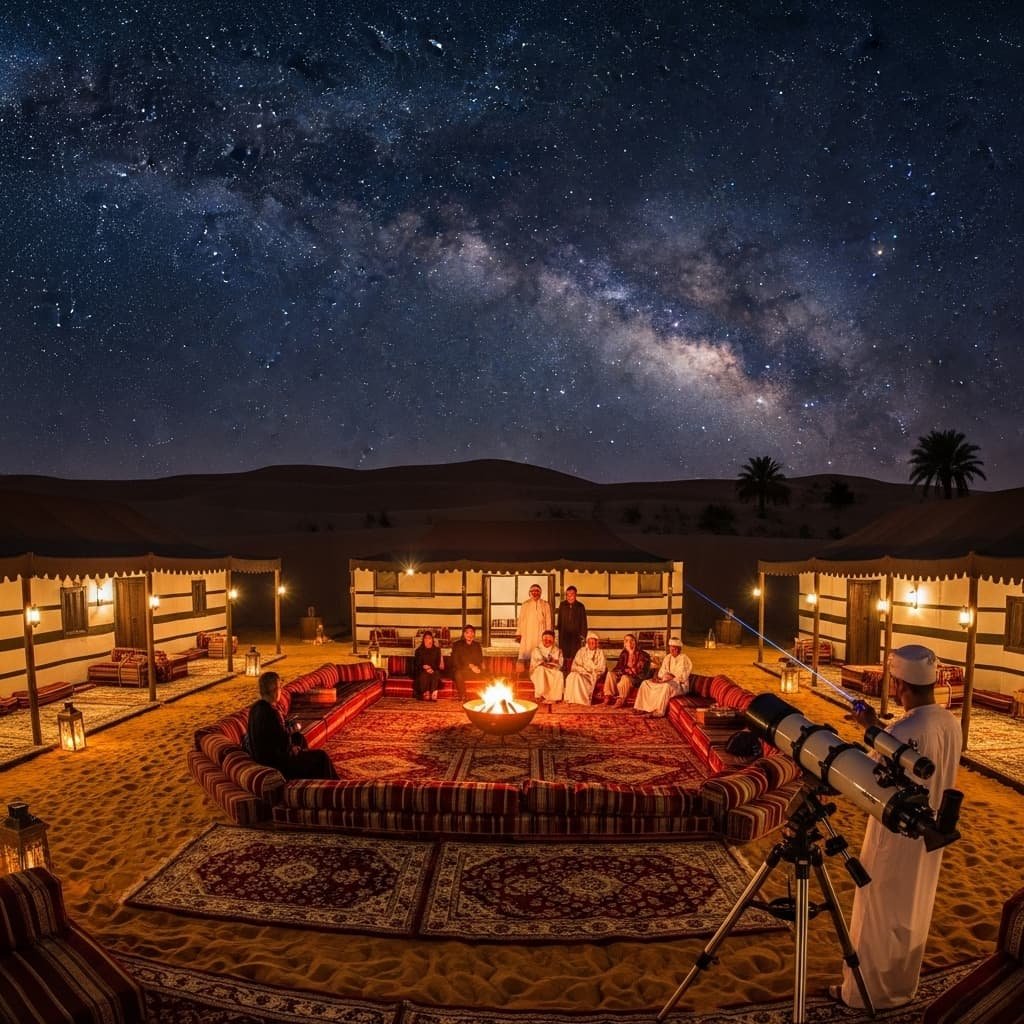
Your guide might have a laser pointer.
They trace the constellations for you on the sky.
It is a live planetarium show.
Bedouin Navigation and History
The stars were not just pretty lights to the Bedouins.
They were a map for survival.
The Dubai Desert Stargazing experience is steeped in history.
The desert is featureless at night.
There are no road signs or landmarks.
The dunes shift and change with the wind.
So, the ancestors used the stars to navigate.
They used Polaris (the North Star) to find North.
They used the rising of specific stars to tell time.
They knew when seasons changed by the sky.
They knew when to plant crops based on star positions.
They knew when to move their herds to new pastures.
This knowledge was passed down orally for generations.
It is called “Al Falak” in Arabic.
On a good tour, you will hear these stories.
You will learn the Arabic names of the stars.
Did you know many star names are Arabic?
Betelgeuse, Rigel, Altair.
These are all Arabic words adopted by the West.
It shows the Golden Age of Arab astronomy.
Astrophotography 101
You will definitely want to take photos.
A regular phone snap won’t work well.
You need to know the right settings.
For Dubai Desert Stargazing photography, you need a tripod.
The camera must be perfectly still.
Even a small shake blurs the stars into lines.
Set your camera to “Pro” or “Manual” mode.
Set the shutter speed to 15 or 20 seconds.
This lets light in for a long time.
Set the ISO to 1600 or 3200.
This makes the sensor sensitive to faint light.
Set the focus to infinity (manual focus).
Use a timer to take the shot.
This prevents shake when you press the button.
If you do this, you will capture the stars.
You might even capture colors the eye can’t see.
The camera accumulates light over time.
The result is magical and shareable.
Make sure you bring a power bank.
Long exposures drain the battery quickly.
Check https://dubaidesertsafarie.com/ for tours that cater to photographers.
They understand the need for time and patience.
They won’t rush you while you set up.
Telescopes vs Naked Eye
Do you strictly need a telescope?
Not necessarily to enjoy the view.
The naked eye view is stunning on its own.
You see the massive scale of the sky.
Binoculars are a great middle ground.
They are portable and easy to use.
They let you see craters on the moon.
They reveal star clusters like the Pleiades.
However, a telescope changes the game completely.
Some Dubai Desert Stargazing tours provide them.
With a telescope, Saturn has visible rings.
Jupiter has visible moons orbiting it.
Nebulas look like fuzzy, glowing clouds.
It brings the deep sky closer to you.
If you have a telescope, bring it along.
But don’t worry if you don’t own one.
Lie on a carpet on the sand.
Look up at the zenith.
Let your eyes adjust to the darkness.
It takes 20 minutes for human eyes to fully adapt.
Don’t look at your phone screen.
The blue light ruins your night vision instantly.
If you need light, use a red flashlight.
Red light does not hurt night vision.
The Role of the Moon
The moon is a double-edged sword for stargazers.
A full moon is beautiful to look at.
It lights up the dunes in silver light.
You can walk without a flashlight.
But it washes out the stars significantly.
The light is too bright for deep Dubai Desert Stargazing.
For the best star views, go during a New Moon.
This is when the moon is not visible in the sky.
The sky is darkest at this time.
The stars pop out with incredible intensity.
Check the lunar calendar before booking your trip.
If you want romance and landscape views, go during a Full Moon.
If you want galaxies and meteors, go during a New Moon.
Both are lovely experiences.
But they offer very different views.
Meteor Showers in Dubai
Sometimes, the sky puts on a dynamic show.
Meteor showers happen throughout the year.
The Perseids in August are famous.
The Geminids in December are spectacular.
During these events, you see shooting stars.
You might see 50 or 100 per hour.
It looks like natural fireworks.
A Dubai Desert Stargazing trip during a shower is unforgettable.
You lie back and count them with friends.
It is exciting and active.
You hear people shouting “There! There!”
These meteors are tiny dust particles burning up.
They hit the atmosphere at high speed.
They create streaks of bright light.
It is nature’s own cinema screen.
Plan your trip around these specific dates.
It is worth the extra effort.
Combining with Dinner
You cannot stare at the sky on an empty stomach.
Most tours include a dinner option.
Imagine a BBQ under the stars.
You sit on traditional carpets and cushions.
You eat grilled meats and fresh salads.
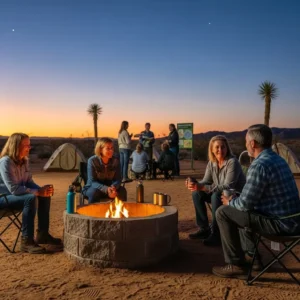
The fire crackles nearby, keeping you warm.
This is the hospitality of the desert.
The Dubai Desert Stargazing is the entertainment.
You sip hot sweet tea.
The steam rises into the cold night air.
It is cozy and comforting.
It creates a sense of community.
You share the experience with others.
You talk about the universe and life.
Big questions often come up.
“Are we alone?”
“How big is the universe?”
The setting encourages deep conversation.
Check menus at https://royaldesertadventures.ae/.
They offer great food options for evening tours.
Good food makes the night even better.
Romance in the Dunes
This is the ultimate date night idea.
It is private and secluded.
It is quiet and intimate.
It is awe-inspiring and beautiful.
Couples love Dubai Desert Stargazing.
You can book a private setup.
Just a table for two in the dunes.
Far away from the main camp noise.
Candlelight (or starlight) dinner.
It is very romantic.
Proposals often happen here under the stars.
“I love you to the moon and back” takes on real meaning.
If you want to impress someone, do this.
It beats a crowded restaurant any day.
It is a memory you build together.
Educational Value for Kids
Kids are natural explorers and scientists.
They love space and rockets.
They learn about planets in school.
Seeing them in real life is powerful.
A Dubai Desert Stargazing tour is educational.
They learn to identify the North Star.
They learn about the solar system scale.
It sparks curiosity and imagination.
It might inspire a future scientist or astronaut.
The open space lets them run freely (safely).
They can roll down the dunes for fun.
Then they can lie down and look up.
It gets them away from iPads and screens.
It shows them the real physical world.
It teaches them about light pollution issues.
It teaches them to appreciate nature.
Seasonal Guides Winter vs Summer
Winter (October – April): The weather is perfect for camping. Nights are cool (10°C – 15°C). You need a jacket or hoodie. The sky is crisp and clear. This is the peak season for Dubai Desert Stargazing. Orion dominates the southern sky. Sirius (the brightest star) is visible.
Summer (May – September): It is hot, even at night (30°C+). The humidity can cause haze near the horizon. This makes low stars hard to see. However, the Milky Way core is visible overhead. Scorpio is high in the sky. You need plenty of water to drink. You don’t need a jacket. Prices are often lower in summer. If you can handle the heat, the galaxy view is rewarding.
What to Pack
Preparation is key for a good trip.
-
Warm Clothes: Even in April, the desert gets chilly at 3 AM. Layers are best.
-
Red Light: Buy a red headlamp. Or put red tape over your phone torch. This protects your eyes.
-
Binoculars: Enhance your view of clusters.
-
Star Map App: Download “SkyGuide” or “Star Walk”. It helps you identify what you see.
-
Water: Always stay hydrated in the desert.
-
Chair/Mat: If you go on your own, you need something to sit on. Sand gets cold.
-
Camera & Tripod: For long exposure photos.
-
Snacks: If dinner isn’t included in your package.
Don’t bring heavy luggage.
Keep it light and portable.
Safety in the Dark
The desert at night is safe but requires care.
Don’t wander off alone into the dark.
It is easy to get disoriented without landmarks.
Every dune looks the same in the dark.
If you walk away for privacy, keep the camp lights in sight.
Watch your step on the sand.
The sand is uneven and can be soft.
Scorpions and snakes are nocturnal animals.
They are rare in winter and tourist areas.
But wear closed shoes just in case.
Don’t run blindly down dunes at night.
Listen to your guide’s instructions.
They know the terrain and dangers.
During Dubai Desert Stargazing, stay with the group.
If you drive yourself, stay on the tracks.
Don’t drive into soft sand in the dark.
You will get stuck easily.
And recovery is hard at night without visibility.
The Spiritual Connection
There is a spiritual side to this experience.
The universe is vast and old.
We are tiny and temporary.
Looking at the stars induces “awe”.
Psychologists say awe is good for mental health.
It reduces stress and anxiety.
It makes us feel connected to humanity.
In the silence of the Dubai Desert Stargazing, you feel peace.
It is a form of meditation.
Religious people find it faith-affirming.
Atheists find it scientifically wondrous.
It transcends beliefs and cultures.
It is a purely human experience.
Choosing the Right Tour
There are many options available.
Some are just “dinner with a view”.
Some are dedicated astronomy tours.
If you really want to learn, book an astronomy tour.
They bring telescopes and charts.
They have an astronomer guide.
If you just want the vibe, a standard safari is fine.
Ask questions before booking your slot.
“Is there a telescope included?”
“Do we go to a dark area?”
“How long do we stay out?”
Check https://htdesertsafari.com/ for specialized packages.
They cater to different needs and budgets.
Read reviews from other travelers.
See if people mention the stars specifically.
Overnight Camping Option
For the best Dubai Desert Stargazing, stay overnight.
The sky changes throughout the night.
Planets rise and set as the earth turns.
The moon might set, leaving darkness behind.
Camping lets you see it all.
You sleep under the open sky.
You wake up to the sunrise.
It is a complete cycle of nature.
Most stars are visible just before dawn.
The air is clearest at 4 AM.
It is an immersive experience.
You don’t have to rush back to the city.
You let the night unfold naturally.
Impact of Light Pollution
Dubai is growing rapidly.
The city lights are expanding into the desert.
This threatens the dark skies.
Conservation is important for the future.
There are efforts to create “Dark Sky Reserves”.
These are protected areas with no lights allowed.
By booking a Dubai Desert Stargazing tour, you support this.
You show there is economic value in darkness.
It encourages eco-tourism and preservation.
We must protect the night for future generations.
They deserve to see the stars too.
Mythology of the Stars
Every culture has star stories.
The Greeks saw heroes like Hercules and Orion.
The Arabs saw animals and everyday objects.
The constellation “Ursa Major” (Big Bear) has a different story in Arabic.
The guide might tell you about “Suhail”.
Canopus (Suhail) is a star that signaled the end of summer heat.
“If Suhail rises, the night cools.”
These sayings are part of UAE heritage.
Learning them adds depth to the view.
It turns the sky into a storybook of culture.
The Al Thuraya Astronomy Center
For a serious scientific experience, visit this center.
It is located in Mushrif Park.
While not deep desert, it is a hub for learning.
They organize trips to the deep desert.
They have massive professional telescopes.
They have professional astronomers on staff.
If you are a geek about space, check them out.
They often partner with tour operators.
Combining their expertise with the Dubai Desert Stargazing logistics is perfect.
You get the best of both worlds.
Comparison with Other Locations
How does Dubai compare globally?
The Atacama Desert in Chile is the best in the world.
But Dubai is incredibly accessible.
You have luxury hotels nearby.
You have great food and transport.
It is a comfortable adventure.
You don’t need to trek for days.
You can drive 45 minutes and see the Milky Way.
This convenience makes Dubai Desert Stargazing unique.
It is accessible astronomy for everyone.
It is safe, regulated, and fun.
Private vs Group Stargazing
Group tours are fun and social.
You meet people from around the world.
You share the excitement of discovery.
But they can be noisy.
Someone might use a bright flashlight.
Private tours are superior for serious stargazing.
You control the environment completely.
You can ask for total silence.
You can stay as long as you want.
If you are serious about photography, go private.
You need time to set up your tripod.
You don’t want people walking in your shot.
It costs more, but the quality is higher.
Check https://dubaidesertsafarie.com/ for private car options.
The Role of Silence
We mentioned silence, but it bears repeating.
Noise pollution is as bad as light pollution.
In the city, there is a constant hum.
In the desert, silence is heavy and real.
It rings in your ears at first.
This silence amplifies the visual experience.
Your senses sharpen in the dark.
You become more aware of your surroundings.
During Dubai Desert Stargazing, try to be silent for 10 minutes.
Just listen to the nothingness.
It is a rare luxury in modern life.
Conclusion
The Dubai Desert Stargazing experience is a must-do.
It balances the glitz and noise of Dubai.
It offers a perspective you cannot buy in a mall.
It is romantic, educational, and spiritual.
It is accessible to everyone.
Whether you are a photographer or a dreamer.
The stars are waiting for you.
They have been there for billions of years.
But you only have tonight to see them.
Book your trip now.
Drive into the darkness.
Let the universe welcome you home.
Don’t forget to check the links provided.
Use reputable operators like https://royaldesertadventures.ae/.
Ensure you get the quality you deserve.
Look up.
The show is about to begin.
20 FAQs About Dubai Desert Stargazing
1. What is the absolute best time of year for Dubai Desert Stargazing? The optimal time for stargazing in Dubai is during the winter months, specifically from October to April. During this period, the skies are generally clearer with less atmospheric dust and humidity compared to summer. The temperatures are also much cooler, ranging from 10°C to 20°C at night, which makes sitting outside for extended periods very comfortable. Summer viewing is possible, but high humidity can create a haze that obscures stars near the horizon.
2. Do I need to own a telescope to enjoy the experience? No, you do not need to own a telescope. The desert sky in remote locations is dark enough that the naked eye can perceive thousands of stars, major constellations, and the band of the Milky Way. However, if you want to see specific details like the rings of Saturn, Jupiter’s moons, or deep-sky objects like nebulas, a telescope is required. Many specialized tours provide telescopes as part of the package.
3. Where are the darkest accessible spots near Dubai? The most popular accessible dark spot is the Al Qudra Lakes area, though it has some light pollution. For darker skies, you should head to the Al Lisaili desert or the Al Razeen area in Abu Dhabi (about 1.5 hours from Dubai), which is known for having some of the darkest skies in the UAE. The Dubai Desert Conservation Reserve is also a great protected area with minimal light pollution, accessible through specific tour operators.
4. Is the Milky Way visible from Dubai? Yes, the Milky Way is visible, but strictly from the deep desert locations away from city lights. The core of the Milky Way, which is the brightest part, is best viewed during the summer months (June to August) looking towards the southeast. In the winter, you can see the outer arms of the galaxy, which appear as a fainter, cloudy band stretching across the sky.
5. What is the appropriate clothing for a stargazing trip? Even if the day was hot, the desert temperature drops significantly at night. In winter, it can be quite cold. It is essential to wear long trousers and bring layers such as a fleece, hoodie, or a light jacket. Closed shoes are highly recommended to keep your feet warm and to protect them from sand, insects, or thorns. In summer, light breathable clothing is sufficient.
6. Is it safe to be in the desert at night? Generally, yes, it is safe if you remain in known areas or travel with a professional guide. Driving off-road in the dark can be risky for inexperienced drivers due to the potential of getting stuck in soft sand. It is safest to book a Dubai Desert Stargazing tour. There are no large predators, but you should be mindful of where you step to avoid scorpions, though they are rare in frequented spots.
7. How can I take good photos of the stars with my smartphone? Most modern smartphones have a “Night Mode” or “Pro Mode”. To capture stars, you absolutely need a tripod to keep the phone steady. Set the exposure time to the maximum available (usually 10 to 30 seconds). Set the ISO to a high number (1600 or higher). Use a timer function so that pressing the shutter button doesn’t shake the phone. This allows the sensor to gather enough light.
8. Are there tours that specifically focus on astronomy? Yes, there are specialized astronomy tours available. These differ from standard safaris as they often include an astronomer guide who uses a laser pointer to teach you about constellations and navigation. They usually bring professional telescopes for viewing planets. You should check websites like https://htdesertsafari.com/ for packages specifically labeled “Astronomy” or “Stargazing”.
9. Can I camp overnight to watch the stars? Yes, overnight camping is arguably the best way to experience the desert sky. It allows you to watch the stars move throughout the night and see the sunrise. Many operators offer overnight safari packages that include tents, sleeping bags, and breakfast, providing a safe and comfortable way to stay in the desert all night.
10. How does the moon affect the view of the stars? The moon has a massive impact. A bright Full Moon acts like a giant light bulb in the sky, washing out the fainter stars and making the Milky Way invisible. For the best stargazing experience, you should plan your trip during the New Moon phase (when the moon is not visible) or during the Crescent phases. Always check the lunar calendar before booking.
11. Is dinner provided on these tours? Most Dubai Desert Stargazing experiences are part of an evening safari package. This typically includes a BBQ dinner buffet at a Bedouin-style camp. You enjoy the meal first, and then the stargazing happens afterwards. Some private astronomy tours might offer lighter snacks or a picnic setup instead of the full buffet, so check the specific itinerary.
12. Is it possible to see shooting stars? Yes, sporadic meteors (shooting stars) are common in the dark desert sky. If you watch for 15-20 minutes, you are likely to see one. During major meteor showers like the Perseids (August) or Geminids (December), the activity is much higher, and you can see dozens per hour. These are the peak times for meteor watching.
13. Why do astronomers use red flashlights? Human eyes take about 20 to 30 minutes to fully adapt to darkness. Once adapted, you can see much fainter stars. White light (like a phone screen or car headlight) instantly resets this adaptation, making you “night blind” again. Red light has a different wavelength that does not affect the chemical rhodopsin in your eyes, preserving your night vision.
14. Is stargazing suitable for children? Yes, it is a fantastic activity for children. It is educational and sparks curiosity about the universe. They can learn about navigation and planets. However, very young toddlers might get bored or cold. It is best suited for school-aged children who have an interest in science. Ensure they are dressed warmly and have snacks.
15. What happens if the weather is cloudy? Weather is unpredictable. Fog is common in Dubai winter mornings but can occur at night. Clouds will obviously block the view of the stars. If the sky is overcast, the stargazing portion of the tour will be compromised. Most operators do not offer refunds for weather unless it is a dangerous storm, so check the forecast.
16. How long is the drive to the stargazing locations? It usually takes between 45 minutes to 60 minutes to drive from the city center to the darker desert locations like Al Qudra or the Red Dunes. The drive is mostly on highways, followed by a short off-road section to reach the specific viewing spot or camp.
17. Can I combine stargazing with dune bashing? Yes, most packages combine them. The standard itinerary involves pickup, dune bashing for 30-45 minutes, sunset photography, dinner at the camp, and then stargazing. Stargazing is the relaxing conclusion to an adrenaline-filled day. You can also book private tours to skip the bashing if you prefer a calm evening.
18. Why is the URL slug important for this page? The URL slug dubai-desert-stargazing-magical-secrets helps search engines and users identify the content of the page before clicking. It ensures you are landing on the correct information. For booking purposes, verifying the URL ensures you are on a legitimate site like https://royaldesertadventures.ae/ and not a phishing site.
19. Can I bring my own laser pointer? It is generally advised not to bring high-powered green laser pointers. They are regulated in the UAE and can be dangerous if pointed at aircraft, which are frequent in Dubai skies. Your guide will likely have a safe, authorized laser pointer for the tour. If you do bring one, never point it at planes, cars, or people.
20. Are there toilet facilities at the stargazing spots? If your stargazing takes place at a desert camp, yes, there are permanent restrooms with water, lights, and cleaning staff. If you go to a very remote spot like deep Al Lisaili on a private drive, there are no facilities; it is pure nature. If restrooms are a priority, ensure you book a tour that is based at or near a camp.