Desert Safari Etiquette: The Unspoken Rules for a Respectful and Safe Journey
A desert safari is a thrilling gateway to the UAE’s ancient Bedouin heritage. However, the experience takes place within a setting rich with tradition.
Observing proper Desert Safari Etiquette is essential. It ensures both your safety and respect for local culture.
Understanding the unspoken rules transforms a good trip into an exceptional one.
This comprehensive guide breaks down the critical Visitor Do’s and Don’ts every traveler needs.
Mastering Safari Etiquette Do’s and Safari Etiquette Don’ts guarantees the Best Desert Safari.
1. Attire and Dress Code: Safari Etiquette Do’s
Choosing the right clothing is the first step in demonstrating Desert Safari Etiquette.
Safari Etiquette Do’s: Practicality and Modesty
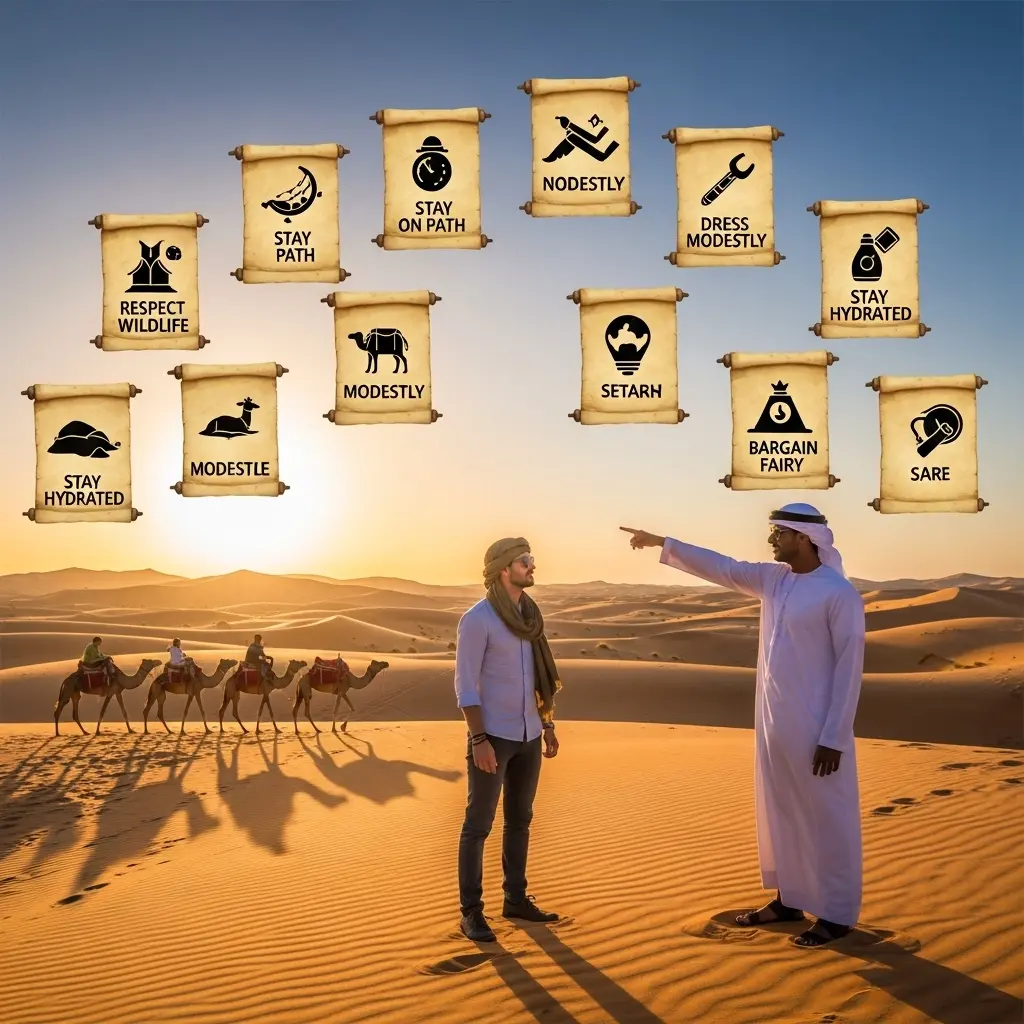
Do choose comfortable, loose-fitting clothing. Linen and cotton are excellent choices.
Do cover your shoulders and knees, especially when at the Bedouin camp.
Modest attire is a simple, effective way to show respect for the local Cultural Desert Safari setting.
Do wear sunglasses and a wide-brimmed hat for protection from the intense sun.
Safari Etiquette Don’ts: The Fashion Faux Pas
Don’t wear overly revealing clothing, such as very short shorts or low-cut tops.
Don’t wear high heels or formal shoes. They are impractical, unsafe, and will ruin the Dubai Desert Etiquette.
Don’t forget warm layers. The temperature drops drastically after sunset.
This preparation is a key Desert Safari Tips component.
2. Dune Bashing and Safety: Visitor Do’s and Don’ts
The dune bashing portion of the safari is high-risk, demanding strict adherence to safety rules.
Safari Etiquette Do’s: Pre-Ride Safety
Do listen carefully to the driver’s safety briefing. Their instructions are non-negotiable.
Do fasten your seatbelt securely and keep it fastened until the driver tells you to unbuckle.
Do communicate any pre-existing health conditions (like back pain or pregnancy) to the driver before the ride begins.
Do inform the driver if you are prone to motion sickness.
Safari Etiquette Don’ts: Risky Behavior
Don’t eat or drink heavily just before or during the dune bashing activity.
Don’t lean out of the windows or try to record video without securing your device properly.
Don’t distract the driver; their focus is critical for maintaining Desert Safari Rules.
Don’t panic; trust the driver’s skill and the vehicle’s safety features.
3. Photography and Privacy: Respectful Travel UAE Guidelines
Taking photos is natural, but certain Desert Safari Etiquette rules apply to people and places.
Safari Etiquette Do’s: Respectful Captures
Do ask for explicit permission before taking photographs of local people, especially women and children.
Do focus your camera on the landscape, the camels, or the professional performers.
Do use the golden hour light to capture silhouettes of the scenery.
Do be mindful of your surroundings; avoid stepping on sacred areas or delicate vegetation.
Safari Etiquette Don’ts: Privacy Invasion
Don’t take close-up photos of strangers without their consent. This is a crucial Safari Etiquette Don’ts.
Don’t photograph security personnel, government buildings, or military checkpoints on the way to the desert.
Don’t wander off alone to take photos; this poses a major safety risk and violates Respectful Travel UAE guidelines.
4. Cultural Interaction: Dubai Desert Etiquette at the Camp
The Bedouin camp is the cultural heart of the experience, demanding appropriate Dubai Desert Etiquette.
Safari Etiquette Do’s: Engaging with Hosts
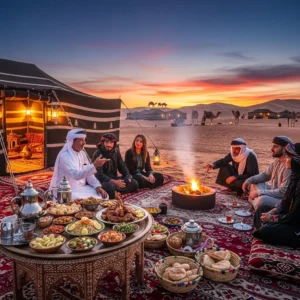
Do accept the Gahwa (Arabic coffee) and dates offered upon arrival; it is a sign of hospitality.
Do use your right hand when shaking hands, passing food, or accepting a drink.
Do feel free to try the cultural activities, such as henna painting or traditional attire.
Do engage politely with the staff and express your thanks for the service.
Safari Etiquette Don’ts: Offenses
Don’t refuse the initial offering of dates and coffee without a polite explanation.
Don’t point the sole of your shoe directly at another person while seated; this is a serious sign of disrespect.
Don’t openly consume alcohol outside of designated areas, if alcohol is provided at all.
Don’t touch or move the traditional items or props without permission.
5. Tipping and Service: Visitor Do’s and Don’ts
Tipping is customary in the UAE service industry and requires proper Desert Safari Etiquette.
Safari Etiquette Do’s: Showing Gratitude
Do tip your driver/guide if they provided good service, safe driving, and a pleasant experience.
Do budget a small amount of cash (Dirhams) for tipping.
Do tip the camp staff, including the waiter and henna artist, for excellent service.
Do tip immediately after the service is rendered.
Safari Etiquette Don’ts: Budget Blunders
Don’t assume tipping is included in your package; it rarely is.
Don’t over-complicate the tipping; a simple, genuine “thank you” along with the tip is sufficient.
Don’t use foreign currency for tipping; use local Dirhams.
6. Vehicle Etiquette: Desert Safari Rules on the Road
Proper behavior in the 4×4 vehicle is crucial for the comfort of all passengers and the driver’s focus.
Safari Etiquette Do’s: Common Courtesy
Do be punctual for your hotel pickup to avoid delaying the rest of the group.
Do keep your belongings secure and contained, not spilling onto the seats of others.
Do be considerate if you are carrying snacks; offer them to the driver and fellow passengers.
Do keep the noise level reasonable inside the vehicle.
Safari Etiquette Don’ts: Disruptions
Don’t smoke inside the vehicle without the driver’s explicit permission (smoking is generally forbidden).
Don’t leave trash or litter inside the safari vehicle or in the desert.
Don’t demand unscheduled, high-risk stops for photos during the dune bashing segment.
7. Environmental Respect: Respectful Travel UAE Standards
The desert is a fragile ecosystem. Desert Safari Etiquette demands environmental care.
Safari Etiquette Do’s: Preserve the Land
Do keep all your trash (food wrappers, bottles) secure and dispose of it only in designated bins at the camp.
Do stay within the areas marked by your guide for activities.
Do report any unusual wildlife sightings to your guide immediately.
Do support operators who practice ethical, low-impact tourism.
Safari Etiquette Don’ts: Littering and Damage
Don’t litter under any circumstances; the desert environment is sensitive and difficult to clean.
Don’t attempt to feed or touch the wildlife (like gazelles or camels).
Don’t damage or pick desert flora, even if it seems small or inconsequential.
8. Health and Wellness: Desert Safari Tips for Comfort
Prioritizing your own well-being is a key Desert Safari Tips component.
Safari Etiquette Do’s: Be Prepared
Do take your necessary medications (motion sickness, allergies) well in advance.
Do drink plenty of water, even during the camp experience.
Do let your guide know if you are feeling unwell at any point.
Do carry a small first-aid kit for minor needs.
Safari Etiquette Don’ts: Self-Neglect
Don’t ignore the signs of dehydration (headache, dizziness).
Don’t overindulge in food or drinks, which can lead to discomfort during the return journey.
Don’t stay out in the direct sun for too long during the camp setup time.
9. Activity Participation: Best Desert Safari Engagement
Engagement is key to making the most of your Best Desert Safari.
Safari Etiquette Do’s: Try New Things
Do try the short camel ride; it is a traditional and gentle part of the Cultural Desert Safari.
Do feel free to get a henna design, as it’s a fun and complimentary activity.
Do try the sandboarding; it is a safe and accessible desert sport.
Do participate in the dance and music towards the end of the evening.
Safari Etiquette Don’ts: Overexertion
Don’t pressure yourself or others into activities they are uncomfortable with (e.g., highly aggressive dune bashing).
Don’t wander off alone into the darkness after the camp lights are dimmed.
Don’t over-consume alcohol, as it can be unsafe and affects your Desert Safari Etiquette.
10. Booking and Vetting: Avoiding Dubai Desert Etiquette Traps
Selecting a reputable tour is the first rule of Desert Safari Etiquette.
Safari Etiquette Do’s: Choose Wisely
Do book your safari through verified agents or reputable operators.
Do check the quality of the vehicles and the operator’s safety record before booking.
Do verify that the itinerary matches your expectations for a true Cultural Desert Safari.
Do use external links like https://hafiztourism.com/ for independent reviews on service quality.
Safari Etiquette Don’ts: Compromising Quality
Don’t book based solely on price; this often leads to a lower-quality experience and unsafe practices.
Don’t assume all links are reliable; verify the operator’s name.
Don’t hesitate to ask the booking agent questions about the Desert Safari Rules and camp setup.
11. Advanced Cultural Nuances: Respectful Travel UAE Details
Understanding deeper nuances shows heightened Respectful Travel UAE knowledge.
Safari Etiquette Do’s: Gestures of Respect
Do use both hands when passing or accepting a significant item, such as a large dish of food.
Do stand up when an older or highly respected person enters the Majlis seating area.
Do be patient and polite in all interactions with local staff.
Do appreciate the quiet moments as much as the loud performances.
Safari Etiquette Don’ts: Body Language
Don’t engage in public displays of affection (PDAs) at the camp. Keep romance discreet.
Don’t stare or use intrusive body language toward staff or other guests.
Don’t interrupt traditional storytelling or performances.
12. Photography Etiquette: Best Desert Safari Photo Rules
Perfecting the art of taking photos requires adhering to the Best Desert Safari rules.
Safari Etiquette Do’s: The Landscape
Do use the vast landscape and the beautiful Desert Sunset as your primary subjects.
Do utilize the light to capture stunning silhouettes of camels and dunes.
Do use professional operators (like those linked on https://royaldesertadventures.ae/) for exclusive photo shoots.
Do shoot the cultural performances from a designated viewing area.
Safari Etiquette Don’ts: The Crowd
Don’t block the view of others during the main sunset moment.
Don’t climb on vehicles or camp structures to get a better vantage point.
Don’t use flash photography during the performances, as it can be distracting.
13. Tipping Protocol: Safari Etiquette Do’s Summary
Tipping is a straightforward part of Desert Safari Etiquette.
-
Driver/Guide: AED 50–100 per car group (optional, based on service).
-
Camp Waiter: AED 10–20 (if dedicated service is provided).
-
Henna Artist/Camel Handler: A small token of AED 5–10 for personalized service.
This simple gesture enhances the feeling of Bedouin Hospitality.
14. Activity Safety: Desert Safari Rules Enforcement
Desert Safari Rules are enforced for your safety.
Quad Biking
If you choose to quad bike (often an add-on), always wear the helmet and follow the instructor’s path.
Deviation from the marked path is extremely dangerous and a violation of Desert Safari Etiquette.
The instructor’s word is final during the quad biking segment.
Camel Rides
During camel rides, listen to the handler’s instructions for mounting and dismounting.
Hold on firmly; the movement is jarring when the camel stands up or kneels down.
15. The Final Word: Respectful Travel UAE
The ultimate goal of all Desert Safari Etiquette is to ensure Respectful Travel UAE.
This respect enhances your own experience by opening the door to genuine Cultural Desert Safari moments.
A polite traveler is a welcome traveler in the Arabian Desert.
16. Finding Quality: External Vetting for Visitor Do’s and Don’ts
To find tours that practice strong Visitor Do’s and Don’ts, look for evidence of high standards.
Check external resources like https://dubaidesertsafarie.com/ for companies with excellent service reviews.
A well-run company attracts polite, professional staff.
17. The Benefits of Adhering to Safari Etiquette Don’ts
Adhering to Safari Etiquette Don’ts guarantees a smoother, safer, and more pleasant trip.
Avoiding common mistakes like improper attire or distracting the driver ensures your comfort and the safety of others.
The simple rules are designed to protect both the visitor and the host environment.
18. Choosing Your Cultural Desert Safari Experience
Make your selection based on a commitment to Desert Safari Etiquette and genuine cultural interaction.
Avoid shortcuts on price that lead to compromised experiences.
Your respectful engagement with the culture will be the most rewarding part of the entire adventure.
Frequently Asked Questions (FAQs) – Long Answers
1. What is the proper Desert Safari Etiquette for attire, especially considering the cultural sensitivity and the desert climate?
The proper Desert Safari Etiquette for attire balances practicality, comfort, and modesty. Do wear lightweight, loose-fitting clothes (linen or cotton) to combat the heat and choose light colors. Do ensure shoulders and knees are covered, especially at the Bedouin camp, as a sign of respect for local customs. Don’t wear heavy denim or restrictive synthetic materials that will make you overheat. Most importantly, Don’t wear high heels; opt for comfortable, closed-toe shoes or sturdy sandals due to the sand. Layering is key, as the temperature drops significantly after sunset.
2. Why is tipping considered an important part of Desert Safari Etiquette, and what is the recommended amount for the driver/guide?
Tipping is considered an important part of Desert Safari Etiquette because it is a direct way to acknowledge the personalized service and hard work provided by the staff, which is customary in the UAE service industry. It is a gesture of thanks for ensuring safety during dune bashing and providing insightful commentary. The recommended amount for the driver/guide is typically AED 50 to AED 100 per car group, based on the quality of service and your satisfaction. Always carry local currency (Dirhams) for tipping camp staff as well.
3. What are the strict Desert Safari Rules regarding food and drink consumption during the high-speed Dune Bashing activity?
The strict Desert Safari Rules regarding food and drink consumption during dune bashing are in place primarily for safety and comfort. Visitors are strictly advised not to eat or drink heavily just before or during the high-speed activity. The jarring, roller-coaster motion of dune bashing can easily induce nausea, leading to motion sickness or vomiting. For safety, no loose objects (including water bottles or food) should be held, as they can become projectiles during sharp turns or unexpected bumps, posing a risk to passengers.
4. What are the key Safari Etiquette Don’ts related to photography at the camp to respect the privacy of performers and local staff?
The key Safari Etiquette Don’ts for photography at the camp are centered on respecting privacy and the environment. Don’t take unauthorized close-up photos of local women, children, or staff without their explicit permission. Don’t use flash photography during cultural performances (like the Tanoura or Belly Dance), as it can be highly distracting to the artist. Don’t climb on camp structures, vehicles, or prop displays for photos, as this violates Desert Safari Rules and poses a safety hazard. Focus pictures on the landscape or the professional, distant performances.
5. How should visitors handle the offering of Gahwa (Arabic coffee) and dates as part of the Cultural Desert Safari experience?
Visitors should handle the offering of Gahwa (Arabic coffee) and dates with polite adherence to Cultural Desert Safari traditions. Do accept the offer with your right hand (the left hand is traditionally considered unclean). This acceptance is a key sign of Bedouin Hospitality and respect. The coffee is served in small cups; shake the cup gently when you have had enough to signal you are finished. Don’t refuse the initial offer without a polite reason, as this can be viewed as an offense against hospitality.
6. How does adhering to the Visitor Do’s and Don’ts regarding littering contribute to the preservation of the fragile desert ecosystem?
Adhering to the Visitor Do’s and Don’ts regarding littering is critical for preserving the fragile desert ecosystem. The desert environment is highly susceptible to pollution because the arid climate means waste (especially plastics) does not decompose quickly. Littering can harm native wildlife and spoil the natural beauty of the Best Desert Safari environment. The simple rule is to Do keep all trash secured and Don’t leave anything behind, ensuring every visitor acts as a responsible steward of the land.
7. What are the necessary steps visitors must take to comply with Desert Safari Rules concerning safety during the camel riding activity?
Visitors must comply with Desert Safari Rules concerning safety during the camel ride by following the handler’s instructions precisely. Do listen carefully to the instructions for mounting and dismounting. Do hold on firmly when the camel stands up or kneels down, as this movement is jarring and sudden. Don’t try to stand up or dismount without the handler’s direct cue. Keep noise levels low around the animals to avoid startling them.
8. What are the key Safari Etiquette Do’s for communicating with the driver/guide when requesting stops or adjustments during the journey?
The key Safari Etiquette Do’s for communicating with the driver/guide are based on politeness and awareness of their primary responsibility. Do make requests politely and clearly, using simple language. Do ask for permission before taking any unscheduled stops. Don’t distract the driver while they are actively navigating the dunes. For adjustments (like temperature or music), Do communicate your needs respectfully when the vehicle is stopped or on the highway portion of the trip.
9. How should a tourist handle a situation where they accidentally commit a Dubai Desert Etiquette faux pas or feel they have been disrespectful?
If a tourist accidentally commits a Dubai Desert Etiquette faux pas, they should handle the situation by being apologetic, respectful, and discreet. A sincere, quiet apology to the person affected (or the guide) is often enough. The intent behind the action is generally understood. The guide is usually able to smooth over minor errors, but the tourist should be mindful to avoid repeating the mistake and continue to show respect for the Cultural Desert Safari traditions for the remainder of the evening.
10. How does a reputable tour operator ensure guests are fully informed of the Desert Safari Etiquette and Visitor Do’s and Don’ts before the tour begins?
A reputable tour operator ensures guests are fully informed of the Desert Safari Etiquette and Visitor Do’s and Don’ts through multiple communication channels. Pre-Tour: They provide a detailed guide via email or on their website (like Safari Planning Tips). On-Site: The driver/guide gives a verbal briefing during the highway drive, covering critical safety, cultural, and environmental rules. This proactive approach ensures guests are well-prepared for the Best Desert Safari experience.
11. What are the essential Safari Etiquette Don’ts for consuming alcohol during the Evening Safari, even if it is offered by the operator?
The essential Safari Etiquette Don’ts for consuming alcohol are centered on moderation and discretion, even when the operator provides it. Don’t drink excessively or become visibly intoxicated, as this violates Respectful Travel UAE standards and detracts from the cultural environment. Don’t consume alcohol outside of the designated bar or service area at the camp. Don’t bring your own alcohol to the camp; only consume what is offered by the licensed operator.
12. In the context of Desert Safari Etiquette, why should visitors always use their right hand for social interactions, and what items does this apply to?
In the context of Desert Safari Etiquette, visitors should always use their right hand for social interactions because the left hand is traditionally considered unclean in many Middle Eastern cultures. This rule applies to all forms of social exchange: Do use the right hand when accepting or passing food, shaking hands, accepting coffee (Gahwa), or giving money (like a tip). This small gesture shows immediate and profound Respectful Travel UAE awareness.
13. What should be done with chewing gum or sweets during the dune bashing, according to Desert Safari Rules, and why?
According to Desert Safari Rules, visitors should remove and dispose of chewing gum or hard sweets before the dune bashing begins. The reason is a simple safety precaution: the sudden, jarring movements and high G-forces during the activity pose a choking hazard, especially if the object is accidentally swallowed. This is a critical Visitor Do’s and Don’ts rule enforced by all responsible safari operators.
14. How does the adherence to Desert Safari Tips regarding puncture repair kits ensure a smoother experience for all passengers in the Group Safari?
The adherence to Desert Safari Tips regarding puncture repair kits ensures a smoother experience for all passengers in a Group Safari by preventing significant delays. Desert terrain frequently causes tire punctures. If the tour operator follows proper Desert Safari Rules and equips their vehicles with readily available repair kits and trained drivers, a flat tire can be fixed quickly on-site. This avoids the major inconvenience of waiting for a lengthy vehicle recovery, preserving the schedule and enjoyment of the entire group.
15. What are the Safari Etiquette Do’s for children regarding interacting with the camels and other animals at the Best Desert Safari camp?
The Safari Etiquette Do’s for children interacting with camels and other animals at the Best Desert Safari camp are focused on safety and respect. Do teach children to approach animals quietly and calmly. Do ensure children only touch the camel with the handler’s permission and supervision. Do not allow children to feed the animals unless explicitly instructed by the guide. Do ensure children stand back during the Falcon Show display. These rules keep the animal and the child safe during the Best Desert Safari.