A Desert Birdwatching Guide: The Hidden Avian Treasures of a Dubai Safari
The Arabian Desert often conjures images of a vast and silent sea of sand. But for those who know where to look and, more importantly, how to listen, the desert is alive with a surprising and spectacular array of birdlife. A desert safari offers an unexpected and thrilling opportunity for avian enthusiasts, transforming the journey into a rewarding birdwatching expedition.
This is not your typical safari experience. It requires patience, a keen eye, and a shift in focus from the high-speed thrills to the subtle wonders of the natural world. This comprehensive Desert Birdwatching Guide is your key to unlocking this hidden world. It will introduce you to the key resident and migratory species, explain why the UAE is a global hotspot for birdwatching, and provide the practical tips you need to turn your desert adventure into a successful birding trip.
Forget the silence; the desert is filled with the calls of larks, the chatter of babblers, and the powerful presence of birds of prey. It’s time to discover the feathered jewels of the Emirates.
Why the UAE is a Birdwatcher’s Paradise
The UAE’s strategic location and diverse habitats make it one of the most exciting places in the world for birdwatching, a fact that is central to any good Desert Birdwatching Guide.
A Crossroads of Continents
The Arabian Peninsula sits at a crucial global crossroads. It forms a land bridge between Eurasia and Africa, placing it directly on the path of several major bird migration routes, or “flyways.” Twice a year, in the spring and autumn, hundreds of thousands of birds, from massive eagles to tiny warblers, pass through the UAE on their incredible journeys. This creates a dynamic and ever-changing avian landscape for birdwatchers.
Surprisingly Diverse Habitats
While our focus is the desert, it is not a uniform environment. A desert safari can take you through several micro-habitats, each attracting different species. These include vast open dunes, gravel plains with sparse vegetation, and pockets of acacia trees. Furthermore, the presence of oases and man-made lakes near the desert’s edge creates vital stopover points for migratory birds, making this a rich area for a dedicated Desert Birdwatching Guide.
Key Resident Birds: The Year-Round Inhabitants
While migrants provide seasonal excitement, the desert is home to a tough and resilient community of resident birds that have adapted perfectly to the arid conditions.
Pharoah Eagle-Owl
This magnificent, large owl is one of the most sought-after sightings. With its prominent ear tufts, huge orange eyes, and powerful build, it is the apex avian predator of the desert night. They often nest in rocky outcrops or on small cliffs and are best spotted at dawn or dusk when they begin to hunt.
Houbara Bustard
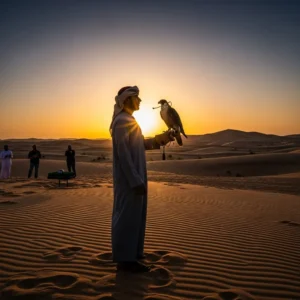
The Houbara Bustard is a culturally significant bird, deeply linked to the Emirati heritage of falconry as it was a traditional prey for falcons. It is a large, terrestrial bird with a sandy-brown camouflage coat. They are famously shy and difficult to spot, making a successful sighting a true highlight for any birdwatcher.
Desert Lark
The quintessential sound of the desert morning is often the beautiful, melodic song of the Desert Lark. This small, streaky, ground-dwelling bird is perfectly camouflaged against the sand and gravel. They are best located by listening for their song and then carefully scanning the ground.
Arabian Babbler
These are highly social and entertaining birds. Arabian Babblers live in noisy family groups and spend their time foraging on the ground near acacia trees. They maintain a constant, chattering communication with each other, making them relatively easy to find. Their cooperative social structure is fascinating to observe.
The Migratory Spectacle: Seasonal Visitors
The true excitement in this Desert Birdwatching Guide comes during the migration seasons. The variety of birds that can be seen passing through is astounding.
Steppe Eagle
This massive bird of prey is an impressive sight as it soars on the desert thermals. They migrate from their breeding grounds in Central Asia to spend the winter in Africa, and the UAE is a key stopover point. Large numbers can sometimes be seen circling high in the sky.
European Roller
One of the most colorful birds you can hope to see, the European Roller is a flash of brilliant blue, turquoise, and chestnut. They are often seen perched on a prominent branch or wire, from which they dart out to catch insects. Their stunning plumage makes them a favorite among photographers.
Blue-cheeked Bee-eater
Another vibrantly colored migrant, the Blue-cheeked Bee-eater is a graceful, slender bird with a long tail and a distinctive call. As their name suggests, they are expert aerial hunters of bees and other insects. They are often seen in small, talkative flocks.
A Practical Guide to Birdwatching on Safari
To make your Desert Birdwatching Guide a success, you need to plan your safari with this specific goal in mind.
Choose a Nature-Focused Safari
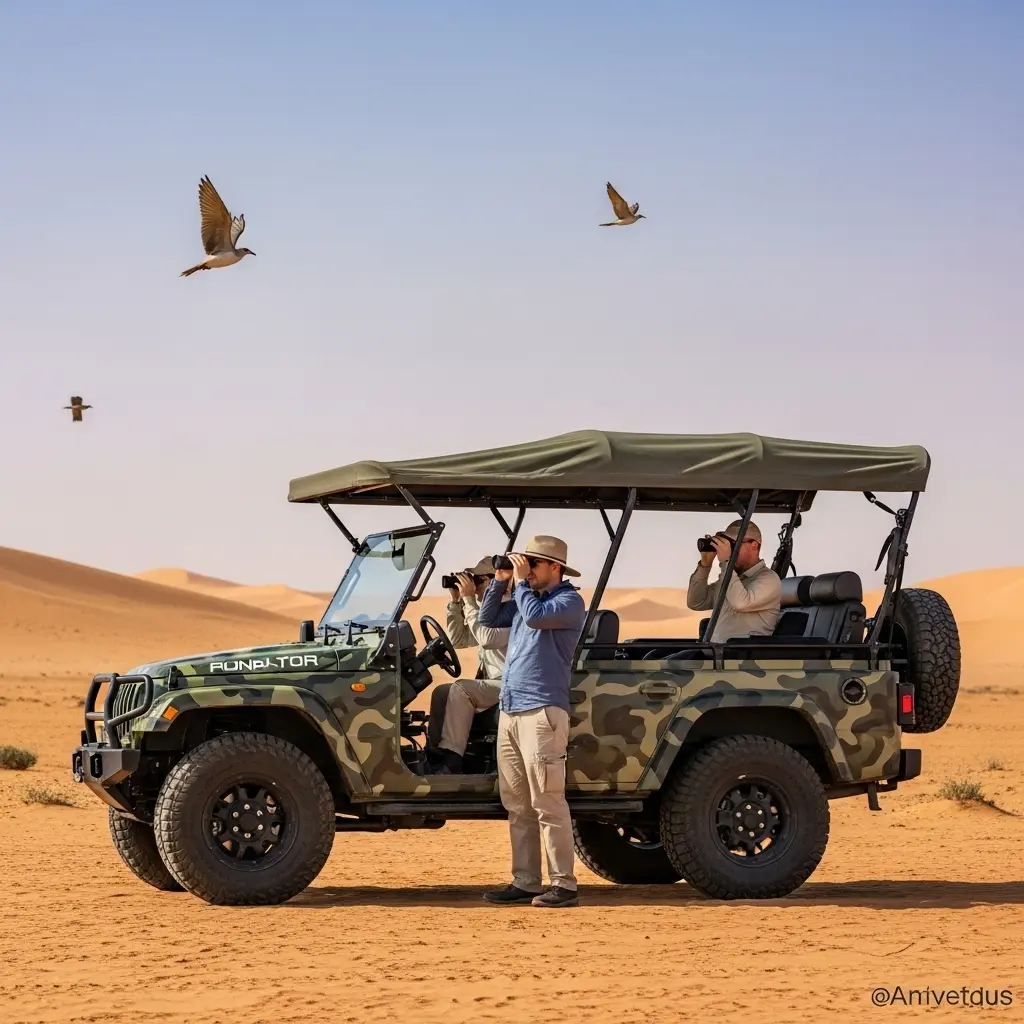
This is the most critical step. A standard dune-bashing safari is not suitable for birdwatching. You must book a dedicated “nature safari” or a “conservation drive.” These tours, like some offered on https://royaldesertadventures.ae/, are conducted at a slow pace in protected areas with expert guides.
Visit a Protected Area
The best location for desert birdwatching is undoubtedly the Dubai Desert Conservation Reserve (DDCR). Access is restricted to a few select operators, ensuring the habitat is pristine and the wildlife is undisturbed. Researching operators on portals like https://dubaidesertsafarie.com/ or https://hafiztourism.com/ can help you find companies with the necessary permits to enter the DDCR.
Time Your Visit
The best season for birdwatching is from late September to April. This period covers the autumn migration, the wintering season for many species, and the spring migration. The absolute peak times are the migratory months of October/November and March/April. The best time of day is always the first few hours after sunrise and the last couple of hours before sunset.
Pack the Essential Gear
- Binoculars: This is the single most important piece of equipment. A pair with 8x or 10x magnification is ideal.
- Camera with Zoom Lens: To capture images, you’ll need a lens with at least a 300mm focal length.
- Field Guide: A good field guide app or book for the birds of the Arabian Peninsula is invaluable.
- Patience: Wildlife viewing is unpredictable. The most important thing to bring is patience.
Desert Birds Checklist
Frequently Asked Questions (FAQs)
1. What is a “flyway” and why is it important for the UAE? A flyway is a major, established route that migratory birds follow between their breeding grounds and their wintering grounds. The UAE is strategically located on the Central Asian and East African-East Asian flyways, which act like avian superhighways. This means millions of birds from hundreds of species pass through the country twice a year, making it a critical stopover point for them to rest and refuel, and a world-class location for birdwatching.
2. What is the Houbara Bustard’s cultural significance? The Houbara Bustard is deeply significant in Emirati heritage because it was the traditional and most prestigious prey for falconers. The sport of falconry was a vital part of Bedouin life, and the challenging hunt of the Houbara was a true test of a falcon’s skill. This cultural connection is why there are major conservation and captive-breeding programs for the Houbara in the UAE today.
3. Can I really see vultures in the desert near Dubai? Yes, though they are not as common as they once were. The Lappet-faced Vulture, one of the largest and most powerful Old World vultures, is a resident species in the UAE. They are magnificent but endangered. Sightings are rare and special, typically in more remote desert areas or near the mountains, and are a true highlight for any dedicated Desert Birdwatching Guide.
4. What is the smallest bird I might see in the desert? You could potentially see several species of small warblers passing through on migration. One of the smallest resident birds you might encounter is the Arabian Dunn’s Lark, a very pale, small lark that is perfectly adapted to the sandy environment.
5. Are there any nocturnal birds to spot on an overnight safari? Yes, an overnight safari is a fantastic opportunity for nocturnal birding. The prime target is the magnificent Pharoah Eagle-Owl. You might also spot or hear the Desert Owl. Another fascinating nocturnal bird, though technically a mammal-like bird, is the Egyptian Nightjar, which is incredibly well-camouflaged and often seen on tracks at night.
6. What are the main threats to birds in the Arabian desert? The main threats include habitat loss due to rapid urbanization and development, collisions with power lines and buildings, and climate change affecting their food sources and migration patterns. For migratory birds, the loss of wetland “stopover” sites is a major concern. This is why protected areas like the DDCR are so vital for their survival.
7. How does the Dubai Desert Conservation Reserve (DDCR) help protect birds? The DDCR protects a vast and pristine desert habitat from development and disturbance. This ensures that resident birds have a safe place to breed and that migratory birds have a reliable place to rest and feed. The management of the reserve also maintains the natural vegetation and water sources that are essential for the birds’ survival.
8. What is the best type of binoculars for desert birdwatching? A good all-round choice is a pair of binoculars with 8×42 or 10×42 specifications. The first number (8x or 10x) is the magnification power. The second number (42) is the diameter of the objective lens in millimeters, which determines how much light the binoculars can gather. A larger number means a brighter image, which is helpful in the low light of dawn and dusk.
9. Are there birdwatching clubs or groups in Dubai that I can join? Yes, the UAE has a very active birdwatching community. The main group is the Emirates Bird Records Committee (EBRC), which is part of the Emirates Natural History Group. They organize field trips, maintain official checklists, and are a fantastic resource for any visiting or resident birdwatcher.
10. What is the most colorful bird I am likely to see? While many desert residents are camouflaged, the migrants can be incredibly colorful. The European Roller, with its dazzling turquoise and blue plumage, is a strong contender. The Indian Roller, which can also be seen, is similarly spectacular. The Blue-cheeked and European Bee-eaters also add a splash of vibrant green and yellow to the desert landscape.
11. Is it better to go on a private or group nature safari for birdwatching? A private tour is often better for serious birdwatching. It allows you to focus on your specific interest, spend as much time as you want observing a particular bird, and ask your guide to stop whenever you see something of interest. A group tour is still excellent, but you will have to share the time and focus with the interests of the other guests.
12. What is a “lifer” in birdwatching terms? A “lifer” is a term birdwatchers use for the first time they see a particular species of bird in their life. The UAE is a great place to see many lifers for birders from Europe and the Americas, as it is home to many species that are not found in those regions.
13. Do I need to be silent during the entire nature drive? While you should avoid loud talking and shouting, you do not need to be completely silent. You can and should talk to your guide in a normal, conversational tone. The birds are accustomed to the sound of human voices from within the vehicles. The key is to avoid sudden, loud noises that could startle them.
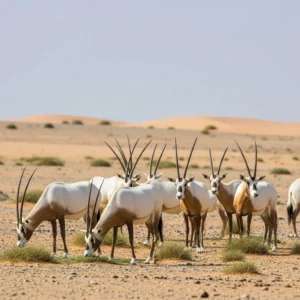
14. What other wildlife might I see while birdwatching? A nature safari is a great opportunity to see all desert wildlife. While you are scanning the trees for birds, you will almost certainly spot the herds of Arabian Oryx and gazelles. You might also catch a glimpse of a desert monitor lizard basking in the sun or, if you’re very lucky, an Arabian red fox.
15. Are there any coastal birdwatching spots near Dubai to complement a desert trip? Yes, absolutely. To get a full picture of the UAE’s birdlife, you should combine your desert trip with a visit to a coastal wetland. The Ras Al Khor Wildlife Sanctuary, famous for its thousands of flamingos in the winter, is right on the edge of Dubai and is a world-class birdwatching site.
16. Why is the Houbara’s conservation so important? The Houbara is what is known as an “umbrella species.” Protecting this iconic bird and its habitat—the vast gravel plains—indirectly protects all the other smaller and less famous species that share that same ecosystem. The massive conservation efforts for the Houbara therefore benefit the entire desert environment.
17. What is the best field guide for birds of the region? A highly recommended and widely used field guide is “Birds of the Middle East.” There are also several excellent smartphone apps, such as the Merlin Bird ID app, which now have regional packs that can help you identify birds by their appearance or their song.
18. Do the seasons affect what resident birds do? Yes, even though they don’t migrate, the behavior of resident birds changes with the seasons. The cooler winter months are the primary breeding season for many desert birds. During this time, you are more likely to hear them singing to establish territories and to see courtship displays.
19. How close can I get to the birds? This depends on the species and the situation. The goal is to observe the birds without disturbing them or altering their natural behavior. Your guide will ensure the vehicle stays at a respectful distance. A good pair of binoculars and a camera with a zoom lens are the tools that allow you to get “close” without physically intruding on their space.
20. Why is a safari the best way to do a desert birdwatching trip? A safari is the best way because the desert is a vast and inaccessible place. A professional guide with a proper 4×4 vehicle knows how to navigate the terrain safely and, most importantly, knows where to find the different habitats and the birds they attract. The restricted-access conservation reserves, which are the best places for birding, can only be entered with a licensed operator. The safari provides the essential access and expertise for a successful Desert Birdwatching Guide.